
Last Updated: December 24, 2025
Is your sidewalk creating a liability risk? A single cracked or heaved concrete panel can cost you thousands if someone trips and gets injured. With Salem’s unique climate conditions—freeze-thaw cycles, heavy winter rain, and abundant tree roots—sidewalk damage isn’t just unsightly; it’s a genuine safety and legal concern that demands immediate attention.
Whether you’re a property owner facing a city citation or simply want to maintain safe pedestrian access, understanding your options for sidewalk concrete repair in Salem, OR is essential. From minor grinding to full panel replacement, the approach you choose affects not only your budget but also your compliance with ADA regulations and city standards.
Quick Answer: When and How to Repair Sidewalk Concrete
Minor sidewalk damage (cracks under ¼ inch, small surface spalling) can often be ground down or filled. Vertical displacement exceeding ½ inch, extensive cracking, or structural settling typically requires panel replacement to meet safety standards and prevent liability.
Key Takeaways:
- Property owners in Salem are generally responsible for adjacent sidewalk maintenance
- City of Salem Public Works operates a dedicated concrete repair crew since 2008 for municipal projects
- ADA compliance requires maximum 2% cross-slope and proper curb ramp construction
- Typical repair costs range from $8–$15 per square foot for replacement in the Salem area
- Tree root damage and freeze-thaw cycles are the most common causes of sidewalk failure locally
Understanding Sidewalk Concrete Damage in Salem, OR
Salem’s climate and urban landscape create specific challenges for concrete sidewalks. Our wet winters, with average rainfall exceeding 40 inches annually, combined with occasional hard freezes, accelerate concrete deterioration through freeze-thaw cycling. When water penetrates cracks and freezes, it expands, causing spalling and progressive structural damage.
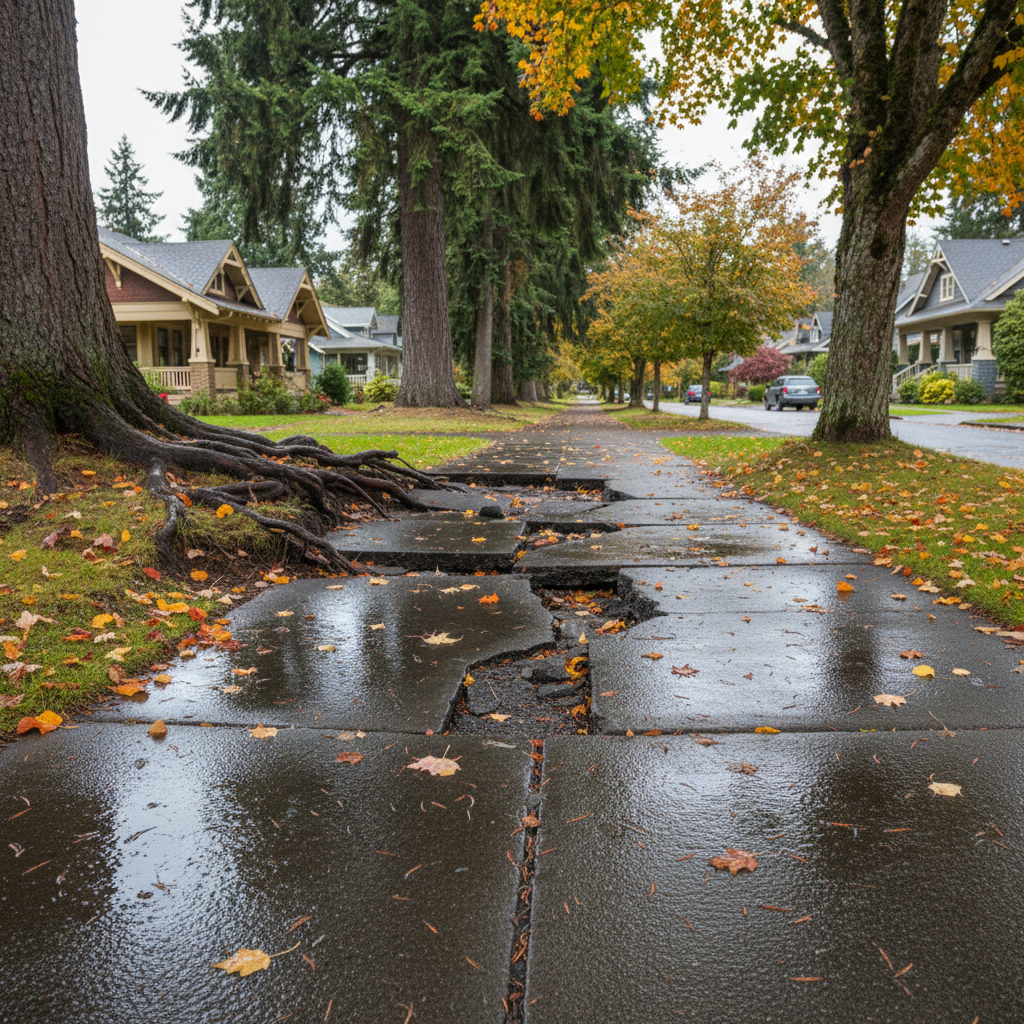
Additionally, Salem’s mature tree canopy—while beautiful—contributes significantly to sidewalk heaving. Tree roots growing beneath concrete panels exert tremendous upward pressure, creating trip hazards and structural failures. We frequently see this along older neighborhoods near Bush’s Pasture Park and in areas around Mission Street, where established trees and aging concrete infrastructure intersect.
Common Types of Sidewalk Concrete Damage
Surface cracking typically appears as hairline fractures that gradually widen over time. While cosmetic initially, these cracks allow water infiltration that accelerates deterioration. Vertical displacement—where one panel sits higher than an adjacent one—creates the most dangerous trip hazards and is a primary liability concern. Spalling occurs when the concrete surface breaks away in flakes or chunks, often due to improper finishing or freeze-thaw damage.
Settlement happens when the soil base beneath concrete panels shifts or compresses, causing sections to sink below grade. This creates pooling water, drainage issues, and accessibility problems. Finally, root heaving lifts entire panels, sometimes several inches, creating both trip hazards and drainage complications.
Why Salem’s Climate Demands Proactive Maintenance
Unlike drier climates where concrete can last 50+ years with minimal maintenance, Salem’s wet conditions mean sidewalks often show significant wear within 30–40 years. The Federal Highway Administration notes that moisture-related damage is the leading cause of premature concrete failure in the Pacific Northwest.
We recommend inspecting sidewalks annually, particularly after winter, to identify emerging issues before they require costly full-panel replacement. Early intervention with crack sealing or minor grinding can extend sidewalk life significantly and prevent liability issues.
Common Mistakes Property Owners Make
Many Salem property owners make costly errors when addressing sidewalk damage, often resulting in repeat repairs or continued liability exposure. Understanding these pitfalls helps you make informed decisions about concrete repair services.
Attempting DIY Structural Repairs
While homeowners can handle minor crack filling, structural repairs require professional expertise. Improper base preparation, incorrect concrete mix ratios, or inadequate reinforcement often lead to premature failure. We’ve seen DIY repairs fail within a single winter season because the concrete wasn’t properly specified for Salem’s freeze-thaw conditions—specifically, air-entrained concrete with 5–7% air content is essential for durability in our climate.
Additionally, sidewalk work often requires coordination with local utilities. Before any digging in Salem, property owners must contact utility providers—including Portland General Electric and Northwest Natural Gas—to mark underground lines. Failure to do so can result in dangerous accidents and expensive penalties.
Ignoring ADA Compliance Requirements
Many older sidewalks in Salem were built before current Americans with Disabilities Act standards took effect. When making repairs, property owners must bring sidewalks into compliance with current regulations, including maximum 2% cross-slope, proper curb ramp construction with tactile warning surfaces, and minimum 36-inch clear width.
Failing to meet ADA standards can result in lawsuits and forced reconstruction at your expense. Even if your old sidewalk was “grandfathered,” any substantial repair triggers the requirement to upgrade to current code.
Choosing Cheap Patches Over Proper Replacement
Asphalt patches over concrete sidewalks create more problems than they solve. These temporary fixes deteriorate rapidly, look unprofessional, and often violate city standards. When our team evaluates sidewalks in neighborhoods near Fairmount Hill or along Commercial Street, we frequently encounter failed patch attempts that ultimately cost more than proper concrete replacement would have initially.
Best Practices for Sidewalk Concrete Repair
Professional sidewalk concrete repair in Salem, OR follows systematic procedures that ensure durability, safety, and code compliance. Understanding the proper approach helps you evaluate contractors and set realistic expectations.
When to Grind vs. Replace
Concrete grinding is appropriate when vertical displacement is less than ½ inch and the concrete itself remains structurally sound. A diamond-blade grinder removes the high side of the offset, creating a smooth transition that eliminates the trip hazard. This approach costs significantly less than replacement—typically $3–$5 per linear foot—and can be completed quickly without curing time.
Full panel replacement becomes necessary when displacement exceeds ½ inch, when panels are extensively cracked (more than two major cracks), or when underlying soil or root issues will cause continued movement. Replacement involves removing the damaged panel, addressing any base or drainage issues, and pouring new concrete to current standards.
Proper Base Preparation and Material Selection
Salem’s clay-heavy soils require careful base preparation. We typically excavate 6–8 inches below the finished sidewalk elevation, install compacted gravel base (minimum 4 inches), and ensure proper drainage away from the concrete. Without adequate base preparation, even properly mixed concrete will settle or crack prematurely.
For concrete work in Salem, we specify air-entrained concrete with a minimum 3,500 PSI compressive strength. The air entrainment creates microscopic bubbles that accommodate freeze-thaw expansion, dramatically extending concrete life in wet climates. Standard non-air-entrained mixes commonly fail within 5–10 years in our environment.
Addressing Root Issues Before Pouring
Tree root management is critical for long-term sidewalk performance. Simply cutting roots and pouring new concrete invites repeat failure. Professional approaches include installing root barriers, using flexible rubber panels in high-risk areas, or in some cases, removing problematic trees after consulting with the City of Salem’s urban forestry program.
We’ve found that in historic neighborhoods with large street trees, installing 2-foot-deep vertical root barriers between the tree and sidewalk can prevent future heaving while preserving the tree. This proactive approach costs more initially but prevents repeated expensive repairs.
Step-by-Step Sidewalk Concrete Repair Process
Understanding the professional repair process helps property owners know what to expect and ensures contractors are following industry best practices for sidewalk concrete repair in Salem, OR.
Initial Assessment and Planning
Professional assessment begins with measuring vertical displacement, documenting crack patterns, and evaluating the underlying cause of damage. We check for soil settlement, root intrusion, inadequate base, and drainage issues. This diagnostic phase determines whether grinding, partial replacement, or full reconstruction is appropriate.
For properties in Salem’s zip codes 97301, 97302, and 97304—which contain many of the city’s older neighborhoods—we also assess whether the existing sidewalk has historic significance. In some cases, matching original joint patterns, textures, and dimensions helps maintain neighborhood character while meeting modern safety standards.
Demolition and Base Preparation
Damaged panels are saw-cut along existing control joints to minimize disturbance to adjacent sections. After removal, we excavate to proper depth, address any root or drainage issues, and install compacted aggregate base. Proper compaction—typically 95% of maximum density—is critical; inadequate compaction leads to settlement and cracking within months.
We also install isolation joints between the new sidewalk and existing structures (buildings, curbs, other panels) using flexible filler material. This allows independent movement and prevents stress cracks from transferring between sections.
Concrete Placement and Finishing
Fresh concrete is placed, consolidated to eliminate voids, and finished to match surrounding sections. For Salem sidewalks, we typically use a broom finish perpendicular to the direction of travel, providing slip resistance when wet. Proper finishing includes establishing the correct cross-slope (1.5–2% away from buildings) and cutting or forming control joints at 5-foot intervals to control where cracks occur.
Curing is critical in Salem’s climate. We apply curing compound or cover fresh concrete with plastic sheeting to retain moisture for at least 7 days. Inadequate curing in our relatively cool, damp climate can reduce concrete strength by 30% or more and lead to surface scaling.
Cost Factors for Sidewalk Concrete Repair in Salem
Several factors influence the cost of sidewalk repairs in the Salem area. Understanding these variables helps property owners budget appropriately and evaluate contractor estimates.
| Repair Type | Typical Cost Range | Best For |
|---|---|---|
| Concrete grinding | $3–$5 per linear foot | Minor displacement under ½ inch |
| Panel replacement | $8–$15 per square foot | Structural damage, major cracks |
| ADA curb ramp | $1,500–$3,000 per ramp | Accessibility compliance |
| Root barrier installation | $200–$500 per section | Prevention of future heaving |
Accessibility improvements often represent the largest cost factor when upgrading older sidewalks. Installing compliant curb ramps with proper slopes, landings, and detectable warning surfaces can add $1,500–$3,000 per intersection. However, these upgrades are typically mandatory when performing substantial sidewalk repairs.
Site access and working conditions also affect pricing. Sidewalks requiring hand work because equipment can’t access the site, or projects requiring temporary pedestrian detours and traffic control, cost more than straightforward replacements along residential streets.
Frequently Asked Questions
Who is responsible for sidewalk repairs in Salem, OR?
In Salem, property owners are generally responsible for maintaining sidewalks adjacent to their property, including repairs. The City of Salem may repair sidewalks as part of capital improvement projects or when addressing specific safety hazards through its Public Works concrete repair crew, but property owners remain primarily responsible for maintenance and liability.
How long does repaired sidewalk concrete last in Salem’s climate?
Properly installed air-entrained concrete sidewalks in Salem typically last 30–50 years with minimal maintenance. Factors affecting longevity include base preparation quality, proper concrete mix specification, drainage management, and tree root control. Regular inspection and minor maintenance can extend service life significantly.
Can I repair just one damaged panel, or must I replace the entire sidewalk?
Individual panel replacement is standard practice and typically more cost-effective than full sidewalk reconstruction. Control joints between panels allow for independent removal and replacement. However, if multiple adjacent panels show damage, or if underlying soil or drainage issues affect a larger area, more extensive work may be necessary to prevent recurring problems.
What permits are required for sidewalk repair in Salem?
Minor sidewalk repairs typically don’t require building permits, but any work in the public right-of-way may require a right-of-way permit from the City of Salem. Significant reconstruction, particularly including curb ramps or accessibility improvements, may trigger permit requirements. Check with Salem’s Building and Safety Division before starting work to ensure compliance.
How soon can I walk on newly repaired concrete sidewalks?
New concrete typically reaches sufficient strength for foot traffic within 24–48 hours, though full curing takes 28 days. Most contractors allow pedestrian traffic after 24 hours but recommend keeping vehicular loads (including crossing for driveways) off the concrete for at least 7 days to prevent surface damage during the critical early curing period.
Conclusion
Sidewalk concrete repair in Salem, OR requires understanding local climate challenges, ADA compliance requirements, and proper construction techniques for long-lasting results. Whether addressing minor trip hazards through grinding or undertaking full panel replacement, choosing the right approach and working with experienced professionals ensures your sidewalk remains safe, compliant, and durable.
Salem’s combination of wet winters, freeze-thaw cycles, and mature urban forest creates unique demands on concrete sidewalks. Proper material specification—particularly air-entrained concrete—adequate base preparation, and proactive management of drainage and tree roots are essential for repairs that last decades rather than years.
If you’re facing sidewalk damage or have received a city citation, contact us for a professional assessment. Our team understands Salem’s specific requirements and can provide solutions that balance cost, durability, and compliance. Visit our homepage to learn more about our concrete services throughout the Salem area.
Sources and References
- Federal Highway Administration (FHWA) – Concrete durability and freeze-thaw guidance
- Americans with Disabilities Act (ADA) – Accessibility standards for sidewalks and curb ramps
- City of Salem, Oregon – Building and Safety Division regulations
- City of Salem Public Works – Street and Sidewalk Program documentation