
Last Updated: December 24, 2025
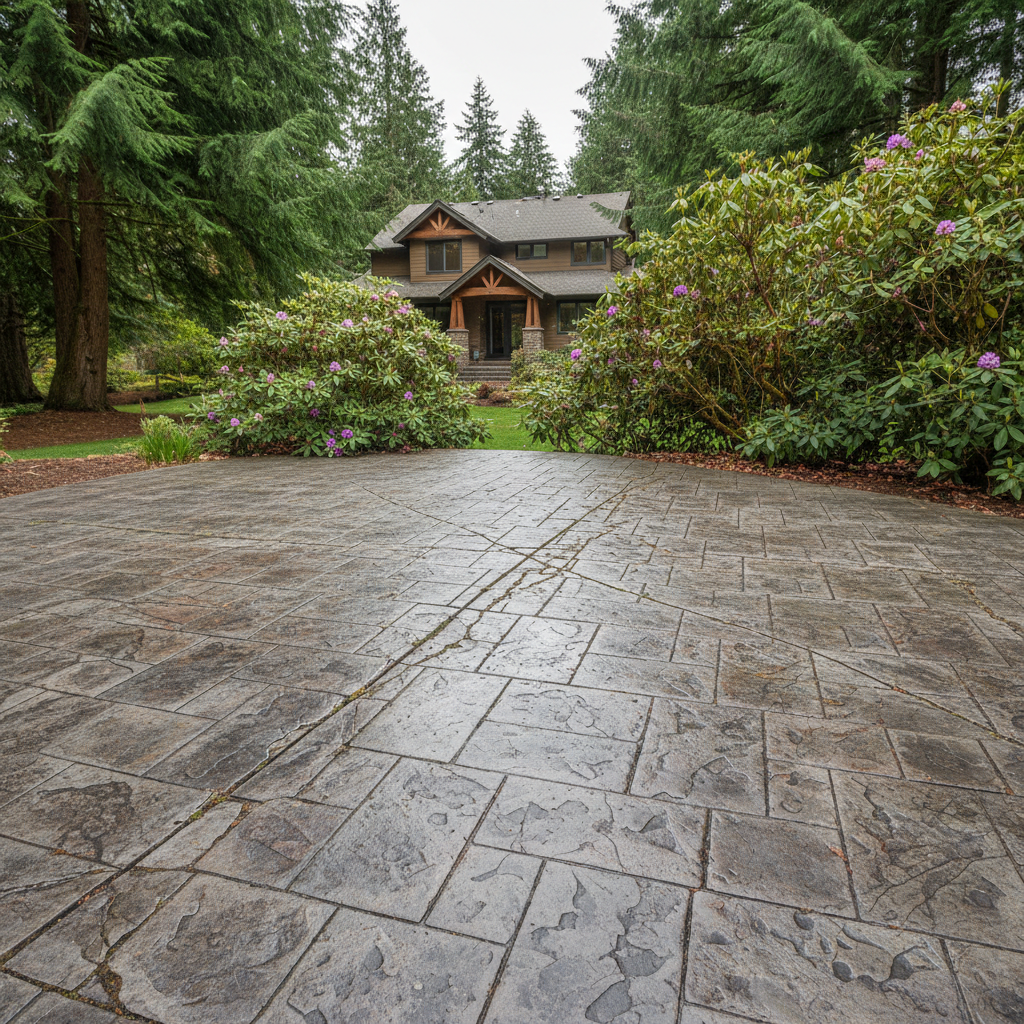
Is your once-beautiful stamped concrete patio now faded, cracked, or flaking? You’re not alone. Across Salem, OR, thousands of homeowners face the same dilemma: aging decorative concrete that’s lost its luster but doesn’t necessarily need full replacement. Between the Willamette Valley’s wet winters, occasional freeze-thaw cycles, and relentless UV exposure, stamped surfaces take a beating—yet most can be restored for a fraction of replacement cost.
When our team works throughout neighborhoods from West Salem to South Gateway, we consistently see similar wear patterns: color fading, sealer breakdown, hairline cracks, and surface scaling. Understanding which issues are repairable versus which require replacement can save property owners thousands while extending the life of their decorative concrete by decades.
Quick Answer: When Is Stamped Concrete Repair the Right Choice?
Stamped concrete repair in Salem, OR is cost-effective when the base slab remains structurally sound but shows cosmetic deterioration like color loss, minor cracking, or surface wear. Professional restoration typically costs 40-60% less than full replacement and can extend surface life by 15-20 years.
Key situations where repair makes sense:
- Faded or uneven color with intact pattern texture
- Hairline cracks less than ¼ inch wide without vertical movement
- Surface scaling or minor spalling in localized areas
- Worn or failing sealer with underlying concrete in good condition
- Slabs installed 15-30 years ago with proper subgrade preparation
Understanding Stamped Concrete Deterioration in the Willamette Valley
Salem’s climate creates unique challenges for decorative concrete. Our maritime-influenced weather brings heavy seasonal rainfall—often 40+ inches annually—combined with occasional winter freezing and hot, dry summers. This wet-dry-freeze cycle accelerates surface degradation in ways that differ significantly from drier regions or areas with more consistent temperatures.
Common Failure Patterns We See Locally
In neighborhoods throughout the 97301, 97302, and 97306 zip codes, we observe predictable wear patterns based on surface age and exposure. North-facing patios and driveways shaded by Oregon’s abundant conifers tend to retain moisture longer, leading to moss growth, efflorescence, and accelerated sealer breakdown. Surfaces in full southern exposure fade faster from UV damage but experience less moisture-related spalling.
The Willamette Valley’s silty clay soils present another challenge. Unlike sandy or gravelly soils that drain quickly, our region’s fine-grained soils can retain water and experience volume changes during wet-dry cycles. When stamped concrete was installed without adequate gravel base or proper compaction—common in installations from the 1990s and early 2000s—minor settlement and cracking become inevitable after 15-20 years.
The Role of Sealer Maintenance
Most stamped concrete relies on film-forming acrylic or polyurethane sealers for both color depth and surface protection. In Salem’s damp climate, these sealers typically last 2-4 years before reapplication is needed—shorter than the 5-7 years common in drier regions. When homeowners skip resealing, moisture penetrates the concrete matrix, leading to freeze-thaw damage, salt scaling, and color oxidation.
According to research from the Portland Cement Association, properly sealed decorative concrete can withstand 300+ freeze-thaw cycles. Without adequate sealing, that number drops dramatically—especially relevant for Salem’s 20-30 annual freeze-thaw events in typical winters.
Common Mistakes Homeowners Make
When faced with deteriorating stamped concrete, many Salem property owners make decisions that either waste money or worsen the problem. Understanding these pitfalls helps you avoid costly missteps.
Applying New Sealer Over Degraded Surfaces
The most frequent mistake we encounter is homeowners attempting to “refresh” faded concrete by simply applying new sealer over old, failing surfaces. This approach traps moisture beneath the new film and typically leads to whitening, blistering, or delamination within months. Before any sealer application, the existing coating must be completely stripped, the surface thoroughly cleaned, and any structural issues addressed.
Ignoring Drainage and Subgrade Issues
Surface repairs fail quickly when underlying drainage or soil movement problems go unaddressed. If you’re seeing water pooling on your stamped patio after Salem’s winter rains, or notice progressive settlement near downspouts, no amount of color restoration or crack patching will provide lasting results. We always evaluate grading and drainage before recommending repair work, sometimes coordinating with Portland General Electric or Northwest Natural Gas when utility trenching has disrupted proper slope.
DIY Repairs with Incompatible Materials
Big-box store concrete patching compounds rarely match the color, texture, or thermal expansion properties of existing stamped concrete. We’ve removed countless DIY patches that turned darker, cracked independently, or simply popped out after the first winter. Professional repair requires polymer-modified materials specifically formulated for overlay and resurfacing work—products most homeowners won’t find at local hardware stores.
Professional Repair Approaches: What Actually Works
Effective stamped concrete repair in Salem, OR follows a systematic process that addresses both structural integrity and cosmetic appearance. Our restoration protocols have evolved through years of working with the specific conditions found throughout Marion County.
Comprehensive Surface Evaluation
We begin every project with thorough inspection to distinguish between repairable cosmetic issues and structural problems requiring replacement. This includes sounding the slab with a chain drag or hammer to detect delamination, measuring crack widths and patterns, checking for vertical displacement, and evaluating drainage conditions. For properties near busy corridors like Lancaster Drive or Commercial Street SE, we also assess whether traffic vibration may be contributing to crack propagation.
Structural Crack Repair Techniques
Hairline cracks under 1/8 inch often require only routing and filling with flexible polyurethane or epoxy sealants color-matched to the base concrete. Wider cracks may need routing to at least ¾ inch depth, cleaning with compressed air, and filling with semi-rigid repair mortars. For cracks showing vertical movement, we often recommend slab stabilization via polyurethane foam injection—a method that lifts settled sections and fills voids without the mess of traditional mudjacking.
Here’s a contrarian insight from years of local work: Due to the Willamette Valley’s clay soils and seasonal moisture fluctuations, we find that slightly flexible crack fillers outperform rigid epoxies for most residential repairs. While rigid repairs work well in stable, dry climates, Salem’s soil movement benefits from sealants that can accommodate minor seasonal expansion without re-cracking.
Color Restoration and Refinishing
Once structural issues are resolved, we move to cosmetic restoration. This typically involves mechanical surface cleaning (pressure washing or light grinding), application of concrete stains or tinted sealers to restore uniform color, and resealing with high-performance products designed for wet climates. For severely faded surfaces, we may apply a thin stampable overlay—typically 1/4 to 3/8 inch thick—that can be re-textured to match the original pattern.
Modern concrete stains offer far superior UV resistance compared to products from the 1990s. According to the Concrete Network, today’s penetrating stains can maintain color for 10-15 years even in full sun exposure when properly sealed—a significant improvement over earlier formulations that faded within 5-7 years.
Step-by-Step Repair Process
Understanding what a professional restoration entails helps you evaluate contractors and set realistic expectations for your Salem property.
Phase 1: Surface Preparation (Days 1-2)
Thorough preparation determines repair longevity. We strip all existing sealer using chemical strippers or mechanical grinding, then power-wash the surface at 3000+ PSI to remove embedded dirt, moss, and degraded concrete. For surfaces with significant scaling, light diamond grinding creates a sound, profiled substrate for overlay materials. The cleaned surface must dry completely—often 3-7 days in Salem’s damp climate—before proceeding.
Phase 2: Structural Repairs (Days 3-4)
All cracks, spalls, and divots receive individual attention with appropriate repair materials. Small chips and surface damage get filled with polymer-modified patching mortar, feathered to blend with surrounding concrete. Larger structural cracks are routed, cleaned, and filled with semi-rigid sealants. If settlement is present, we coordinate slab leveling before proceeding with cosmetic work.
Phase 3: Color and Texture Restoration (Days 5-6)
For minor color correction, we apply penetrating acid or water-based stains that chemically react with the concrete to create permanent color. When more extensive restoration is needed, we apply a stampable overlay system that accepts new texture patterns matching the original design. This overlay bonds mechanically and chemically to the prepared substrate and can be colored integrally or with surface stains.
Phase 4: Sealing and Protection (Day 7)
Final sealing requires dry conditions and ambient temperatures above 50°F—sometimes challenging in Salem’s spring and fall. We apply two coats of solvent- or water-based acrylic or polyurethane sealer, allowing proper dry time between coats. For pool decks and high-traffic areas, we recommend slip-resistant sealers with fine aggregates suspended in the film. Traffic can typically resume after 24-48 hours, with full cure in 7 days.
If you’re considering new decorative concrete installations alongside repairs, exploring stamped concrete services can help you understand the full range of pattern and color options now available.
Cost Considerations and Value Analysis
Repair costs vary significantly based on damage extent, surface area, and required techniques. Basic cleaning and resealing of a 300-square-foot patio might run $900-1,500, while comprehensive restoration including crack repair, color restoration, and overlay work on the same area typically ranges $2,500-4,500. Compare this to full replacement costs of $6,000-9,000+ for the same space, and the value proposition becomes clear.
| Repair Scope | Typical Cost (per sq ft) | Expected Lifespan |
|---|---|---|
| Cleaning & Resealing | $3-5 | 3-5 years |
| Minor Crack Repair + Color | $6-10 | 8-12 years |
| Full Overlay Restoration | $8-15 | 15-20 years |
| Complete Replacement | $18-30 | 25-40 years |
For properties in established Salem neighborhoods like Morningside or South Gateway, professional repair delivers excellent return on investment by extending the life of existing hardscapes while maintaining curb appeal. This is especially valuable for those considering selling within 5-10 years, as freshly restored stamped concrete photographs well and signals proper maintenance to potential buyers.
Homeowners often ask about the relationship between stamped concrete driveway costs and repair expenses, especially when deciding whether to restore or replace aging driveways.
Frequently Asked Questions
How long does stamped concrete repair last in Salem’s climate?
Properly executed repairs typically last 10-20 years depending on the repair type, with sealer reapplication needed every 3-4 years. Full overlay restorations often match the lifespan of new installations when the underlying slab is structurally sound.
Can all stamped concrete be repaired, or does some need replacement?
Slabs with extensive structural cracking (multiple cracks wider than ½ inch), significant settlement (more than 1-2 inches), or widespread spalling exceeding 30% of the surface typically warrant replacement. However, isolated damaged sections can often be cut out and replaced while preserving the majority of the slab.
What’s the best time of year for stamped concrete repair in Salem, OR?
Late spring through early fall (May through October) offers ideal conditions, with minimal rainfall and temperatures consistently above 50°F. We can work year-round using temporary enclosures and heaters, but open-weather repairs cure better and cost less.
Will repaired areas be visible or match the original surface?
Skilled contractors achieve near-invisible repairs through careful color matching, texture blending, and strategic antiquing techniques. Large repairs or overlays benefit from treating entire panels rather than spot-patching, which eliminates visible seams and ensures uniform appearance.
How do I maintain stamped concrete after repair?
Regular maintenance includes annual cleaning with mild detergent, prompt removal of leaves and organic debris, avoiding de-icing salts, and resealing every 3-4 years. In Salem’s climate, keeping surfaces free of standing water and moss significantly extends repair longevity.
Making the Right Decision for Your Property
Stamped concrete that’s served your home for 15-20 years doesn’t necessarily need replacement when it starts showing age. With professional assessment and appropriate repair techniques, most surfaces can be restored to like-new condition for a fraction of replacement cost. The key lies in addressing problems before they progress from cosmetic to structural.
When evaluating contractors for your project, look for those with specific experience in both structural concrete repair and decorative finishing—two skill sets that don’t always overlap. Ask to see examples of completed repairs, not just new installations, and inquire about warranty coverage for both materials and workmanship.
If you’re also considering decorative concrete for other outdoor spaces, connecting with experienced concrete patio contractors in Salem, OR ensures coordinated design and consistent quality across your property’s hardscaping.
For Salem homeowners weighing repair versus replacement, the decision often comes down to slab condition and long-term property plans. If you’re planning to stay in your home for 10+ years and the underlying concrete is sound, repair delivers excellent value. If you’re preparing to sell within 1-2 years, the improved curb appeal of restoration often pays for itself in higher offers and faster sale times.
Ready to discuss your specific situation? Contact us for a detailed evaluation of your stamped concrete and a no-obligation repair proposal tailored to Salem’s unique conditions.
Sources and References
- Portland Cement Association – Decorative Concrete Research and Best Practices
- Concrete Network – Stamped Concrete Maintenance and Repair Guidelines
- American Concrete Institute – Standards for Concrete Repair and Overlay Systems
- National Weather Service – Salem, OR Climate Data