
Last Updated: December 24, 2025
Picture yourself stepping onto a patio that looks like natural flagstone but performs like engineered concrete—no shifting pavers, no weeds sprouting between cracks, just a seamless surface that weathers Salem’s wet winters and summer heat without losing its appeal. That’s the promise of stamped concrete, and for homeowners throughout Salem, OR, it’s transforming driveways, patios, and walkways into low-maintenance focal points that complement both historic neighborhoods and contemporary landscapes.
When we work with homeowners in areas like West Salem and South Gateway (zip codes 97304, 97302, and 97306), the conversation often starts with aesthetics but quickly shifts to durability. Oregon’s climate demands thoughtful material choices, and stamped concrete services offer the rare combination of visual appeal and long-term performance that makes sense for Willamette Valley properties.
Quick Answer: What Makes Stamped Concrete Ideal for Salem, OR?
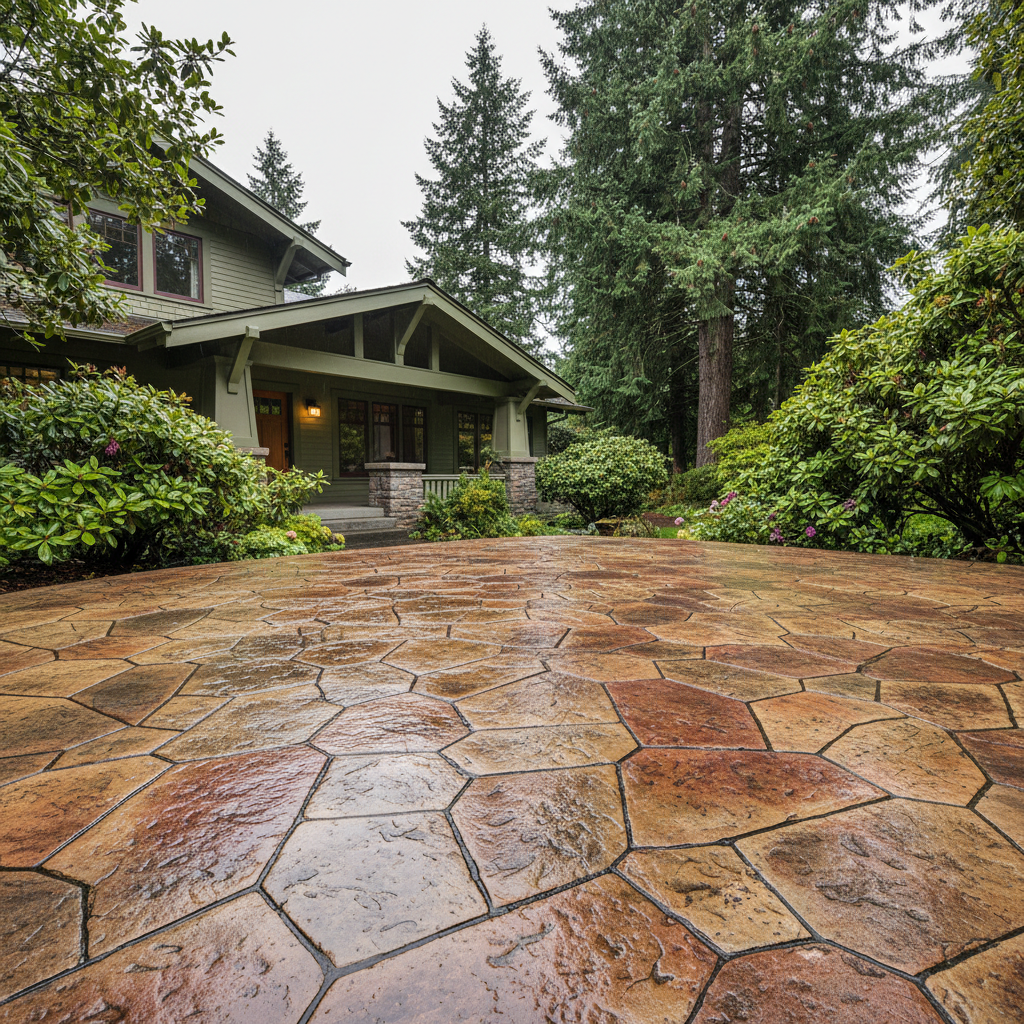
Stamped concrete designs in Salem, OR combine decorative patterns that mimic stone, brick, or tile with the monolithic strength of engineered concrete. Popular patterns include ashlar slate for patios, cobblestone for driveways, and seamless textures for modern outdoor spaces. Earth tones and slate grays dominate local color palettes, reflecting Northwest design sensibilities while adapting to Oregon’s wet winters through proper sealing and air-entrained concrete mixes.
Key Takeaways:
- Climate-adapted installation: Salem contractors emphasize air-entrained concrete and proper drainage to handle freeze-thaw cycles
- Popular patterns: Ashlar slate, cobblestone, seamless stone textures, and brick designs suit various architectural styles
- Color preferences: Earth tones, charcoal, and slate grays align with Pacific Northwest landscapes and overcast lighting
- Maintenance commitment: Resealing every 2–3 years preserves color and protects against moisture intrusion
- Local expertise: Professional installation accounts for Marion County soil conditions, grading, and drainage patterns
Understanding Stamped Concrete Design Options
Modern stamped concrete emerged from innovations pioneered by Brad Bowman in the mid-20th century, who developed metal stamp tools to imprint patterns in fresh concrete. Later advances in urethane stamps and integral color systems created the decorative concrete industry we know today. According to the Federal Highway Administration, Portland cement concrete has been a primary paving material since the early 1900s, and decorative treatments simply extend this proven technology with aesthetic enhancements.
For Salem homeowners, stamped concrete represents a practical middle ground: the visual impact of individual stone or brick units with the structural continuity and lower maintenance of a monolithic slab. When our crews pour concrete patio services in neighborhoods near Bush’s Pasture Park or along Commercial Street SE, we account for site-specific factors like soil compaction, water table depth, and sun exposure that affect long-term performance.
Pattern Categories and Applications
Stamped concrete patterns generally fall into four categories, each suited to different functional and aesthetic goals:
Ashlar slate patterns feature modular stone shapes with irregular edges, creating a natural flagstone appearance. This design works particularly well for concrete patio contractors Salem OR projects where homeowners want to integrate outdoor living areas with landscaping. The pattern’s organic lines complement both Craftsman-style homes common in Salem’s older neighborhoods and contemporary designs in newer subdivisions.
Cobblestone and brick patterns suit driveways and entry approaches, especially on properties with traditional or revival-style architecture. These repeating geometric patterns echo Salem’s downtown historic district, where brick and masonry facades define the commercial core. When properly installed with control joints integrated into pattern lines, these designs minimize visible cracking while maintaining visual authenticity.
Seamless stone textures provide broad, continuous surfaces without visible joints—ideal for modern or minimalist outdoor spaces. This option appeals to homeowners prioritizing clean lines and reduced visual complexity, and it simplifies maintenance by eliminating the numerous grout lines found in tile or paver installations.
Wood plank and specialty patterns replicate the look of timber decking or unique geometric shapes. While less common in Salem, these designs can create dramatic visual interest for pool decks, pergola floors, or commercial plaza accents.
Color Selection and Regional Preferences
Color choices in Salem tend toward muted, naturalistic palettes that harmonize with Oregon’s forested landscapes and frequent overcast skies. Earth tones—tan, sandstone, light gray—form the base color for most residential projects, often enhanced with darker antique release or secondary coloring to emphasize texture and relief.
Charcoal and slate grays have gained popularity for contemporary homes and for properties seeking a cooler, more neutral aesthetic. These colors resist showing dirt and debris during Salem’s rainy season, a practical consideration that influences many design decisions. Bright or highly saturated hues are rare, reflecting broader Pacific Northwest design sensibilities that favor subtlety and integration with natural surroundings.
Common Mistakes When Choosing Stamped Concrete Designs
Even with experienced contractors, homeowners can make design choices that compromise the long-term success of their stamped concrete investment. Understanding these pitfalls helps ensure your project meets both aesthetic and functional goals.
Ignoring Climate-Specific Performance Factors
Salem’s wet winters and occasional freezing temperatures demand specific concrete mix designs and installation practices. A common mistake is selecting stamp patterns without considering how water will drain across the surface or how texture affects slip resistance when wet. Deeply stamped patterns with pronounced relief can trap water and organic debris, accelerating staining and biological growth if not properly sealed and maintained.
We often recommend lightly textured seamless or stone patterns for high-traffic walkways and entry areas where foot traffic occurs during rainy months. For reference on local weather patterns that affect concrete performance, the National Weather Service provides detailed climate data for the Salem area.
Mismatching Pattern Scale to Space Size
Large cobblestone or fieldstone patterns can overwhelm small patios or narrow walkways, creating visual clutter rather than coherence. Conversely, fine brick or tile patterns may appear too busy on expansive driveways. Experienced contractors match stamp scale to project dimensions, typically using larger, simpler patterns for broad areas and more intricate designs for smaller, accent spaces.
Overlooking Long-Term Maintenance Requirements
Stamped concrete requires periodic resealing to maintain color vibrancy and surface protection. Homeowners who view stamped concrete as “zero maintenance” may be disappointed when colors fade or surfaces show premature wear. In Salem’s climate, most installations benefit from resealing every 2–3 years, with the frequency depending on traffic intensity, sun exposure, and whether deicing chemicals are used during winter freezes.
Best Practices for Selecting Stamped Concrete Designs in Salem, OR
Choosing the right stamped concrete design involves balancing aesthetic preferences with site-specific performance requirements. Our approach prioritizes durability alongside visual impact, ensuring installations that perform well across multiple Oregon seasons.
Match Pattern to Architectural Style
Salem’s housing stock ranges from early 20th-century Craftsman bungalows to mid-century ranches and contemporary builds. Ashlar slate and natural stone patterns complement Craftsman details, while cobblestone designs suit Colonial Revival or Tudor-influenced homes. Modern architecture pairs well with seamless textures or geometric patterns that echo clean, linear forms.
When working near Salem’s downtown historic district or established neighborhoods like Fairmount Hill, we consider how new hardscape integrates with existing materials—brick sidewalks, stone foundations, or original concrete work—to maintain neighborhood character while updating functional spaces.
Prioritize Proper Base Preparation and Drainage
Before any concrete is poured or stamped, the success of the project depends on subgrade preparation. Marion County soils vary from well-drained loams to heavier clays, and each requires specific compaction and base aggregate strategies. We coordinate with local utilities—such as Portland General Electric and the City of Salem Public Works—to locate underground lines before excavation and to ensure proper grading that directs water away from foundations.
A contrarian insight specific to Salem: because many properties have relatively shallow water tables during winter, we often specify thicker aggregate bases (6–8 inches rather than the standard 4 inches) to provide additional capillary break and frost protection. This local adaptation isn’t always standard in dryer regions but proves essential for long-term performance in the Willamette Valley.
Select Colors That Hide Staining and Wear
Mid-tone earth colors with variegated shading tend to hide dirt, leaf tannins, and minor surface wear better than solid light or dark colors. In Salem, where organic debris from Douglas firs, maples, and oaks is constant, a sandstone base color with charcoal or brown antiquing provides visual interest while masking the inevitable staining from decomposing foliage.
How to Plan Your Stamped Concrete Project
Successfully executing a stamped concrete installation requires coordination across design, site preparation, concrete placement, stamping, and finishing. Here’s how experienced contractors approach the process in Salem, OR.
Step 1: Site Assessment and Design Consultation
A thorough site visit identifies drainage patterns, existing utilities, soil conditions, and how the new surface will connect to existing structures. During design consultation, homeowners review pattern samples, color charts, and mockup boards that show how different stamp textures and colors appear under natural light.
For cost planning, many Salem homeowners start by researching stamped concrete driveway cost Salem OR to establish budget expectations. Stamped work typically costs more than plain concrete but less than individual stone pavers, offering a value-performance balance.
Step 2: Excavation, Base Installation, and Formwork
Excavation removes topsoil and organic material, followed by installation of compacted aggregate base. Forms are set to define edges and establish proper slope for drainage (typically 1–2% away from structures). Control joint locations are planned at this stage, ideally integrated into stamp pattern lines to minimize visual impact.
Step 3: Concrete Placement, Color Application, and Stamping
Fresh concrete is placed, screeded, and floated to achieve a smooth, level surface. Integral color (mixed into the concrete) or dry-shake color hardeners are applied and worked into the surface. Once the concrete reaches the proper consistency—firm enough to hold an impression but workable enough to accept stamps—release agents (often with a secondary color) are applied, and stamping begins.
Timing is critical: stamp too early, and the concrete smears; stamp too late, and it won’t accept the pattern. Experienced crews monitor weather, temperature, and concrete set time to hit the narrow window when stamping produces crisp, lasting impressions.
Step 4: Finishing, Curing, and Sealing
After stamping, edges are detailed, control joints are cut or formed, and the surface is cleaned of excess release agent. The slab cures for several days, then is washed and allowed to dry before sealer application. High-quality acrylic or polyurethane sealers protect the surface and enhance color depth.
In Salem’s climate, we often recommend breathable, non-gloss sealers that allow moisture vapor transmission while providing stain and UV protection. For galleries of completed installations, homeowners can review our projects to see how different patterns and colors perform in local conditions.
Frequently Asked Questions
How long does stamped concrete last in Salem, OR?
With proper installation, maintenance, and periodic resealing, stamped concrete can last 20–30 years or more. The concrete slab itself has similar longevity to conventional flatwork; the stamped surface pattern and color require ongoing care to maintain appearance.
Can stamped concrete crack?
All concrete can crack due to shrinkage, settlement, or thermal movement. Properly designed control joints direct cracking to planned locations (often hidden within pattern lines), minimizing visible damage. Air-entrained concrete, adequate base preparation, and correct joint spacing reduce cracking risk in freeze-thaw climates like Salem.
Is stamped concrete slippery when wet?
Texture and sealer choice affect slip resistance. Lightly textured patterns with non-gloss sealers generally provide adequate traction for walkways and patios. Glossy sealers can reduce slip resistance, especially when wet, so many Salem contractors recommend matte or satin finishes for outdoor surfaces.
What’s the best time of year to install stamped concrete in Salem?
Late spring through early fall (May–October) offers the most predictable weather for concrete placement and curing. Cooler temperatures and lower rainfall reduce risk of premature drying, washouts, or freeze damage during the critical first few days after pour.
How do I maintain stamped concrete?
Regular sweeping or blowing to remove debris, occasional washing with mild detergent, and resealing every 2–3 years keep stamped surfaces looking fresh. Avoid harsh deicers during winter, and address stains promptly to prevent permanent discoloration.
Conclusion
Stamped concrete designs in Salem, OR offer homeowners a durable, low-maintenance alternative to natural stone or brick, combining aesthetic versatility with the proven performance of modern concrete technology. From ashlar slate patios in West Salem (97304) to cobblestone driveways near South Gateway (97302), local contractors adapt national design trends to Oregon’s climate and architectural character.
Successful installations depend on matching pattern and color to home style, preparing sites for Salem’s wet winters and freeze-thaw cycles, and committing to periodic maintenance. Whether you’re replacing a worn wood deck, upgrading a plain concrete slab, or creating new outdoor living space, stamped concrete provides the visual impact of high-end materials with the structural continuity and manageable upkeep that fits busy lifestyles.
As you plan your next hardscape project, consider how stamped concrete designs can enhance both curb appeal and functional outdoor space while holding up to the unique demands of the Willamette Valley. Working with trusted local providers—such as Salem Concrete—ensures that technical expertise, site-specific knowledge, and quality craftsmanship come together to deliver results that last for decades.
Sources and References
- Federal Highway Administration – fhwa.dot.gov
- National Weather Service – weather.gov
- Portland Cement Association research on decorative concrete
- American Concrete Institute technical resources
Financial Disclaimer: This article is for informational purposes only and does not constitute professional advice. Consult with licensed contractors and building officials regarding specific project requirements, costs, and local building codes.