
Last Updated: December 24, 2025
Does your driveway apron show cracks, crumbling edges, or drainage problems that worsen every winter? That worn transition between your property and the street isn’t just an eyesore—it’s a liability that can damage vehicles, create safety hazards, and trigger code violations. When Oregon’s freeze-thaw cycles and heavy rainfall take their toll, driveway apron replacement in Salem, OR becomes essential for protecting your property value and maintaining safe access.
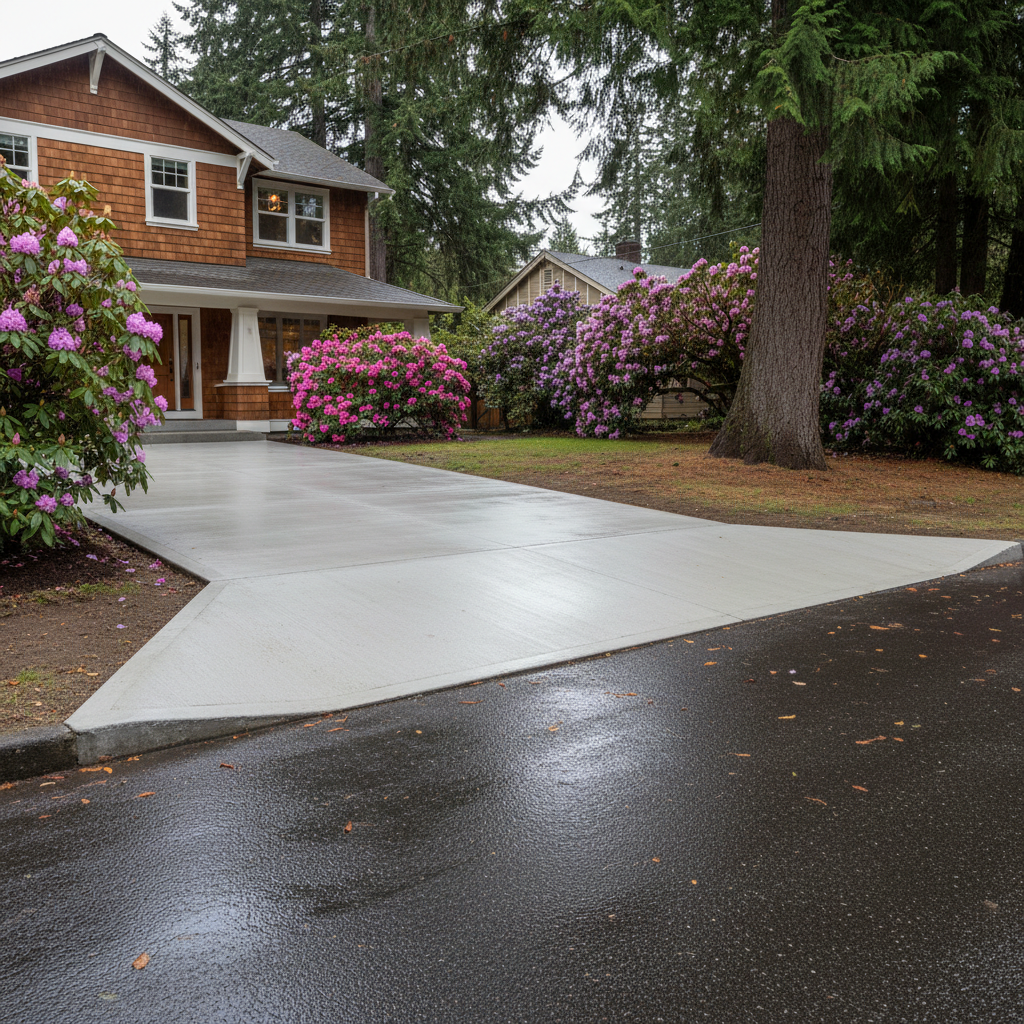
The apron—that critical paved section connecting your driveway to the public street—endures more stress than almost any other part of your property. It handles the weight of every vehicle entering and leaving, bears the brunt of street runoff, and must comply with city regulations for the public right-of-way. In Salem’s climate, with winter freezes and wet springs, these transitional surfaces deteriorate faster than homeowners expect, leading to structural failures that demand professional attention.
Quick Answer: What You Need to Know About Apron Replacement
Driveway apron replacement in Salem, OR typically costs $1,500-$4,500 depending on size and materials. The project requires City of Salem permits, coordination with public works for street easement work, and restoration of sidewalks to original conditions. Most replacements use concrete or asphalt, take 2-5 days to complete, and need contractor bonding for public right-of-way work.
Key Takeaways:
- City permits and bonding are mandatory for apron work affecting public streets
- Material choice (concrete vs. asphalt) impacts longevity and maintenance requirements
- Proper drainage design prevents future water damage and pavement failures
- Professional contractors must restore all street and sidewalk areas to original condition
- Salem’s climate demands climate-appropriate materials and installation techniques
Understanding Driveway Aprons and Why They Fail
A driveway apron serves as the crucial transition zone between your private property and the public street. Unlike the rest of your driveway, the apron sits partially or entirely within the city’s right-of-way, subjecting it to stricter regulations and heavier stress loads. This area experiences constant vehicle traffic, street runoff, snow plow impacts during winter maintenance, and the natural expansion-contraction cycles that Oregon’s temperature swings create.
In Salem, OR, freeze-thaw cycles pose the greatest threat to apron longevity. When water penetrates small cracks and freezes, it expands with tremendous force, widening fissures and breaking apart the pavement structure. Our teams regularly see aprons that looked fine one fall completely deteriorated by spring. The problem accelerates when inadequate drainage allows water to pool, creating ice dams and undermining the base material beneath the surface.
Common Signs You Need Replacement, Not Repair
While minor cracks can often be sealed and surface wear addressed with overlays, certain damage indicators signal that full replacement is necessary. When we evaluate aprons throughout neighborhoods like Grant, West Salem, and South Gateway, we look for these critical warning signs:
- Severe cracking patterns: Multiple intersecting cracks creating a “spider web” or “alligator” pattern indicate base failure
- Settling or sinking: When sections drop below street grade, creating dips or drainage reversals
- Edge deterioration: Crumbling margins where apron meets street or sidewalk
- Standing water: Pooling that persists more than 24 hours after rain signals drainage problems
- Root intrusion: Tree roots lifting or breaking apart the pavement structure
Attempting to repair aprons with these conditions typically wastes money. The underlying structural problems continue deteriorating beneath patches, leading to repeated failures within months.
How Salem’s Climate Affects Apron Durability
Salem receives approximately 40 inches of rainfall annually, concentrated heavily in winter months when temperatures hover near freezing. This creates the perfect storm for pavement damage: water penetration followed by freeze-thaw cycles. When our teams install concrete driveway services, we always specify air-entrained concrete—a material engineered with microscopic air bubbles that provide expansion space for freezing water, preventing the catastrophic cracking that destroys standard concrete.
Additionally, before any excavation work begins, we coordinate with Pacific Power and other utility providers to locate underground lines. Salem’s infrastructure includes numerous utility easements that complicate apron work, making professional coordination essential for safe, compliant installations.
Common Mistakes That Compromise Apron Replacement Projects
Even well-intentioned homeowners and contractors make critical errors during apron replacement that lead to premature failures, code violations, and expensive do-overs. Understanding these pitfalls helps you avoid costly mistakes.
Skipping Permits and City Coordination
The City of Salem requires permits for any work within public right-of-way areas, and contractors must post blanket surety bonds guaranteeing complete restoration of streets, sidewalks, and landscaping to original conditions. We’ve seen homeowners hire unlicensed contractors who skip this process, only to face stop-work orders, fines, and requirements to tear out and redo the entire project at double the original cost.
According to Oregon Construction Contractors Board regulations, any contractor performing work over $1,000 must maintain proper licensing and bonding. For apron work affecting public infrastructure, these requirements protect both homeowners and the city from liability issues.
Inadequate Base Preparation
The most common technical failure we observe is insufficient base material or poor compaction. An apron needs a minimum 6-inch compacted aggregate base to support vehicle loads and prevent settling. Cutting corners on this foundation work—invisible once the surface is paved—guarantees problems within the first year. Proper base preparation includes excavating to appropriate depth, installing geotextile fabric to prevent mixing of subgrade soil with aggregate, and compacting in lifts using proper equipment.
Ignoring Drainage Requirements
Many failed aprons result from poor drainage design. The apron must slope away from structures (minimum 2% grade) while matching street elevation requirements. Water should never flow back toward garages or pool on the surface. In areas throughout zip codes 97301, 97302, and 97304, we commonly encounter existing drainage problems from improperly graded aprons, requiring complete redesign during replacement rather than simple replication of the failed design.
Best Approach: Materials and Design for Long-Term Performance
Selecting appropriate materials and design specifications determines whether your new apron lasts 10 years or 40 years. Each material choice involves trade-offs between initial cost, longevity, maintenance requirements, and aesthetic considerations.
Concrete vs. Asphalt: Making the Right Choice
Concrete aprons offer superior longevity, typically lasting 30-40 years with minimal maintenance in Salem’s climate. The material resists petroleum stains, maintains its appearance better, and provides a more substantial feel. However, concrete costs more initially (typically $8-12 per square foot installed) and requires longer curing time before use—usually 7 days for light traffic, 28 days for full strength.
Asphalt aprons cost less upfront ($4-7 per square foot) and can be used within 24-48 hours after installation. The material’s flexibility better accommodates ground movement and settlement. However, asphalt requires sealcoating every 2-3 years to maintain weather resistance and typically needs replacement after 15-20 years. For homeowners considering various options, reviewing stamped concrete driveway cost Salem OR information can provide insights into decorative concrete options that some property owners choose for enhanced curb appeal.
| Factor | Concrete | Asphalt |
|---|---|---|
| Initial Cost | $8-12/sq ft | $4-7/sq ft |
| Lifespan | 30-40 years | 15-20 years |
| Maintenance | Minimal (seal joints) | Sealcoat every 2-3 years |
| Curing Time | 7-28 days | 24-48 hours |
| Climate Suitability | Excellent (with air entrainment) | Good (with regular maintenance) |
Thickness and Reinforcement Specifications
Residential aprons handling standard passenger vehicles require minimum 4-inch thickness for concrete or 3-inch thickness for asphalt over proper base. However, properties with heavier vehicles (RVs, commercial trucks) need 6-inch concrete or 4-inch asphalt. Concrete aprons should include wire mesh or fiber reinforcement to control cracking, with expansion joints every 10 feet and isolation joints where the apron meets other structures.
Regional Material Consideration for Salem
Unlike coastal areas where salt exposure accelerates concrete deterioration, or high-desert regions where extreme temperature swings dominate, Salem’s moderate climate with high moisture and moderate freezing makes it ideal for concrete installations—provided proper mix design is used. We source aggregate from nearby quarries that provides excellent freeze-thaw resistance and matches the thermal expansion characteristics of existing street infrastructure, preventing differential movement that creates stress cracks at the apron-street junction.
Step-by-Step: How Professional Apron Replacement Works
Understanding the replacement process helps homeowners set realistic expectations and identify contractors who cut corners. A complete apron replacement follows these critical phases:
Phase 1: Permits and Utility Coordination
Before any equipment arrives, professional contractors obtain necessary permits from Salem Public Works and arrange utility locates. The contractor must post a bond guaranteeing restoration of any damaged city infrastructure. This administrative phase typically takes 1-2 weeks and includes surveying to establish exact right-of-way boundaries and existing grade elevations.
Phase 2: Demolition and Excavation
The existing apron is removed using saws to cut clean edges, then broken up and hauled away. Excavation extends deep enough to accommodate new base material and surface thickness while matching required grades. Any damaged base material is removed and replaced. This phase generates significant noise and dust but typically completes in one day for standard residential aprons.
Phase 3: Base Installation and Compaction
Compacted aggregate base (typically ¾-inch crushed rock) is installed in 2-3 inch lifts, each compacted with a plate compactor or roller. Proper compaction—achieving 95% density—is critical and verifiable with nuclear density testing on larger projects. The base surface is graded to final elevations, creating proper drainage slopes.
Phase 4: Surface Installation
For concrete aprons, forms are set, reinforcement placed, and concrete poured. The surface is finished to appropriate texture (broom finish for traction) and joints cut or formed. Curing compound is applied, and the surface protected during curing. For asphalt, hot mix is delivered, spread, and compacted in one continuous operation. Edge details where apron meets street receive special attention to create smooth, durable transitions.
Phase 5: Finishing and Restoration
All adjacent areas—sidewalks, curbs, landscaping—are restored to original or better condition. Street surfaces are cleaned, damaged areas patched, and any temporary traffic control removed. Final inspection by city officials confirms compliance before bond release. Salem Concrete and other professional contractors understand this restoration obligation is not optional—it’s a legal requirement backed by the posted bond.
Selecting the Right Contractor for Your Apron Replacement
The contractor you select determines project success more than any other factor. In Salem’s competitive market, homeowners find numerous options ranging from large paving companies to small concrete specialists. Here’s how to identify truly qualified professionals:
Essential qualifications to verify:
- Oregon CCB license (verify at oregon.gov/ccb)
- General liability insurance with minimum $1 million coverage
- Ability to post required city bonds for right-of-way work
- Experience with Salem’s specific permit requirements and inspection processes
- Portfolio of completed apron projects with verifiable references
Request detailed written estimates that specify materials (including mix designs for concrete or asphalt specs), timeline, warranty terms, and exactly what restoration work is included. Vague estimates often hide costs that emerge as “extras” during construction. For comprehensive project management, reviewing all available services from established contractors ensures you understand the full scope of capabilities.
Frequently Asked Questions About Driveway Apron Replacement
How long does a typical apron replacement take?
Most residential apron replacements complete within 3-5 working days, excluding permit processing time. Concrete aprons require additional curing time (7-28 days) before full use, while asphalt aprons can handle light traffic within 24-48 hours. Weather conditions significantly impact scheduling—rain delays are common during Salem’s wet season.
Can I replace my apron myself as a DIY project?
While technically possible, DIY apron replacement is strongly discouraged. The work requires city permits, posted bonds, specialized equipment, proper material specifications, and restoration guarantees that homeowners cannot typically provide. Additionally, mistakes affecting public infrastructure can result in liability for damage claims. The permitting process alone requires contractor licensing for work within public right-of-way.
What time of year is best for apron replacement in Salem?
Late spring through early fall (May through October) provides optimal conditions. Concrete requires temperatures above 50°F during curing, and both materials need dry conditions for proper installation. We schedule most apron projects for June through September when weather reliability is highest and ground conditions are driest.
Does a new apron require special maintenance?
Concrete aprons benefit from sealing control joints every 3-5 years to prevent water infiltration. Asphalt aprons require sealcoating every 2-3 years to maintain weather resistance. Both materials need prompt crack repair if damage occurs, as small cracks quickly expand during freeze-thaw cycles.
Will the city inspect my new apron?
Yes, Salem Public Works conducts final inspection of all work within public right-of-way before releasing contractor bonds. The inspection verifies proper grades, complete restoration of adjacent infrastructure, and compliance with approved plans. Only after passing inspection can contractors reclaim their bond and consider the project complete.
Moving Forward With Your Apron Replacement Project
A failing driveway apron only worsens with time, accumulating damage that increases replacement costs while creating safety hazards and potential code violations. Addressing the problem proactively—before complete structural failure—provides more control over timing, budget, and contractor selection. December 24, 2025 marks an ideal time to begin planning for spring construction, allowing sufficient time for permit processing and contractor scheduling during the optimal construction season.
Professional apron replacement delivers benefits extending far beyond simple aesthetics. A properly constructed apron protects your vehicles from damage caused by uneven transitions, prevents water infiltration that undermines foundations and landscaping, maintains compliance with city codes, and preserves property value. The investment—typically $1,500-$4,500 for standard residential aprons—provides decades of trouble-free service when completed with appropriate materials and techniques.
When evaluating contractors for your driveway apron replacement in Salem, OR, prioritize those demonstrating comprehensive understanding of local regulations, climate-appropriate construction methods, and commitment to proper restoration of public infrastructure. Request detailed proposals, verify licensing and bonding, and check references from recent projects. The few hours invested in thorough contractor vetting prevents years of problems from substandard work.
Ready to replace your failing apron with a durable, properly constructed surface? Contact us for a detailed evaluation and estimate. Our experienced team handles all aspects of the project—from permit applications through final city inspection—ensuring your new apron meets both regulatory requirements and performance expectations for decades of reliable service.
Sources and References
1. City of Salem Public Works Department – Right-of-Way Requirements
2. Oregon Construction Contractors Board – Licensing and Bonding Requirements (oregon.gov/ccb)
3. American Concrete Institute – Freeze-Thaw Resistance Standards
4. National Asphalt Pavement Association – Maintenance Guidelines