
Last Updated: January 12, 2026
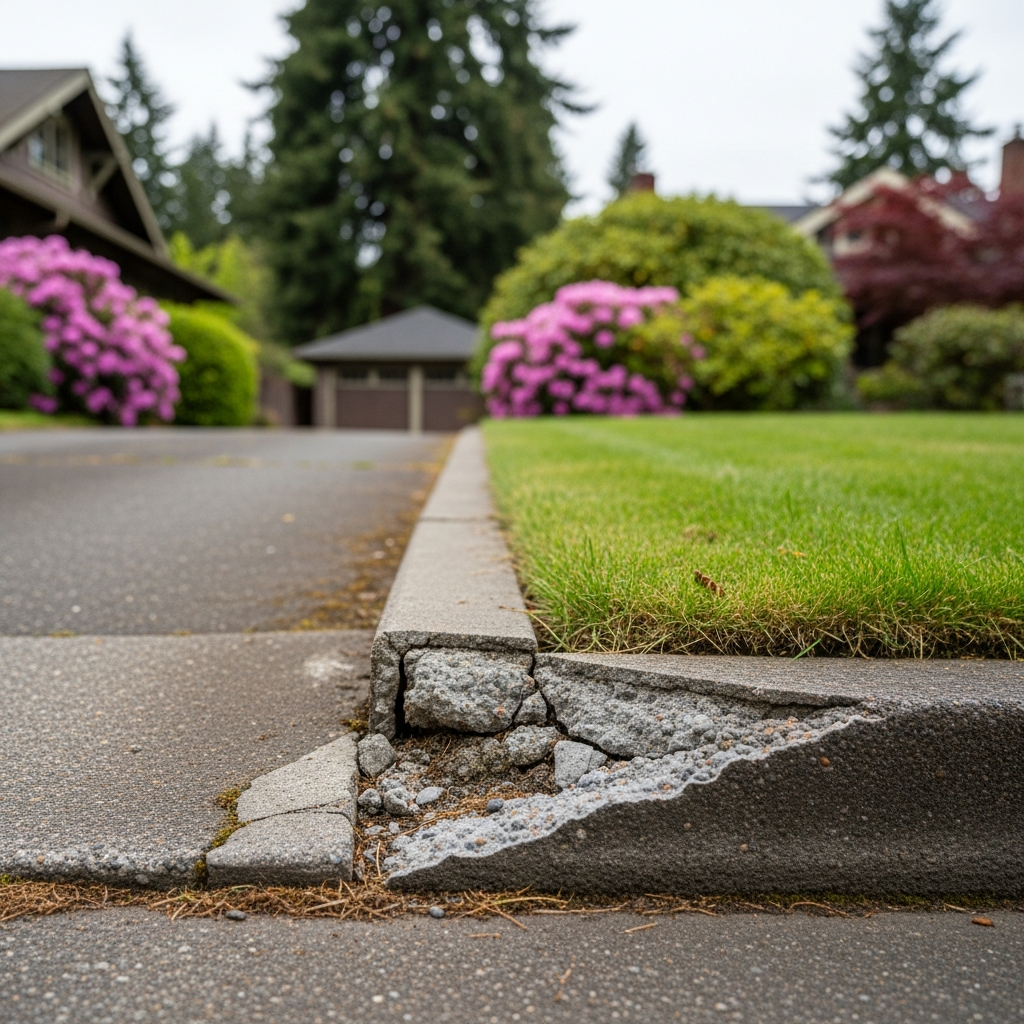
Are the edges of your driveway crumbling, creating unsightly chips and dangerous trip hazards? In Salem, OR, chipped concrete edges aren’t just cosmetic issues—they’re structural warnings that demand immediate attention. Left unaddressed, minor edge damage accelerates into costly replacements, compromising your property’s safety and curb appeal.
Whether you’re dealing with spalling driveway edges near South Commercial Street, sunken walkway corners in West Salem, or deteriorating retaining walls in the Fairmount Hill neighborhood, understanding modern repair solutions can save you thousands. The good news? Advanced techniques like polyurethane foam injection and fiber-reinforced polymer wraps now offer faster, more durable alternatives to traditional patching—often completing repairs in hours rather than days.
Quick Answer: How to Repair Chipped Concrete Edges
To repair chipped concrete edges in Salem, OR, professionals assess the damage extent, identify root causes like soil settlement or freeze-thaw cycles, then apply appropriate solutions—PolyLevel® foam injection for sunken edges, seamless patching for cosmetic chips, or CFRP wraps for structural repairs. Most repairs complete within 1-2 days with minimal disruption.
Key Takeaways:
- Root-cause diagnosis prevents recurring damage and wasted repair costs
- PolyLevel® foam injection lifts sunken edges in 15-30 minutes with pinpoint accuracy
- CFRP wrapping increases structural capacity by 30-50% for retaining walls and curbs
- Professional color-matching ensures seamless aesthetic results
- Salem’s wet climate requires water-resistant sealants like SealantPro® for longevity
Understanding Why Concrete Edges Chip in Salem, OR
The Willamette Valley’s unique environmental conditions create perfect storm scenarios for concrete deterioration. Salem’s clay-rich soils expand during our wet winters and shrink dramatically during summer dry spells, causing subsurface voids beneath concrete slabs. When concrete edges lose underlying support, vehicle loads or foot traffic create stress concentrations that result in chipping and spalling.
Our teams working throughout the 97301, 97302, and 97305 zip codes consistently identify several primary culprits behind edge damage. According to Oregon Department of Transportation research, freeze-thaw cycles account for 20-30% of concrete edge deterioration within the first decade of installation. Water infiltrates small surface cracks, freezes during cold snaps, expands, and literally pries concrete apart from the inside.
Soil Movement and Foundation Settlement
Before pouring any repair mix, we coordinate with Salem Electric to mark underground utilities—a critical step that many DIY attempts overlook. Soil settlement creates the most common scenario we encounter: improperly compacted fill beneath driveways and walkways gradually compresses under load, creating voids. Research shows 60% of sinking concrete stems from soil shrinkage, while rain erosion contributes another 25%.
In neighborhoods near Bush’s Pasture Park and around Fairmount Hill, we’ve observed consistent patterns where original contractors cut corners on base preparation. Without proper aggregate depth and compaction, even perfectly mixed concrete fails prematurely at high-stress points like edges and corners.
Environmental Weathering and Chemical Damage
Salem’s annual rainfall—averaging 40 inches—accelerates concrete deterioration when edges lack proper water channeling. We’ve documented cases where downspouts discharge directly onto driveway edges, saturating the concrete-soil interface year after year. Add deicing salts during occasional winter storms, and the chemical attack on cement paste intensifies exponentially.
Unlike Portland’s milder climate, Salem experiences more pronounced temperature swings that stress concrete through thermal expansion and contraction. This movement creates micro-cracks at edges—the weakest structural points—which propagate into visible chips within 3-5 years of installation.
Common Mistakes When Attempting DIY Edge Repairs
We routinely repair botched DIY attempts that actually worsened the original problem. Understanding these pitfalls can save homeowners from doubling their repair costs and extending project timelines.
Ignoring the Underlying Cause
The most expensive mistake? Patching chipped edges without addressing why they failed. If soil voids or poor drainage caused the original damage, surface repairs will fail within months. Local contractors report that 80-90% of edge chipping stems from installation defects, soil settlement, corroded reinforcement, or chemical attack—not surface-level issues.
When we evaluate properties along Lancaster Drive or near Chemeketa Community College, proper assessment always precedes repair. This includes probing beneath the slab to identify voids, inspecting drainage patterns, and testing for soil compaction. Skipping this diagnostic phase guarantees recurring problems.
Using Improper Patching Materials
Big-box store “concrete repair” products rarely match your existing concrete’s thermal expansion coefficient or compressive strength. We’ve seen countless repairs where mismatched materials create differential movement at repair boundaries—the patch shrinks at a different rate than the original concrete, causing new cracks that radiate from the repair zone.
Professional-grade polymer-modified repair mortars bond chemically with existing concrete and flex slightly during temperature changes. Standard hardware store products lack these properties, resulting in repairs that pop out during the first freeze-thaw cycle.
Insufficient Surface Preparation
For patch materials to bond effectively, you must remove all loose concrete, clean thoroughly, and profile the surface to create mechanical interlock. DIY attempts typically skip the grinding and acid-etching steps that ensure adhesion. When we perform concrete driveway services throughout Salem, surface preparation consumes 40% of project time—but delivers 90% of long-term success.
Professional Repair Solutions for Chipped Concrete Edges
Modern repair technology has evolved dramatically from the basic mudjacking and epoxy patching of the 2000s. Today’s methods offer superior durability, faster completion, and minimal property disruption.
PolyLevel® Foam Injection for Sunken Edges
When chipped edges result from slab settlement, PolyLevel® polyurethane foam injection delivers remarkable results. This process involves drilling penny-sized holes through the concrete, then injecting expanding foam beneath the slab. The foam fills voids, lifts the concrete with precision, and cures in 15-30 minutes—allowing same-day use.
Unlike traditional mudjacking that pumps heavy cement slurry beneath slabs, PolyLevel® weighs just 2-4 pounds per cubic foot compared to mudjacking’s 100+ pounds. This lightweight characteristic proves crucial in Salem’s problematic soils, where additional weight would stress already compromised subsurface conditions. The material achieves 95% void-fill accuracy and won’t wash out during our rainy seasons.
| Repair Method | Cure Time | Weight Load | Best Application |
|---|---|---|---|
| PolyLevel® Injection | 15-30 minutes | 2-4 lbs/cu ft | Sunken driveways, walkways |
| Traditional Mudjacking | 24-72 hours | 100+ lbs/cu ft | Limited use (soil stress risk) |
| CFRP Wrapping | 24 hours | Minimal | Structural walls, load-bearing edges |
| Polymer-Modified Patching | 4-6 hours | N/A | Cosmetic edge chips |
Carbon Fiber Reinforced Polymer (CFRP) for Structural Repairs
For retaining walls and load-bearing edges showing structural compromise, CFRP wrapping offers exceptional reinforcement. Oregon Department of Transportation testing documented shear capacity increases of 30-50% when applying surface-bonded CFRP to damaged concrete structures. This technology involves bonding carbon fiber fabric to cleaned concrete surfaces using epoxy resins, creating a composite system stronger than the original concrete.
We’ve successfully applied CFRP repairs to retaining walls throughout Salem’s hillside neighborhoods, where soil pressure creates edge spalling. The material resists moisture infiltration—critical in our climate—and maintains structural integrity through decades of service. According to Federal Highway Administration studies, properly installed CFRP systems outlast traditional steel reinforcement while avoiding corrosion issues.
Seamless Patching and Resurfacing
When edge damage is primarily cosmetic—surface spalling without structural compromise—professional patching with color-matched materials delivers excellent results. Our approach involves grinding away damaged concrete, applying bonding agents, then troweling polymer-modified repair mortars that match your existing concrete’s color and texture.
For larger areas, micro-topping resurfacing creates a uniform new surface over structurally sound but cosmetically damaged edges. This technique works exceptionally well for concrete patio services where appearance matters as much as function. The key lies in proper surface preparation and using materials engineered for Oregon’s temperature ranges.
Step-by-Step Professional Repair Process
Understanding the systematic approach professionals use helps homeowners evaluate contractors and appreciate the complexity of quality repairs.
Comprehensive Assessment and Diagnosis
Every repair project begins with thorough evaluation. We probe beneath edges using specialized equipment to map subsurface voids, measure slab thickness, check for rebar corrosion, and assess concrete quality. Moisture meters identify ongoing water infiltration, while ground-penetrating radar reveals hidden damage extent.
This diagnostic phase often reveals surprises. A seemingly minor edge chip might indicate widespread subsurface erosion requiring foam injection before surface repairs. Conversely, dramatic-looking spalling sometimes masks minimal structural impact, allowing cost-effective cosmetic solutions.
Subsurface Stabilization
When soil voids contribute to edge failure, stabilization must precede surface repairs. PolyLevel® injection fills these voids and lifts settled sections to proper grade. For severe foundation-related settling, helical piers provide permanent support—we’ve installed these systems throughout Salem when building foundations shift on inadequately compacted fill.
Proper drainage correction prevents recurring damage. This might involve regrading adjacent soil, installing French drains, or redirecting downspouts—modifications that address root causes rather than symptoms.
Edge Reconstruction and Reinforcement
With subsurface issues resolved, edge reconstruction begins. We remove all compromised concrete, exposing sound material with clean, defined edges. Power washing and acid etching create the surface profile necessary for bonding. For structural repairs, we may drill and epoxy-set rebar dowels to tie new material to existing concrete.
Formwork installation ensures proper edge geometry and finish. We pour high-strength, fiber-reinforced concrete mixes engineered for Salem’s climate—typically specifying air-entrained concrete that resists freeze-thaw damage. Due to the Willamette Valley’s clay soils and temperature fluctuations, we always specify air-entrained concrete for edge repairs, a detail that national contractors often miss but dramatically extends repair lifespan.
Sealing and Protection
After repairs cure, protective sealants extend longevity. SealantPro® treatments create moisture barriers that resist water, chemicals, and temperature extremes. These penetrating sealers don’t create surface films that peel or wear away—instead, they chemically bond within the concrete matrix. In Salem’s wet climate, this protection proves essential for achieving the 10-20+ year service life that quality repairs should deliver.
Frequently Asked Questions
How long do professional edge repairs last in Salem’s climate?
Properly executed repairs using modern materials typically last 10-20+ years in Salem, OR. Longevity depends on addressing underlying causes, using climate-appropriate materials (especially air-entrained concrete for freeze-thaw resistance), and applying protective sealants. Regular maintenance like resealing every 3-5 years maximizes durability.
Can I drive on repaired concrete edges immediately?
It depends on the repair method. PolyLevel® foam injection allows same-day use after just 15-30 minutes of cure time. Traditional concrete patching requires 24-72 hours before light traffic and 7 days for full strength. CFRP structural repairs need 24 hours before loading. Always follow your contractor’s specific curing recommendations.
What’s the cost difference between repair and replacement?
Edge repairs typically cost 40-60% less than full replacement. Minor cosmetic patching may run a few hundred dollars, while comprehensive repairs involving lifting and structural reinforcement cost more but still remain significantly cheaper than tearing out and replacing entire sections. Get multiple assessments—some damage that appears severe can be repaired economically.
Will repaired edges match my existing concrete color?
Professional contractors use color-matching techniques including integral pigments, surface stains, and aggregate selection to blend repairs seamlessly. Perfect matches prove challenging with aged concrete that has weathered and developed patina, but skilled work produces near-invisible repairs. Discuss color expectations during the estimate phase—sometimes slight variations are inevitable.
Should I repair small chips immediately or wait?
Address edge damage promptly. Small chips expose interior concrete to moisture infiltration, accelerating deterioration through freeze-thaw cycles. What starts as minor cosmetic damage often progresses to structural failure requiring expensive intervention. Early repairs cost far less than delayed action—we consistently see homeowners who waited face 3-5 times higher costs.
Choosing the Right Contractor in Salem, OR
Selecting qualified professionals makes the difference between repairs that last decades and those that fail within seasons. Look for contractors with demonstrable experience in concrete restoration—not just installation. Request references from projects at least 5 years old to verify long-term performance.
Verify proper licensing and insurance coverage. Oregon requires contractor licensing through the Construction Contractors Board, and legitimate contractors carry comprehensive liability and workers’ compensation insurance. Check these credentials before signing contracts.
Detailed written estimates should outline the diagnosis, proposed solutions, materials specifications, timeline, and warranty terms. Be wary of contractors who offer repairs without thorough assessment—those who don’t identify underlying causes will deliver temporary fixes at best. Whether you need help with your driveway, walkway, or retaining wall, our comprehensive services address both immediate damage and long-term durability.
Salem Concrete specializes in advanced concrete restoration throughout the Salem area. Our approach prioritizes root-cause diagnosis and climate-appropriate solutions that deliver lasting results rather than temporary patches. When you’re ready to eliminate those chipped edges permanently, contact us for a comprehensive assessment and detailed repair plan.
Conclusion: Invest in Permanent Solutions
Repairing chipped concrete edges in Salem, OR requires more than surface-level patching—it demands comprehensive diagnosis, proven repair techniques, and climate-appropriate materials. Modern solutions like PolyLevel® foam injection, CFRP reinforcement, and polymer-modified mortars offer superior performance compared to outdated methods, delivering repairs that withstand our wet winters and temperature fluctuations.
The key to successful concrete edge restoration lies in addressing underlying causes rather than treating symptoms. Whether soil settlement, drainage issues, or installation defects caused your edge damage, professional intervention that stabilizes subsurfaces and applies appropriate repair methodologies prevents recurring failures and protects your investment for decades.
Don’t let minor edge chips evolve into major structural problems. Early intervention costs a fraction of delayed repairs while preserving your property’s safety, functionality, and curb appeal. With the right contractor using proven techniques, your repaired concrete edges will deliver reliable performance well into the 2030s and beyond.
Sources and References
- Federal Highway Administration – Concrete Repair Research and Guidelines
- Oregon Construction Contractors Board – Licensing and Regulations
- Oregon Department of Transportation – Infrastructure Repair Studies (SPR 636)
- American Concrete Institute – Repair Standards and Best Practices
Disclaimer: This article provides general information about concrete edge repair techniques and considerations. Specific repair requirements vary based on individual circumstances including damage extent, soil conditions, and structural factors. Always consult with licensed professionals for assessment and recommendations tailored to your property. Repair costs and timelines mentioned are estimates and may vary based on project scope and market conditions as of January 2026.