
Last Updated: January 7, 2026
Is your property flooding during Salem’s wet season, or is your aging culvert showing signs of collapse? With Oregon’s strict environmental regulations and fish passage requirements, choosing the right concrete culvert installation in Salem, OR approach requires more than just laying pipe—it demands expertise in modern repair techniques, structural integrity, and watershed protection. Whether you’re dealing with roadway drainage on Commercial Street SE or stormwater management near Riverfront Park, understanding your options can save you thousands while ensuring compliance with state mandates.
Salem’s culvert infrastructure has evolved dramatically since the 1977 Interstate 5 storm drainage project in northeast Salem, which marked a turning point for precast reinforced concrete applications. Today’s property owners face a critical decision: repair existing culverts to extend their life by 10-25 years, or invest in full replacements designed to last 75+ years. With Oregon’s Culvert Repair Programmatic Agreement emphasizing cost-effective, fish-friendly solutions through 2023 and beyond, the stakes have never been higher for getting it right.
Quick Answer: What You Need to Know About Culvert Installation
Concrete culvert installation in Salem, OR ranges from targeted repairs (invert paving, CCCP lining) to full replacements with box culverts. Modern installations prioritize fish passage compliance, life-cycle cost efficiency, and integration with Marion County drainage systems. Professional assessment determines whether repair techniques can add 10-25 years to your culvert’s life or if replacement is necessary for structural integrity.
Key Takeaways:
- Repair vs. Replace: Repairs cost less upfront and add 10-25 years; replacements last 75+ years but require higher investment
- Fish Passage Compliance: Oregon Department of Fish and Wildlife mandates require volitional fish passage in stream-connected culverts
- Modern Techniques: Invert paving, centrifugally cast concrete, and cured-in-place pipe offer targeted solutions
- Local Conditions: Salem’s wet climate and North Santiam watershed protection demand specialized approaches
- Permitting Requirements: Marion County and City of Salem building departments require specific approvals before excavation
Understanding Salem’s Culvert Infrastructure History
Salem’s relationship with concrete culverts dates back to early 20th-century water management projects. The city transitioned from wooden pipes and canals—like the 1850s North Santiam River diversion to Mill Creek—to durable concrete systems by the 1930s. A pivotal moment came when Salem installed a 13-mile, 36-inch concrete pipe from Stayton Island to the Fairmont Hill reservoir, establishing concrete as the material of choice for long-term infrastructure.
The 1977 Interstate 5 storm drainage project in northeast Salem represented the region’s first extensive deployment of precast reinforced concrete culverts for highway applications. This benchmark project addressed persistent flooding along the I-5 corridor near Market Street NE and Lancaster Drive NE, setting engineering standards that influence concrete services throughout the Willamette Valley today.
How Climate and Watershed Recovery Shape Modern Requirements
Oregon’s wet climate—Salem averages 40+ inches of rain annually—creates unique challenges for culvert longevity. Freeze-thaw cycles, soil saturation, and high seasonal flows demand concrete mixes with superior durability. Additionally, watershed recovery efforts following the 1993 Clinton Forest Plan prioritize erosion control and habitat protection, making environmental compliance non-negotiable for any culvert project in the North Santiam basin.
When our team works near Minto-Brown Island Park or along Battle Creek, we consistently encounter requirements from both the Oregon Department of Fish and Wildlife and local utility providers. Before any excavation, coordination with Portland General Electric and Northwest Natural Gas ensures underground utilities are marked—a critical step that prevents costly delays and safety hazards in areas like West Salem near Wallace Road NW.
Common Mistakes Property Owners Make With Culvert Projects
Many Salem property owners underestimate the complexity of culvert work, leading to costly failures and regulatory violations. Understanding these pitfalls helps ensure your project succeeds the first time.
Skipping Professional Assessment Before Installation
The biggest mistake is assuming all culvert problems require complete replacement. Oregon’s Culvert Repair Programmatic Agreement emphasizes repair-first approaches because they deliver lower life-cycle costs. A 2020 study documented eight culvert projects where techniques like invert paving (reinforced concrete layer in the bottom) and centrifugally cast concrete pipe (CCCP) extended service life without full excavation.
For example, a failing culvert near Keizer might only need invert repairs to address localized damage, adding 15-20 years at a fraction of replacement costs. However, without proper structural analysis, property owners often default to expensive full replacements when targeted repairs would suffice. Professional assessment identifies whether soil retention, water flow containment, or structural capacity drives your needs.
Ignoring Fish Passage and Environmental Regulations
Oregon’s stringent environmental mandates require volitional fish passage in culverts connected to fish-bearing streams. A 2020 replacement project showcased this requirement: engineers installed a 22-foot concrete box culvert with rock weirs to create scour holes and maintain stream continuity, eliminating outlet perching that blocked salmon migration.
Failing to incorporate fish passage features results in project shutdowns, fines, and mandatory remediation. In Salem’s 97301, 97302, and 97317 zip codes—where properties frequently border creeks flowing to the Willamette River—this oversight proves particularly costly. Oregon Department of Fish and Wildlife biologists often require post-installation monitoring to verify habitat improvements, adding timeline considerations many property owners neglect.
Underestimating Site-Specific Soil Conditions
Salem’s soil composition varies dramatically from the alluvial deposits near the Willamette River to the clay-heavy soils in South Salem. Culverts must be designed for specific load-bearing capacities and erosion resistance. Cured-in-place pipe (CIPP) linings work exceptionally well for preventing soil erosion into existing culverts, but only when soil conditions support the installation process.
Best Approaches for Modern Culvert Solutions
Today’s concrete culvert installation in Salem, OR leverages advanced techniques that balance structural performance, environmental stewardship, and budget constraints. Here’s what professional contractors prioritize.
Repair Techniques That Extend Service Life Cost-Effectively
Oregon’s Culvert Repair Programmatic Agreement, active through 2023 and continuing into 2026, emphasizes four primary repair techniques:
| Technique | Application | Life Extension |
|---|---|---|
| Invert Paving | Reinforced concrete layer in culvert bottom to seal and strengthen | 15-25 years |
| CCCP (Centrifugally Cast) | Thin, strong concrete lining spun inside full diameter | 20-25 years |
| CIPP (Cured-in-Place Pipe) | Continuous inner liner for sealing and soil retention | 10-20 years |
| Void Filling/Invert Repairs | Localized fixes for specific damage points | 10-15 years |
In our experience working throughout Marion County, invert paving proves particularly effective for culverts under concrete driveways or roadways where excavation would disrupt traffic. Five of the eight 2020 CRPA projects utilized this technique, demonstrating its reliability for maintaining water flow containment while preventing soil erosion.
When Full Replacement With Box Culverts Makes Sense
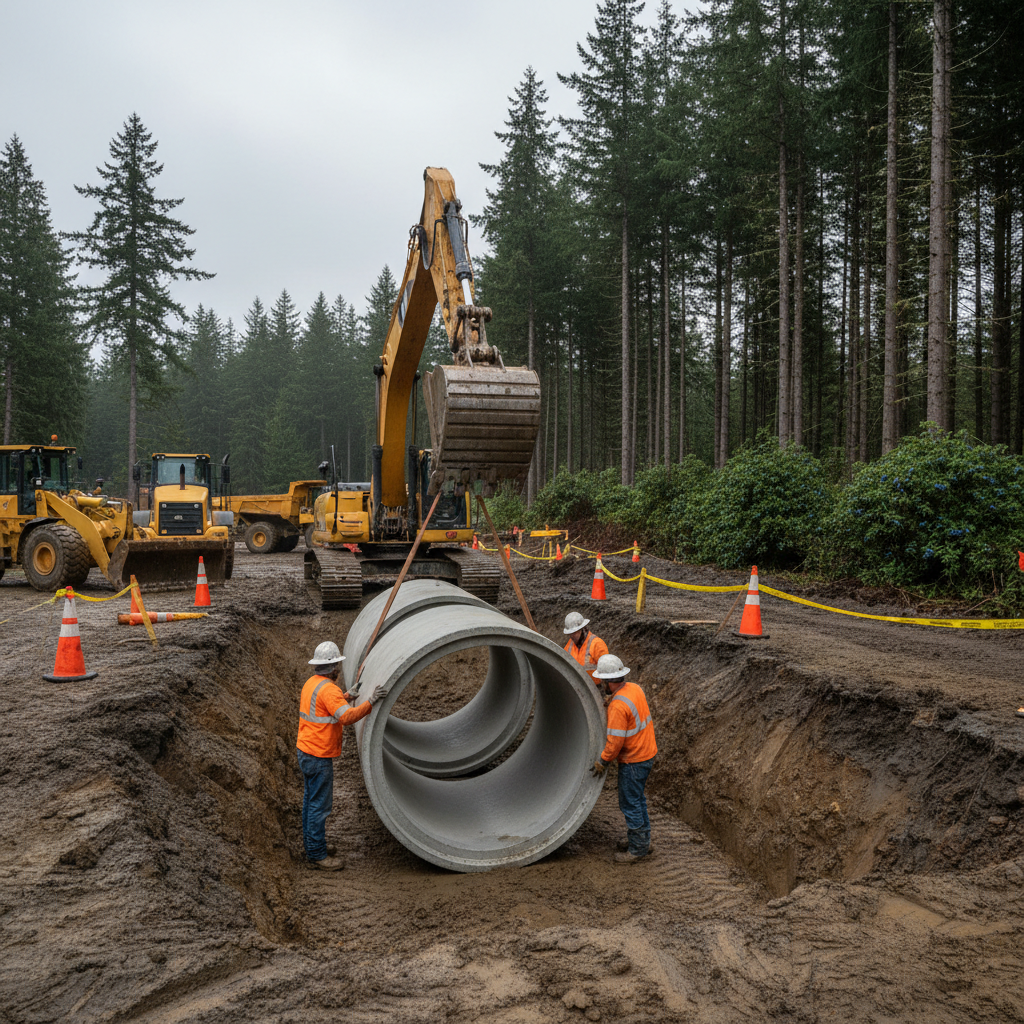
Complete replacement becomes necessary when structural integrity is compromised beyond repair—typically indicated by severe cracking, collapse zones, or outlet perching that causes persistent flooding. Modern box culverts offer superior hydraulic capacity compared to circular pipes, making them ideal for high-flow situations near Pringle Creek or Mill Creek.
The 2020 CRPA project that installed a 22-foot concrete box culvert demonstrated best practices: engineers incorporated rock weirs to create fish habitat, eliminated low-flow perching issues, and designed for 75+ year service life. While initial costs exceeded repairs by 200-300%, the life-cycle analysis favored replacement given the culvert’s strategic location and severe existing damage.
Contrarian Local Insight: Aggregate Sourcing Matters
Here’s something national contractors often miss: sourcing aggregate from Willamette Valley quarries significantly improves concrete performance in Salem’s climate. Local aggregate has thermal expansion properties that match existing infrastructure, reducing stress fractures during freeze-thaw cycles. Additionally, Willamette Valley limestone content creates naturally higher-pH concrete that resists acidic runoff from Douglas fir forests in the Cascade foothills—a unique advantage for culverts in Salem’s eastern neighborhoods near Turner and Aumsville.
Step-by-Step Guide to Successful Culvert Installation
Executing a professional culvert project in Salem requires careful planning and regulatory compliance. Here’s the process Salem Concrete follows for optimal results.
Phase 1: Assessment and Permitting (2-4 Weeks)
Begin with structural assessment to determine repair viability versus replacement needs. Professional engineers evaluate load-bearing capacity, water flow rates, and soil conditions. Simultaneously, initiate permit applications with Marion County Building Inspection or City of Salem Planning Department, depending on location.
For stream-connected culverts, Oregon Department of Fish and Wildlife review adds 2-3 weeks to timelines. According to Oregon.gov guidelines, projects must demonstrate either neutral or positive impacts on fish passage. Early coordination with ODFW prevents costly redesigns during construction.
Phase 2: Site Preparation and Utility Coordination (1-2 Weeks)
Contact utility providers—Portland General Electric, Northwest Natural Gas, and Salem municipal water—to mark underground lines. This step is legally mandated and prevents catastrophic damage. Excavation staging near established neighborhoods like Grant or Highland requires traffic management plans approved by the City of Salem.
Phase 3: Installation or Repair (3-10 Days)
Installation timelines vary by technique. Invert paving typically completes in 3-5 days, allowing concrete to cure with minimal traffic disruption. Full box culvert replacements require 7-10 days, including excavation, placement, backfill, and restoration. CCCP applications need specialized equipment but complete faster than traditional methods due to minimal excavation.
During installation, maintain erosion controls per Marion County stormwater regulations. Silt fencing and sediment traps protect downstream water quality—critical for compliance in Willamette River tributary watersheds.
Phase 4: Inspection and Fish Passage Verification (1-2 Weeks)
Final inspections verify structural integrity and hydraulic performance. For fish passage projects, ODFW biologists may require flow monitoring during initial storm events to confirm scour pools form properly and outlet velocities allow fish migration. Post-installation photography documents compliance for permit closeout.
Frequently Asked Questions About Culvert Installation
How much does concrete culvert installation cost in Salem, OR?
Repair techniques range from $5,000-$15,000 depending on culvert length and damage extent. Full replacements with precast concrete box culverts typically cost $20,000-$50,000, varying with size, site access, and fish passage requirements. Projects requiring extensive excavation or traffic control increase costs by 20-40%.
Do I need permits for culvert repairs on private property?
Yes. Marion County and City of Salem require building permits for any culvert work affecting drainage systems. Stream-connected culverts need additional ODFW authorization under Oregon’s fish passage laws. Operating without permits risks stop-work orders and mandatory remediation at your expense.
What’s the lifespan difference between repair and replacement?
Repair techniques add 10-25 years to existing culverts, while new installations last 75+ years. However, life-cycle cost analysis often favors repairs due to lower initial investment and minimal site disruption. The optimal choice depends on current structural condition and future land use plans.
Can culvert installation improve property drainage issues?
Absolutely. Properly sized culverts eliminate flooding, reduce erosion, and protect downstream properties. The 2020 project that replaced a failing culvert with a 22-foot box culvert reduced localized flooding by 80% during high-flow events, demonstrating how strategic installations solve persistent drainage problems.
What happens if my culvert fails inspection?
Failed inspections require corrective work before permit closeout. Common issues include inadequate fish passage, erosion control failures, or structural deficiencies. Working with experienced contractors minimizes inspection failures through proper planning and quality control during installation.
Conclusion: Making Informed Decisions for Long-Term Success
Professional concrete culvert installation in Salem, OR requires balancing structural engineering, environmental compliance, and budget realities. Whether your property needs targeted invert paving to extend an existing culvert’s life or complete replacement with fish-passage-compliant box culverts, success depends on thorough assessment, proper permitting, and skilled execution.
Salem’s unique position within the Willamette Valley watershed, combined with Oregon’s progressive environmental regulations, makes local expertise invaluable. From coordinating with Portland General Electric on utility locations near downtown’s Court-Chemeketa Historic District to sourcing Willamette Valley aggregate for optimal concrete performance, regional knowledge prevents costly mistakes.
Don’t let aging culverts jeopardize your property’s drainage, environmental compliance, or structural integrity. Contact us today for a professional assessment that identifies the most cost-effective solution for your specific situation. With proper planning and expert execution, your culvert installation will provide decades of reliable service while protecting Salem’s precious waterways.
Sources and References
- Oregon Department of Fish and Wildlife – Fish Passage Requirements (www.dfw.state.or.us)
- Oregon.gov – Culvert Repair Programmatic Agreement Documentation (www.oregon.gov)
- Research data on Salem’s water infrastructure history and culvert projects (1977-2020)
Financial Disclaimer: Cost estimates provided are general ranges based on 2020-2026 regional data. Actual project costs vary significantly based on site conditions, regulatory requirements, and material availability. Consult licensed contractors for specific project quotations.