
Last Updated: January 13, 2026
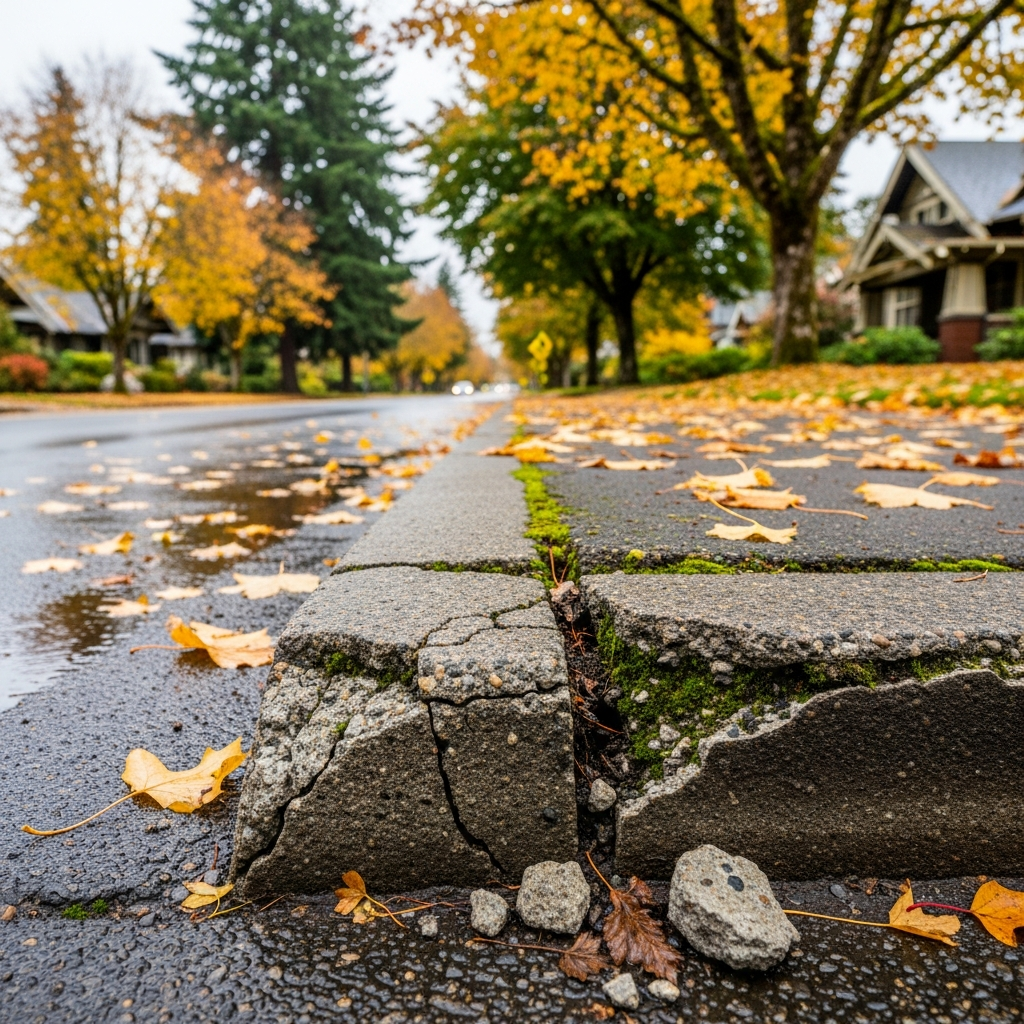
Driving through Salem, OR neighborhoods, you’ve probably noticed cracked, crumbling curbs along countless streets—unsightly damage that compromises both property values and safety. Whether it’s freeze-thaw cycles breaking down decades-old concrete or tree roots pushing up sidewalk sections, deteriorating curbs are more than cosmetic issues. They create tripping hazards, drainage problems, and potential ADA compliance violations that property owners can’t afford to ignore.
When we evaluate concrete curbing repair in Salem, OR, we’re looking at infrastructure that often dates back to the mid-20th century or earlier. Salem’s concrete sidewalks and curbs have been part of the city’s landscape since wooden walkways transitioned to concrete in the early 1900s. Today’s repair work must balance preserving this historical infrastructure with meeting modern safety standards and accessibility requirements.
Quick Answer: What You Need to Know About Curb Repair
Concrete curb repair in Salem, OR typically costs $8-$15 per linear foot for basic repairs and $20-$40 per linear foot for complete replacement. The process involves removing damaged sections, preparing the subgrade, and pouring new concrete that matches existing specifications. ADA-compliant curb cuts require specialized design and typically cost $1,200-$2,500 per ramp installation.
Key Takeaways:
- Freeze-thaw cycles are the primary cause of curb deterioration in Salem
- ADA compliance is mandatory for commercial properties and public spaces
- Repairs should use air-entrained concrete for improved durability
- City permits are required for work adjacent to public right-of-way
- Professional assessment prevents costly mistakes and ensures code compliance
Understanding Curb Damage Patterns in Salem
When our team evaluates curbing throughout Salem, OR—from the historic neighborhoods near the State Capitol to newer developments in South Salem—we consistently encounter similar damage patterns. Understanding these helps property owners recognize when repair becomes necessary and what methods will provide lasting solutions.
Climate-Related Deterioration
Oregon’s Willamette Valley experiences temperature fluctuations that cause freeze-thaw cycling—water penetrates concrete pores, freezes, expands, and gradually breaks down the material from within. According to the National Weather Service, Salem experiences an average of 25-35 freeze events annually, creating significant stress on concrete infrastructure.
We’ve found that older curbs constructed before modern air-entrainment specifications are particularly vulnerable. The 1939 Oregon State Highway Department specifications established baseline standards for curb construction, but they didn’t account for air entrainment—a critical feature that allows trapped water to expand into microscopic air bubbles rather than fracturing the concrete matrix.
Root Damage and Settlement Issues
Salem’s tree-lined streets add character but create infrastructure challenges. Mature trees near Commercial Street SE and in established neighborhoods like Grant and Bush’s Pasture Park frequently cause root heaving that lifts and cracks curbs. When evaluating these situations, we coordinate with the City of Salem Public Works Department to ensure any tree root management complies with urban forestry regulations.
Settlement issues occur when inadequate base preparation or erosion beneath the curb causes sections to sink or tilt. This creates drainage problems that accelerate further deterioration—standing water infiltrates joints and accelerates freeze-thaw damage.
Impact Damage and Surface Scaling
Commercial areas and high-traffic residential streets experience impact damage from vehicles, snow plows, and maintenance equipment. We frequently see chipped edges and spalled corners along Liberty Street and in parking areas near Keizer Station. Surface scaling—where the top layer flakes away—often results from using de-icing salts or improper finishing techniques during original installation.
Common Mistakes Property Owners Make
Over our years working throughout Salem, OR, we’ve seen property owners make several costly errors when approaching concrete curbing repair. Understanding these pitfalls helps ensure your project delivers lasting results rather than temporary patches.
Attempting Surface Patches on Structural Damage
The most common mistake is trying to patch cracks and spalls without addressing underlying structural issues. Surface coatings and thin repairs inevitably fail when the base has settled, roots continue pushing, or freeze-thaw cycles persist. When damage extends through more than one-third of the curb’s thickness or involves movement, complete section replacement becomes necessary.
We’ve repaired countless “patch over patch” scenarios where homeowners spent hundreds on temporary fixes that lasted only one or two winters. Professional evaluation determines whether patching or replacement provides better long-term value.
Ignoring Permit Requirements
Property owners frequently assume curb work doesn’t require permits, but the City of Salem requires permits for work adjacent to public right-of-way. This ensures proper grade, drainage, and accessibility standards are maintained. Unpermitted work can result in costly removal and replacement orders, plus fines that exceed the original permit fees.
Before we begin any curb repair project, we verify jurisdiction and secure necessary permits. Work in public right-of-way requires coordination with Salem Public Works, while private property curbs may still need building permits depending on scope and location.
Overlooking ADA Compliance
Commercial property owners sometimes repair curbs without ensuring ADA-compliant access points meet current standards. The Americans with Disabilities Act requires specific slopes, dimensions, and detectable warning surfaces for curb ramps. When we work on commercial properties or multi-family developments throughout zip codes 97301, 97302, and 97305, ADA compliance is non-negotiable.
The original 1939 specifications called for right-angled curbs of at least nine inches in height—a standard that directly conflicts with accessibility requirements. Modern repair work must balance preserving this traditional profile where appropriate while providing compliant accessible routes where required.
Best Practices for Durable Curb Repair
Professional concrete curbing repair in Salem, OR follows proven techniques that extend service life and prevent recurring problems. Our approach combines modern materials science with proper installation methods specific to Oregon’s climate conditions.
Material Selection and Mix Design
Due to Salem’s freeze-thaw cycles, we always specify air-entrained concrete with a minimum 5% air content. This creates microscopic air bubbles throughout the concrete that provide space for expanding ice without generating destructive internal pressures. This contrarian approach costs slightly more upfront but dramatically extends curb lifespan compared to standard mixes.
We use concrete with a minimum compressive strength of 4,000 PSI—higher than standard sidewalk specifications—because curbs endure vehicle impact, snow plow contact, and concentrated loads that sidewalks don’t experience. For properties requiring quick turnaround, we can discuss specialized concrete services that minimize curing time without compromising strength.
Proper Base Preparation
Before placing new concrete, we verify the subgrade provides adequate support and drainage. This typically involves removing damaged material at least 6 inches beyond visible cracks, compacting native soil or adding engineered fill, and installing a minimum 4-inch granular base layer.
In areas with clay soils common throughout the Willamette Valley, we add geotextile fabric to prevent soil migration into the base layer—a detail that prevents settlement issues that plague many repairs. When working near utility corridors, we coordinate with Portland General Electric and local utility providers to identify and protect underground infrastructure before excavation.
Control Joints and Isolation
Properly placed control joints allow concrete to crack in predetermined locations rather than randomly. We space joints at intervals no greater than 10 feet and align them with joints in adjacent concrete driveways or sidewalks to maintain a cohesive appearance.
Isolation joints separate the new curb from existing structures, allowing independent movement that prevents damage from differential settlement or thermal expansion. This detail is particularly important when repairing curbs adjacent to older infrastructure with different expansion characteristics.
Step-by-Step Curb Repair Process
Understanding the complete repair process helps property owners know what to expect and why each step matters for long-term performance. Here’s how we approach a typical curb repair project in Salem, OR.
Assessment and Planning
We begin with thorough site evaluation to identify damage extent, underlying causes, and any accessibility requirements. This includes checking for hidden damage beyond visible cracks, verifying property lines and right-of-way boundaries, and determining permit requirements. For commercial properties or work in public areas, we coordinate with city inspectors early to ensure compliance with all regulations.
During assessment, we also evaluate drainage patterns and identify whether water management improvements should accompany the repair. Poor drainage accelerates curb deterioration and often requires addressing simultaneously with structural repairs.
Removal and Excavation
Damaged sections are saw-cut to create clean edges that facilitate proper bonding with new concrete. We remove material to expose sound concrete and adequate base depth, typically excavating 8-12 inches below the finished curb height. Root barriers are installed when tree roots caused the original damage, preventing recurrence without harming established trees.
Excavation debris is hauled away, and the site is prepared for formwork installation. This stage also includes verifying that the finished grade will provide proper drainage away from buildings and toward street drainage systems.
Forming, Pouring, and Finishing
Forms are set to match existing curb profiles or updated specifications if ADA compliance requires modifications. We verify forms are properly braced, aligned, and at correct elevations before concrete placement begins. Air-entrained concrete is placed in a single pour when possible to minimize cold joints that create weak points.
Finishing includes consolidating concrete to eliminate voids, creating the specified surface texture for slip resistance, and cutting control joints at appropriate intervals. For properties interested in enhanced aesthetics, we can incorporate decorative stamped concrete techniques that add visual appeal while maintaining functionality.
Proper curing is critical—we apply curing compounds or moisture-retaining covers and restrict traffic for a minimum of seven days to allow concrete to achieve design strength before exposure to loads.
Cost Factors for Curb Repair Projects
Several variables influence the total investment required for concrete curb repair in Salem, OR. Understanding these factors helps property owners budget appropriately and make informed decisions about repair versus replacement options.
| Repair Type | Cost Range | Typical Applications |
|---|---|---|
| Surface Patching | $5-$10 per linear foot | Minor spalling, cosmetic cracks |
| Partial Depth Repair | $8-$15 per linear foot | Moderate damage, stable base |
| Full Replacement | $20-$40 per linear foot | Structural damage, settlement issues |
| ADA Curb Ramp | $1,200-$2,500 each | Accessibility compliance |
Project costs increase when tree root barriers are needed, when extensive base repair is required, or when matching specialty finishes on historic properties. Accessibility modifications for commercial properties typically represent the highest per-unit costs but are mandatory for compliance.
Permit fees in Salem typically range from $100-$300 depending on project scope, with additional costs for inspections on larger commercial projects. Property owners throughout the 97301, 97302, and 97304 areas should budget for these regulatory costs when planning curb repair or replacement work.
Frequently Asked Questions
How long does concrete curb repair last?
Properly executed curb repairs using air-entrained concrete and correct installation techniques typically last 20-30 years in Salem’s climate. Repairs that skip critical steps like adequate base preparation or proper curing may fail within 3-5 years. The key difference is using materials and methods appropriate for freeze-thaw exposure rather than taking shortcuts.
Can I repair curbs myself or should I hire professionals?
While minor cosmetic repairs might be suitable for experienced DIYers, structural repairs and any work in public right-of-way should be handled by licensed contractors. Professional work ensures proper base preparation, appropriate concrete mix specifications, ADA compliance where required, and proper permitting. The investment in professional installation prevents costly do-over scenarios and potential code violations.
What time of year is best for curb repair in Salem?
Late spring through early fall (May through September) provides optimal conditions for concrete work in Salem. Temperatures consistently above 50°F during the critical first week of curing ensure proper strength development. Winter repairs are possible using cold-weather concrete mixes and protection methods, but scheduling flexibility often makes warm-season work more practical and cost-effective.
Do I need a permit for curb repair in Salem?
Yes, permits are typically required for curb work adjacent to public right-of-way in Salem. Even work entirely on private property may require permits depending on scope and whether the repair affects drainage patterns. Consulting with the City of Salem Building Division before beginning work ensures compliance and prevents enforcement actions that could require removal and replacement of completed work.
How do I find qualified concrete contractors in Salem?
Look for contractors with specific curb and gutter experience, proper licensing and insurance, and familiarity with Salem’s permit processes. Companies like Salem Concrete, Berrien Concrete, and established firms with local project portfolios demonstrate the expertise needed for quality work. Requesting references from recent curb repair projects helps verify capabilities before making hiring decisions.
Taking Action on Your Curb Repair Project
Deteriorating concrete curbs compromise property values, create liability exposure, and worsen over time without intervention. Whether you’re managing a commercial property near downtown Salem or maintaining residential infrastructure in established neighborhoods, addressing curb damage promptly prevents minor problems from becoming major reconstruction projects.
The most important step is professional evaluation that identifies underlying causes rather than just visible symptoms. This assessment determines whether patching, partial repair, or complete replacement provides the best long-term value for your specific situation. Understanding permit requirements, ADA compliance obligations, and material specifications appropriate for Oregon’s climate ensures your investment delivers decades of reliable performance.
If you’re ready to address curbing issues on your Salem property, we invite you to contact our team for a detailed assessment and proposal. We’ll evaluate your specific situation, explain options ranging from targeted repairs to complete replacement, and provide transparent pricing that accounts for all necessary work including permitting and accessibility compliance.
Professional concrete curbing repair protects your property investment while ensuring safe, compliant infrastructure that serves your needs for decades. With proper materials, correct installation techniques, and attention to Salem’s specific climate challenges, curb repairs become long-term solutions rather than recurring expenses. Visit our main website to learn more about our comprehensive concrete services throughout the Salem area.
Sources and References
- Americans with Disabilities Act (ADA.gov) – Accessibility standards and curb ramp requirements
- National Weather Service – Salem, Oregon climate data and freeze event statistics
- City of Salem Public Works Department – Permit requirements and construction standards
- Oregon State Highway Department Historical Publications – 1939 sidewalk and curb construction specifications