
Last Updated: January 15, 2026
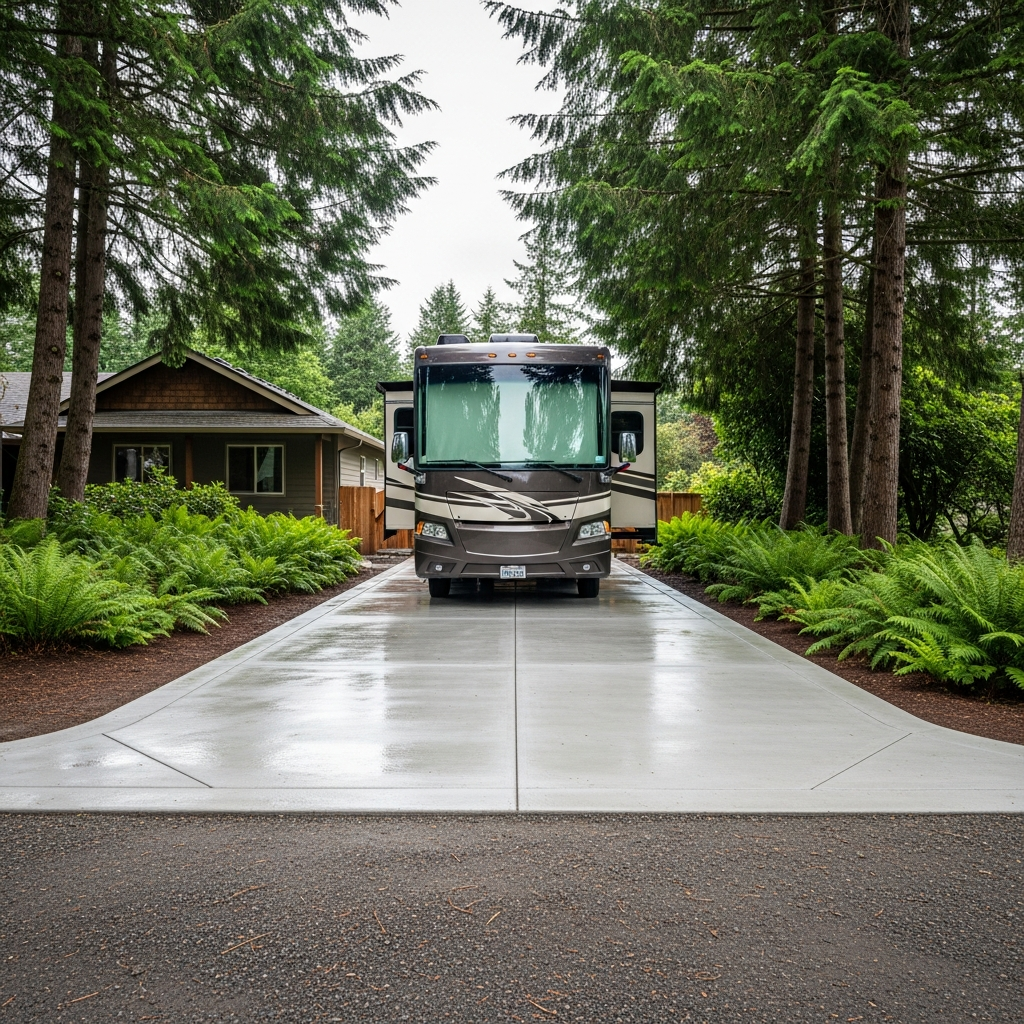
Are you tired of parking your RV on grass, watching it sink into mud every winter? Or maybe you need a stable surface for equipment storage that won’t crack under weight? A professionally installed concrete drive pad solves these problems permanently, but getting it right in Salem, OR requires understanding local soil conditions, permit requirements, and weather considerations that can make or break your investment.
Whether you’re adding space for recreational vehicles, creating equipment storage, or expanding parking capacity, a concrete drive pad represents a significant property improvement. Our team has installed countless drive pads throughout the Willamette Valley, and we’ve seen firsthand how local factors—from Salem’s clay-rich soil to seasonal rainfall patterns—impact installation success and long-term durability.
Quick Answer: What You Need to Know About Concrete Drive Pads
A concrete drive pad installation in Salem, OR typically costs $6-12 per square foot for a standard 4-6 inch thick pad with proper base preparation. Most installations require a City of Salem building permit, and the process takes 3-5 days from excavation to final cure. Professional installation ensures proper drainage, soil compaction, and reinforcement for Salem’s unique soil and climate conditions.
Key Takeaways:
- Standard RV pads measure 12×40 to 14×50 feet depending on vehicle size
- Salem requires 4-inch minimum thickness for vehicle loads; 6 inches for heavy equipment
- Proper base preparation prevents cracking from seasonal ground movement
- Permits typically required for pads exceeding 200 square feet
- Best installation window: April-October to avoid rain delays
Understanding Concrete Drive Pad Requirements in Salem, OR
Before breaking ground on your concrete driveway services project, understanding local requirements saves time and prevents costly mistakes. The City of Salem has specific regulations governing concrete pad installations, particularly for structures that support vehicle loads.
Permit Requirements and Building Codes
The City of Salem requires building permits for most concrete drive pad installations, particularly those exceeding 200 square feet or supporting structures. According to City of Salem regulations, permits ensure compliance with setback requirements, drainage standards, and structural specifications. When we submit permit applications for clients in neighborhoods like West Salem or South Gateway, we typically see approval within 5-7 business days.
Permit applications require site plans showing pad dimensions, property boundaries, setbacks from property lines, and drainage plans. The city pays particular attention to how runoff will be managed, especially in areas near creeks or drainage corridors. Professional contractors like Salem Concrete handle permit applications as part of the installation package, ensuring compliance with all local codes.
Salem’s Unique Soil and Climate Considerations
Salem’s clay-heavy soil presents specific challenges for concrete drive pad installation that differ significantly from neighboring areas. The Willamette Valley’s clay soils expand when wet and contract during dry summers, creating ground movement that can crack improperly installed concrete. When our teams work in areas like South Salem near Commercial Street SE or in the Hayesville neighborhood, we always specify deeper excavation and thicker aggregate base layers to compensate for this movement.
A contrarian insight from our years working in Marion County: many contractors underestimate base preparation in Salem’s clay soil. While standard specifications call for 4 inches of compacted aggregate, we’ve found that 6-8 inches performs dramatically better long-term. The extra cost—typically $1-2 per square foot—pays for itself by preventing the crack repairs we see on thinner bases after just 3-4 years. This is especially critical in areas with poor drainage or high water tables common in low-lying sections near the Willamette River.
Utility Coordination and Site Preparation
Before any excavation begins, we coordinate with Portland General Electric and Northwest Natural Gas to mark underground utility lines. This critical step prevents service disruptions and ensures worker safety. In established neighborhoods throughout the 97301, 97302, and 97305 zip codes, underground utilities can be surprisingly close to the surface, making professional marking essential.
Common Mistakes That Compromise Drive Pad Installations
We regularly repair failed drive pads throughout Salem, and the problems almost always trace back to a handful of preventable mistakes. Understanding these issues helps homeowners avoid contractors who cut corners and ensures their investment lasts decades rather than years.
Inadequate Base Preparation and Compaction
The most common failure we see involves insufficient base preparation. Some contractors skip proper excavation, pouring concrete directly over disturbed soil or inadequate aggregate. In Salem’s expansive clay soils, this guarantees problems. Proper installation requires removing 10-12 inches of soil, installing geotextile fabric to prevent base migration, adding 6-8 inches of ¾-inch crushed aggregate, and compacting in 2-inch lifts with a plate compactor or roller.
When examining failed pads in areas like North Lancaster or near Keizer border neighborhoods, we consistently find base aggregate that was never properly compacted. Visual inspection shows voids beneath cracked sections where the base material settled over time. Professional installation includes compaction testing to verify 95% or better compaction—a step that adds minimal cost but prevents expensive failures.
Insufficient Concrete Thickness and Reinforcement
Another frequent mistake involves using residential driveway specifications (4 inches) for pads that will support RVs or heavy equipment. While 4 inches suffices for passenger vehicles, RVs and equipment require 6-inch minimum thickness with proper steel reinforcement. We specify #4 rebar on 18-inch centers both directions, or welded wire mesh as a minimum, creating a reinforced pad that distributes loads and resists cracking.
Some homeowners attempt DIY installations using inadequate concrete mixes. Professional installations use 4,000 PSI concrete minimum with air entrainment, which is critical for Salem’s freeze-thaw cycles. The air entrainment creates microscopic bubbles that accommodate ice expansion, preventing surface scaling and cracking that occurs with standard mixes.
Poor Drainage Planning
Drainage failures cause more problems than any other factor in Salem’s rainy climate. Drive pads must slope away from buildings at minimum 1/8 inch per foot, and surface water needs clear paths to storm drains or drainage swales. When we work near Bush’s Pasture Park or in the Grant neighborhood, we’re particularly careful about drainage design because these areas already have seasonal water issues.
Best Practices for Concrete Drive Pad Installation
Professional concrete drive pad installation in Salem, OR follows proven methods that ensure longevity and performance. These practices reflect both industry standards and local adaptations for our specific soil and climate conditions.
Proper Site Layout and Excavation
Installation begins with precise layout using stakes and string lines to establish pad dimensions, elevations, and slopes. We extend excavation 12 inches beyond the final pad dimensions to accommodate formwork and edge compaction. Excavation depth depends on existing grade but typically reaches 10-14 inches below finished surface elevation to accommodate base aggregate and concrete thickness.
The excavated subgrade receives compaction before aggregate placement, creating a stable foundation. In areas with particularly poor soil—common near Mission Street SE or in low areas of Morningside—we sometimes remove additional soil and increase aggregate depth, or install geogrid reinforcement for extra stability.
Base Installation and Compaction Process
After subgrade preparation, we install geotextile fabric that separates soil from aggregate and prevents base migration. The ¾-inch crushed aggregate goes down in 2-inch lifts, with each lift receiving multiple passes from a vibratory plate compactor or roller. This methodical approach achieves proper compaction throughout the base depth, not just at the surface.
The finished base surface receives final grading to establish proper slopes for drainage. Laser levels or string lines verify grades before concrete placement begins. This attention to base preparation distinguishes professional installations from quick, cheap jobs that fail within years.
Concrete Placement and Finishing
Professional concrete drive pad installation uses 4,000-4,500 PSI concrete with air entrainment and fiber reinforcement. Steel reinforcement—either rebar grid or welded wire mesh—sits on chairs that maintain proper placement within the concrete thickness. For projects requiring extensive services, we coordinate concrete delivery timing to ensure continuous placement without cold joints.
Concrete receives initial screeding for level, followed by bull floating to smooth the surface and consolidate aggregate. For drive pads, we finish with a broom texture that provides traction in wet weather—critical for Salem’s rainy climate. Control joints cut to 1/4 the slab depth at 10-12 foot intervals control crack location, channeling any shrinkage cracks to planned joint locations rather than random positions.
Step-by-Step Installation Process
Understanding the complete installation process helps homeowners appreciate the work involved and recognize professional execution. Here’s how we approach every concrete drive pad installation throughout the Salem area.
Day 1: Site Preparation and Base Work
The first day involves layout, utility marking verification, and excavation. We mark pad boundaries with stakes and paint, then excavate to required depth using a skid steer or mini excavator. Excavated soil either spreads on-site if the homeowner wants fill material, or loads into trucks for disposal. The excavation process typically takes 3-4 hours for a standard 12×40 foot RV pad.
After excavation, we compact the subgrade and install geotextile fabric. Aggregate delivery arrives, and we spread and compact the base material in systematic lifts. A standard 6-inch compacted base requires approximately 7-8 cubic yards of aggregate for a 12×40 pad. Base installation and compaction typically consumes the remainder of day one.
Day 2: Forms, Reinforcement, and Concrete Placement
Day two begins with formwork installation using 2×6 or 2×8 lumber secured with stakes. Forms establish final pad elevation and edges, and receive careful leveling to ensure proper slopes. Steel reinforcement installation follows, with rebar tied at intersections and supported on chairs to maintain position during concrete placement.
Concrete delivery typically schedules for mid-morning, allowing time for final preparations. A standard 12×40 foot pad at 6 inches thick requires approximately 9 cubic yards of concrete. The placement process takes 2-3 hours including screeding, floating, and finishing. We cut control joints after initial set—typically 4-6 hours after placement depending on weather conditions. For design options including decorative finishes, our stamped concrete driveway cost Salem, OR page provides detailed information.
Days 3-7: Curing and Form Removal
Proper curing proves critical for concrete strength and durability. We apply curing compound immediately after finishing, creating a membrane that retains moisture for proper cement hydration. In Salem’s summer weather, we sometimes supplement with plastic sheeting or periodic water spraying to maintain surface moisture.
Forms remain in place for minimum 24 hours, typically removing on day three. The pad reaches sufficient strength for foot traffic after 3-4 days and vehicle loads after 7 days, though full strength development continues for 28 days. We recommend waiting 10-14 days before parking heavy RVs or equipment to ensure adequate strength development.
Cost Factors for Salem Concrete Drive Pads
Understanding concrete drive pad installation costs helps homeowners budget appropriately and compare contractor quotes accurately. Multiple factors influence final pricing beyond simple square footage calculations.
| Cost Factor | Price Range | Notes |
|---|---|---|
| Standard 4″ pad | $6-8 per sq ft | Passenger vehicles only |
| Heavy-duty 6″ pad | $9-12 per sq ft | RVs, heavy equipment |
| Excavation/hauling | $1-2 per sq ft | Site-dependent |
| Base preparation | $2-3 per sq ft | Aggregate and compaction |
| Permits and fees | $200-500 | Fixed cost |
Site accessibility significantly impacts costs. Properties with good access for concrete trucks and equipment cost less than those requiring pumping or wheelbarrow placement. Slopes, existing landscaping removal, and drainage complications add expenses. When we provide estimates for projects in established neighborhoods, site conditions often vary costs by 20-30% even for identical pad sizes.
Seasonal timing affects availability and sometimes pricing. Spring and fall represent peak seasons when contractor schedules fill quickly. Winter installations face weather delays but sometimes offer better scheduling flexibility. Summer provides ideal curing conditions and fastest completion times.
Frequently Asked Questions
How long does a concrete drive pad last in Salem?
Properly installed concrete drive pads in Salem, OR typically last 30-50 years with minimal maintenance. Lifespan depends on base preparation quality, concrete thickness, reinforcement, and drainage. Regular sealing every 3-5 years extends life by protecting against moisture penetration and surface scaling. Similar to our concrete patio services, proper installation and maintenance are key to longevity.
What’s the best time of year for installation in Salem?
April through October offers the best installation window for concrete drive pads in Salem. Summer months provide warmest temperatures and fastest curing, though extreme heat requires extra curing attention. Spring and fall offer moderate conditions ideal for concrete placement. Winter installations are possible but face rain delays and slower strength development. We schedule most projects for May-September when weather reliability is highest.
Do I need a permit for a concrete RV pad?
Most concrete drive pad installations in Salem require building permits, particularly pads exceeding 200 square feet. Standard RV pads typically measure 480-700 square feet, well above the threshold. Permits ensure compliance with setback requirements, drainage standards, and structural codes. Professional contractors handle permit applications and inspection scheduling as part of their service.
Can I pour a drive pad myself to save money?
While DIY concrete work is technically possible, drive pads require equipment, expertise, and physical labor that challenge most homeowners. Proper excavation needs machinery, base compaction requires specialized equipment, and concrete placement demands speed and skill. Mistakes prove expensive to repair and compromise longevity. Most homeowners find professional installation delivers better value when considering time, equipment rental, materials, and quality assurance.
What thickness do I need for an RV pad?
RV pads require minimum 6-inch concrete thickness with steel reinforcement. Class A motorhomes and large fifth-wheels exceed passenger vehicle weights, demanding heavier construction. The combination of 6-inch thickness, proper rebar grid (typically #4 bars at 18-inch spacing), and adequate base preparation handles these loads without cracking or settling. Lighter travel trailers can sometimes use 5-inch thickness, but 6 inches provides better long-term performance.
Conclusion: Investing in Quality Drive Pad Installation
A concrete drive pad installation in Salem, OR represents a significant property improvement that delivers decades of service when properly executed. The key to success lies in understanding local conditions—from Salem’s expansive clay soils to seasonal rainfall patterns—and implementing installation practices that address these challenges. Proper base preparation, adequate concrete thickness, steel reinforcement, and attention to drainage separate professional installations from problematic shortcuts.
Whether you’re creating space for RV parking, equipment storage, or additional vehicle capacity, working with experienced local contractors ensures your investment performs as expected. Professional installation includes proper permitting, coordinated utility marking, systematic base preparation, and quality concrete placement that meets or exceeds code requirements. The result is a durable, functional surface that serves your property for decades while requiring minimal maintenance.
For homeowners throughout the Salem area—from West Salem to South Gateway, from Hayesville to neighborhoods near Bush’s Pasture Park—quality drive pad installation begins with understanding what proper execution entails and selecting contractors with proven local experience. The difference between a pad that lasts 5 years and one that serves for 50 years comes down to installation details that only experience and commitment to quality can deliver.
Sources and References
This article draws on industry best practices, local building codes, and field experience from concrete installations throughout Salem, OR and Marion County. For additional information on concrete installation standards and requirements:
- City of Salem building and permit requirements: cityofsalem.net
- American Concrete Institute standards and guidelines: concrete.org
- Portland Cement Association technical resources: cement.org
Financial Disclaimer: Cost estimates provided represent typical ranges for Salem, OR area installations as of January 2026. Actual costs vary based on site conditions, access, soil type, local material prices, and project specifications. Obtain detailed written estimates from licensed contractors for accurate project pricing.