
Last Updated: January 4, 2026
Are you tired of replacing rotted wooden fence posts every few years? Many Salem, OR homeowners discover too late that Oregon’s wet winters and freeze-thaw cycles destroy traditional wood posts faster than anywhere else in the Pacific Northwest. The constant moisture penetration, combined with our unique soil composition, creates the perfect storm for fence failure—often within just five to seven years.
Concrete fence posts offer a permanent solution to this persistent problem. When professionally installed with proper techniques for Salem’s specific climate conditions, concrete posts can last 50+ years without the rot, warping, or pest damage that plague wooden alternatives. Whether you’re planning a new fence installation or replacing failing posts in historic neighborhoods like Fairmount Hill or Grant, understanding the local requirements and best practices is essential for long-term success.
Quick Answer: What You Need to Know About Concrete Fence Posts
Concrete fence post installation in Salem, OR typically costs $45-$85 per post including materials and labor. Professional installation ensures posts meet local building codes, withstand Oregon’s wet climate, and provide 50+ years of maintenance-free service. The process involves proper depth calculations (minimum 36 inches in Salem’s soil), concrete mix selection for freeze resistance, and compliance with historic district regulations where applicable.
Key Takeaways:
- Concrete posts last 5-7 times longer than treated wood in Oregon’s climate
- Properties in Salem’s historic districts require special approval and design specifications
- Professional installation prevents common failures like frost heaving and inadequate depth
- Initial costs are 40-60% higher than wood but eliminate replacement cycles
- Portland cement concrete with air entrainment resists freeze-thaw damage
Understanding Concrete Fence Posts in Oregon’s Climate
Concrete fence posts were originally developed in the early twentieth century as farmers sought alternatives to wooden posts that failed rapidly in agricultural settings. Today’s concrete posts represent significant technological advancement, but their performance in Salem, OR depends heavily on proper installation techniques that account for our specific environmental challenges.
Our team at Salem Concrete works throughout Marion County addressing the unique factors that affect concrete fence post longevity. The Willamette Valley’s clay-heavy soil, combined with annual rainfall exceeding 40 inches, creates conditions that differ dramatically from drier regions of Oregon. Posts must be engineered not just for strength, but for moisture management and thermal cycling.
Why Concrete Outperforms Wood in Salem
The wet season in Salem typically runs from October through May, delivering consistent moisture that penetrates even pressure-treated lumber. When we install fences near neighborhoods like West Salem or South Gateway, we frequently remove rotted wooden posts that homeowners installed less than a decade ago. The rot pattern is predictable: it begins at the soil line where moisture concentrates, then spreads upward and downward as fungal growth accelerates.
Concrete posts eliminate this vulnerability entirely. They’re impervious to moisture, immune to insect damage, and won’t warp during our summer heat. The material’s density also provides superior strength for supporting chain-link, vinyl, or wooden fence panels—particularly important when winter winds sweep through the valley.
Local Soil Considerations
Salem’s predominant soil types—Willamette silt loam and Woodburn silt loam—present specific challenges for fence post installation. These soils have high clay content that expands when wet and contracts during dry periods. This movement, combined with freeze-thaw cycles during winter cold snaps, can cause frost heaving that pushes inadequately installed posts out of alignment.
Professional concrete fence post installation in Salem, OR addresses this through proper depth specification. According to Oregon building codes, posts must extend below the frost line, which varies by location but generally requires 36-inch minimum depth in the Salem area. We typically excavate to 42 inches for posts supporting heavy gates or in areas with known soil instability.
Common Mistakes That Lead to Fence Failure
Even with superior materials like concrete, improper installation techniques guarantee premature failure. When our team evaluates failing fences throughout Salem—from the tree-lined streets of Fairmount Hill to newer developments near Keizer—we see the same preventable errors repeated consistently.
Inadequate Post Depth and Diameter
The most common mistake is insufficient hole depth. Many DIY installers use the standard “one-third rule” (one-third of post height underground), which may work in stable, dry soils but fails in Salem’s conditions. Clay soils with high moisture content exert tremendous lateral forces during freeze-thaw cycles. A six-foot fence with posts set only 24 inches deep will develop lean within two to three years as the soil shifts.
Equally problematic is using undersized post holes. The concrete collar surrounding the post—not the post itself—provides stability. We excavate holes at least 10-12 inches in diameter for standard fence posts, creating a substantial concrete mass that resists soil movement. This contrarian approach differs from minimum code requirements but reflects decades of experience in Marion County’s specific conditions.
Wrong Concrete Mix Selection
Not all concrete performs equally in Oregon’s climate. Standard concrete mixes without air entrainment will develop surface scaling and internal cracking after repeated freeze-thaw cycles. When water penetrates the concrete, freezes, and expands, the internal pressure creates progressive damage that weakens the post anchoring.
We specify air-entrained concrete with 5-7% air content by volume for all fence post installations. These microscopic air bubbles provide expansion space for freezing water, preventing the hydraulic pressure that causes cracking. This specification aligns with Portland Cement Association recommendations for freeze-thaw regions and adds minimal cost while dramatically extending service life.
Ignoring Historic District Requirements
Salem’s designated historic districts—including portions of Court-Chemeketa, Fairmount Hill, and Grant neighborhoods—impose additional regulations on exterior modifications. The Salem Historical Commission reviews fence applications to ensure compatibility with the historical character of these areas. Properties in zip codes 97301 and 97302 often fall within these regulated zones.
Installing concrete posts without commission approval can result in removal orders and fines. The commission specifies requirements for post spacing, dimensions, and visible appearance. Recent commission records show approved projects with posts spaced 8 feet apart, 12 inches wide, and designed to complement historical architecture. Homeowners must submit detailed specifications before beginning work.
Professional Installation Process and Best Practices
Successful concrete fence post installation requires systematic execution of multiple steps, each critical to long-term performance. Our approach to concrete services in Salem incorporates lessons learned from hundreds of local installations across diverse soil conditions and fence styles.
Site Assessment and Utility Coordination
Before any excavation begins, we coordinate with Portland General Electric and NW Natural to mark underground utilities. Oregon law requires 48-hour notice to utility companies before digging, and Salem’s aging infrastructure means unexpected utility lines exist throughout established neighborhoods. A fence line that appears clear may conceal buried electrical service to detached garages or gas lines installed decades ago.
We also evaluate soil drainage patterns and existing grade. Properties near Mill Creek or Pringle Creek may have elevated water tables that require modified installation techniques. In these situations, we incorporate drainage aggregate around posts to prevent water accumulation that can undermine stability during winter saturation.
Excavation and Post Setting Techniques
We excavate post holes using power augers calibrated for Salem’s clay soils, which can bind and overload undersized equipment. The hole bottom receives 4-6 inches of crushed gravel for drainage and frost protection. This base layer prevents water accumulation at the post bottom while providing a stable foundation that resists frost heaving.
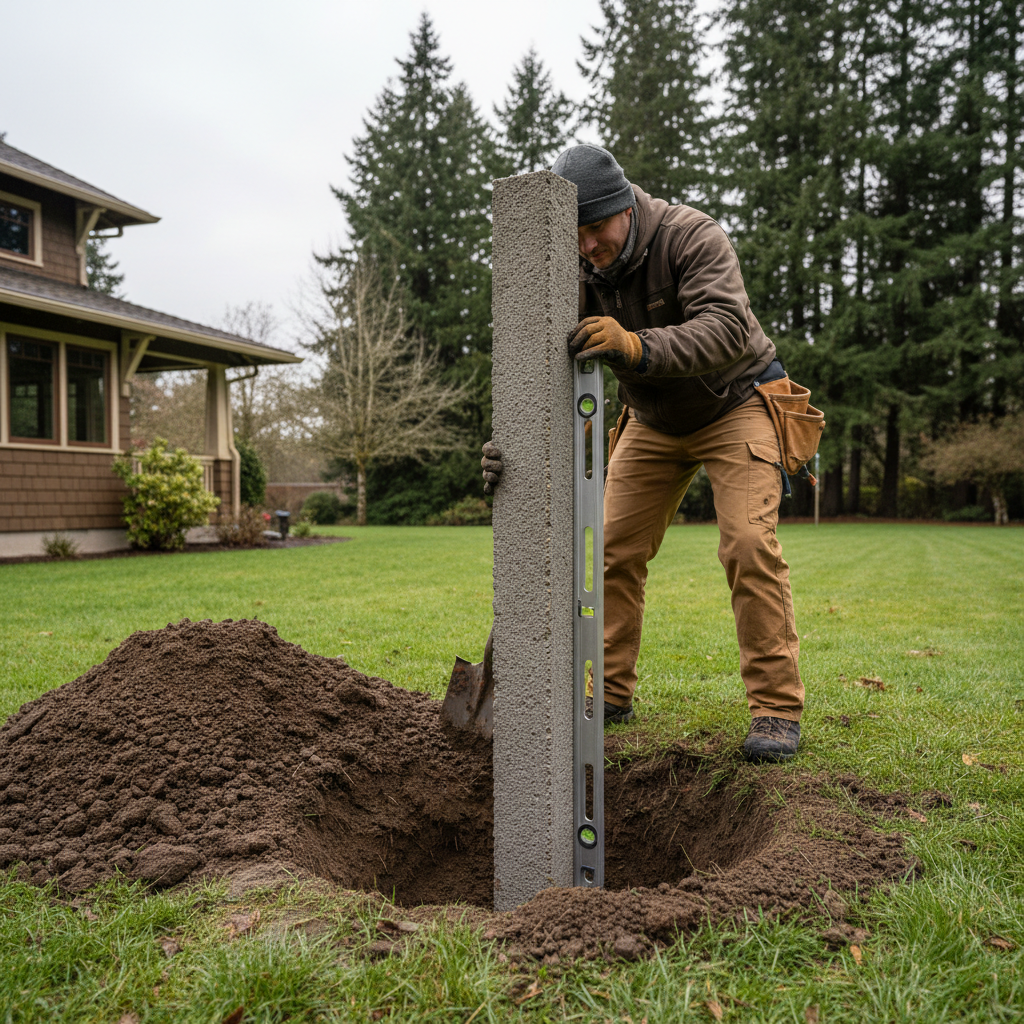
Post alignment requires precision—even slight variations from vertical create cumulative lean over the fence length. We use laser levels and multiple checking points during concrete placement, making adjustments before initial set begins. The concrete mix is placed in lifts, consolidated with vibration to eliminate voids, and crowned above grade to shed water away from the post base.
Curing and Load Timing
Concrete reaches approximately 70% of design strength in seven days under normal conditions, but Salem’s cool, wet weather during much of the year slows this process. We protect fresh concrete from rain during the critical first 24 hours and delay fence panel installation for a minimum of 72 hours—longer during winter months when temperatures remain below 50°F.
Premature loading is a common cause of post settlement and misalignment. Homeowners eager to complete projects sometimes attach panels or gates before concrete reaches adequate strength, creating micro-movements that compound into visible problems over time. Patience during curing prevents years of regret.
Cost Factors and Investment Analysis
Understanding the complete cost picture for concrete fence post installation helps homeowners make informed decisions. While initial expenses exceed wood alternatives, the lifecycle analysis reveals concrete’s superior value proposition, particularly in Oregon’s demanding climate.
| Cost Component | Typical Range (Salem, OR) | Notes |
|---|---|---|
| Materials (post, concrete, gravel) | $18-$35 per post | Varies by post size and style |
| Labor (excavation, setting, finishing) | $27-$50 per post | Higher in historic districts |
| Utility location and permits | $150-$300 project total | One-time costs |
| Historical commission review | $0-$200 | If applicable |
A typical 150-foot residential fence requires approximately 20 posts at 8-foot spacing. At $45-$85 per post, the concrete post component totals $900-$1,700. Comparable pressure-treated wood posts cost $25-$40 each installed ($500-$800 total), representing 40-60% savings initially.
However, wood posts in Salem’s climate require replacement every 7-12 years. Over a 50-year ownership period, homeowners replace wooden posts 4-6 times, incurring $2,000-$4,800 in future costs. Concrete posts installed once last the entire period, delivering $1,100-$3,100 in net savings while eliminating the disruption and hassle of multiple replacements.
We serve homeowners throughout the greater Salem area, including zip codes 97301, 97302, and 97304, with transparent pricing and detailed project estimates. Similar to our concrete patio services, fence post installation includes comprehensive site assessment and material recommendations tailored to each property’s specific conditions.
Frequently Asked Questions
How long does concrete fence post installation take?
A typical residential fence with 15-25 posts requires 1-2 days for excavation and setting, plus 3-7 days curing time before panels can be installed. Historic district projects may extend timelines due to approval processes. Weather conditions significantly impact scheduling—we avoid installations during heavy rain or freezing temperatures.
Can I attach wood fence panels to concrete posts?
Yes, concrete posts accommodate all fence panel types including wood, vinyl, chain-link, and metal. Posts include mounting brackets or can be drilled for custom attachment hardware. The combination of concrete posts with wood panels provides optimal durability—the posts last indefinitely while panels can be replaced independently as needed.
Do concrete posts work for sloped properties?
Concrete posts excel on sloped terrain, providing superior stability compared to wood. Installation requires careful calculation of varying post heights and depths to maintain consistent fence line appearance. Stepped or racked panel configurations both work well with concrete post systems. Salem’s hilly neighborhoods benefit particularly from concrete’s resistance to soil movement on slopes.
What maintenance do concrete fence posts require?
Properly installed concrete posts require virtually no maintenance. Occasional washing removes dirt and organic staining. Unlike wood, concrete doesn’t need sealing, staining, or pest treatment. Annual inspection of mounting hardware ensures panels remain secure, but the posts themselves should show no deterioration for decades.
Are permits required for fence installation in Salem?
Salem’s building code generally requires permits for fences exceeding six feet in height or located in designated historic districts. Properties on corner lots face additional setback requirements for sight lines. Even when permits aren’t legally required, contacting the City of Salem planning department prevents conflicts with zoning regulations and easements.
Making the Right Choice for Your Property
Concrete fence post installation represents a significant upgrade in fence durability and longevity, particularly in Salem’s challenging climate. The initial investment exceeds wooden alternatives, but the elimination of rot, warping, and pest damage delivers decades of maintenance-free performance that wood simply cannot match.
Success depends on proper installation that accounts for local soil conditions, climate patterns, and regulatory requirements. Professional contractors understand the nuances of Marion County’s clay soils, the importance of freeze-thaw resistant concrete mixes, and the documentation required for historic district approvals. These factors separate installations that perform flawlessly for generations from those that fail within years.
Whether you’re planning a new fence for a property in West Salem, replacing failing posts in the Grant neighborhood, or adding security fencing to a commercial property near Lancaster Drive, concrete posts provide the foundation for long-term success. The material’s imperviousness to Oregon’s wet winters and resistance to the soil movement that plagues our region makes it the superior choice for homeowners prioritizing durability over initial cost savings.
For professional concrete fence post installation in Salem, OR, contact us for a detailed site assessment and project estimate. Our team brings extensive experience with local soil conditions, building codes, and installation techniques that ensure your fence posts perform flawlessly for decades to come.
Sources and References
- Oregon.gov – Oregon Building Codes and Standards
- Portland Cement Association – Concrete Durability in Freeze-Thaw Conditions
- City of Salem Planning Department – Historic District Guidelines
- Salem Historical Commission – Fence Application Requirements