
Last Updated: January 12, 2026
When your construction project in Salem, OR demands professional-grade concrete forms, the clock is already ticking. Whether you’re pouring foundation walls, curved architectural features, or commercial slabs, the right forming system can mean the difference between a smooth pour and costly delays. For contractors across Marion County, accessing quality concrete forms rental in Salem, OR has evolved from fragmented local networks to organized exchanges and regional suppliers serving the Mid-Willamette Valley.
The demand for formwork rentals in our region reflects Salem’s continued growth, from residential developments near South Salem to commercial projects along Lancaster Drive. Understanding your rental options, from lightweight aluminum systems to heavy-duty steel forms, positions your team for success in concrete construction projects of any scale.
Quick Answer: Concrete Forms Rental Options in Salem, OR
Salem contractors access concrete forms through regional suppliers like Masons Supply Company (MASCO), which operates facilities in Portland, Woodinville, and Ridgefield serving the Northwest, including Oregon. These providers offer wall systems (straight, round, curved), slab forms, and specialized structures available for rental or purchase with on-site assembly options.
Key Takeaways:
- Regional suppliers maintain Northwest’s largest inventories for concrete forming systems
- Rental options include aluminum and steel systems for walls, slabs, and architectural features
- Salem Contractors Exchange connects local firms with equipment networks established since 1949
- Most rentals accommodate job-assembled systems customized to project specifications
- Coordination with local suppliers reduces mobilization costs compared to distant metropolitan sources
Understanding Concrete Formwork Systems Available for Rent
Before committing to concrete forms rental in Salem, OR, contractors must match formwork types to project demands. Modern forming systems have evolved significantly from the early steel innovations pioneered by companies like Metal Forms Corporation in 1909, which produced Thomas Edison’s monolithic concrete homes.
Today’s rental inventory spans multiple categories, each engineered for specific applications. Understanding these distinctions prevents costly mismatches between equipment and job requirements.
Wall Form Systems
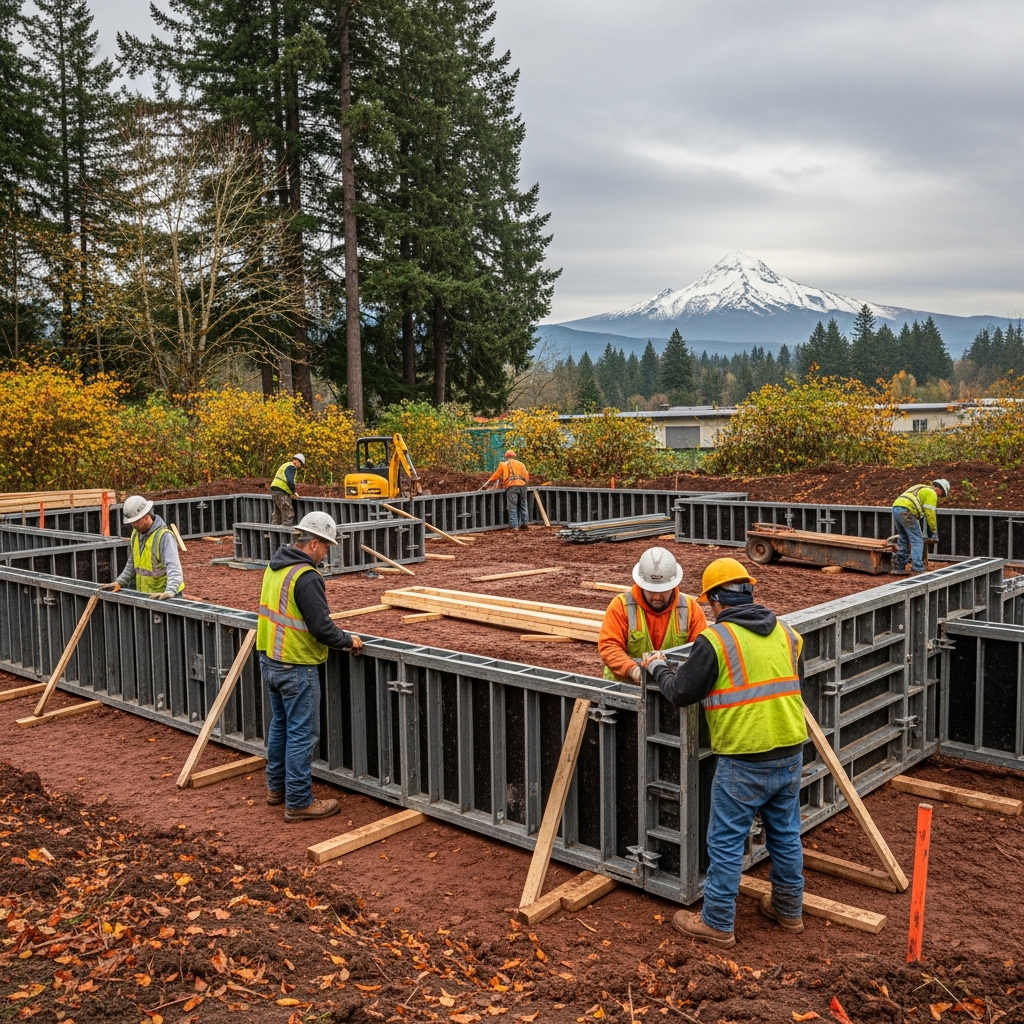
Wall forming systems represent the most commonly rented category for Salem projects. These modular panels come in aluminum or steel configurations, with aluminum systems offering lighter weight for manual handling on residential jobs, while steel systems withstand repeated use on large commercial pours. MASCO’s rental inventory includes straight wall panels in standard widths, plus specialized curved and radius forms for architectural features increasingly popular in Salem’s downtown redevelopment projects.
We’ve found that Oregon’s climate demands attention to form coating conditions. Unlike drier regions, the Willamette Valley’s moisture requires checking release agent application more frequently—forms stored outdoors near locations like the intersection of Commercial Street SE and Mission Street SE may need additional preparation before deployment.
Slab and Deck Forms
For elevated slab work and concrete patio applications, rental suppliers provide shoring systems with adjustable heights and load capacities. These systems accommodate varying story heights common in Salem’s mixed-use developments, particularly in the growing South Commercial area. According to NIST construction safety standards, proper shoring calculations prevent catastrophic failures during concrete placement.
Specialized and Custom Forms
Architectural concrete demands specialized rentals: radius forms for columns, void forms for utilities, and custom configurations. Metal Forms Corporation’s innovations including their Poly Meta Forms®—lightweight polymer systems introduced in 2000—now appear in regional rental fleets. These prove particularly valuable for projects requiring frequent repositioning, such as the precast barrier work that MFC expanded into by 2018.
Common Mistakes When Renting Concrete Forms
Contractors new to formwork rentals in the Salem market often encounter predictable pitfalls. Learning from established firms prevents expensive setbacks.
Underestimating Lead Time and Availability
Salem’s construction season peaks create equipment shortages. We’ve observed that May through September demand frequently exhausts local inventories, forcing contractors to source from Portland suppliers 45 miles north. Scott Erickson, whose Viesko Quality Concrete built a thriving Salem paving business through the Salem Contractors Exchange in the 1980s, emphasizes relationship-building with suppliers during slower months to secure priority access during peak season.
Reserve forms at least two weeks ahead for standard projects, four weeks for specialized systems. This timeline accounts for transportation from regional hubs and allows inspection before deployment.
Ignoring Local Soil and Foundation Conditions
Marion County’s varied soils—from alluvial deposits near the Willamette River to clay-heavy areas in West Salem—affect form stability. Inadequate bracing calculations lead to blowouts during placement. When working in neighborhoods like South Gateway (zip code 97302) or Near South (97306), our teams coordinate with Portland General Electric to identify underground utilities that influence footing excavations and form placement strategies.
Overlooking Rental Terms and Damage Policies
Rental agreements specify daily or weekly rates, but hidden costs emerge from damage deposits, cleaning requirements, and late return penalties. Forms returned with concrete residue trigger cleaning fees averaging $50-$150 per panel. Read contracts carefully, documenting pre-existing damage with photos before leaving the supplier’s yard.
Best Practices for Securing Formwork Rentals in Salem
Successful contractors approach form rentals with systematic planning that balances cost control against schedule demands.
Leverage Local Construction Networks
The Salem Contractors Exchange, established August 25, 1949 at its permanent site on 2256 Judson Street SE, connects project owners, general contractors, and trade subcontractors. This 75-year-old organization evolved from manual plan distribution and card tracking to digital bidding platforms, but its core purpose remains unchanged: facilitating connections that help firms like Rich Duncan Construction—who famously “lived at the exchange” during his startup days—access equipment and expertise.
Membership provides access to contractors who’ve navigated local concrete services for decades, sharing insights on reliable rental sources and equipment performance under Oregon conditions.
Match Forms to Project Duration and Complexity
For concrete driveway work and single-pour residential jobs, simpler form systems minimize rental costs. Multi-pour commercial projects justify investing in modular systems with maximum reusability. Calculate break-even points: if rental costs exceed 60% of purchase price over the project timeline, consider buying.
Coordinate with Ready-Mix Suppliers and Inspectors
Form design directly impacts concrete placement logistics. Coordinate rental specifications with your ready-mix supplier—Salem’s plants adjust mix designs based on form dimensions and placement methods. Additionally, City of Salem building inspectors require form inspections before concrete placement for structural work, particularly in zip codes 97301, 97302, and 97306 where commercial development concentrates. Schedule inspections before rental periods begin to avoid paying for idle equipment.
Step-by-Step Guide to Renting Concrete Forms
Follow this systematic approach when securing formwork for Salem projects.
Step 1: Calculate Form Requirements
Measure total square footage of forming surfaces, accounting for waste factors (typically 10-15% for complex layouts). Identify special conditions: curves, corners, varying heights, or architectural features. Create detailed takeoffs showing panel quantities by size, plus accessories like walers, ties, and bracing.
Step 2: Contact Regional Suppliers
Reach out to suppliers serving Salem at least three weeks before needed on-site dates. MASCO, with facilities across the Northwest including Portland, maintains one of the region’s largest concrete forming inventories. Request quotes specifying rental duration, delivery requirements, and insurance coverage. Ask about package deals that bundle forms with accessories at reduced rates.
Step 3: Inspect Equipment Before Delivery
When possible, inspect forms at the supplier’s yard before delivery to your Salem jobsite. Check for bent panels, damaged hardware, and missing components. Document conditions with dated photos—this protects against disputed damage charges at return. Verify quantities match your order and rental agreement.
Step 4: Plan Staging and Assembly
Designate staging areas on-site with level ground and equipment access. Forms delivered on flatbed trucks require unloading equipment—coordinate with your supplier whether they provide this service or if your crew handles it. According to OSHA formwork safety standards, proper stacking prevents injuries and equipment damage during storage between pours.
Step 5: Execute Pour and Return Process
After concrete cures and forms strip cleanly, clean all panels before return. Power washers remove concrete residue without damaging coatings—most Salem tool rental outlets carry appropriate equipment. Schedule return pickup to minimize rental days, remembering that suppliers charge by calendar days, not usage days.
Regional Rental Sources and Networks
Salem contractors benefit from proximity to Portland’s construction supply infrastructure while leveraging local connections.
| Supplier Type | Service Area | Typical Inventory |
|---|---|---|
| Regional suppliers (MASCO) | Northwest multi-state | Wall systems, slab forms, shoring |
| Local contractors via SCE | Marion County focus | Variable specialty items |
| Portland metro suppliers | 45-mile radius | Comprehensive systems |
Willamette Graystone, which expanded into concrete forms by 1958 after founding as Willamette Concrete Products in 1946, exemplifies regional companies that grew through strategic acquisitions in 1966 and 1968, eventually acquiring expanded facilities by 1978. These established firms maintain long-term relationships with contractors throughout the Mid-Willamette Valley.
Frequently Asked Questions About Concrete Forms Rental
How much does concrete form rental typically cost in Salem, OR?
Rental rates vary by system type and duration. Aluminum wall panels typically rent for $2-$4 per square foot per week, while steel systems range $3-$6 per square foot. Slab shoring systems cost approximately $0.50-$1.50 per square foot weekly. Minimum rental periods usually span one week, with discounts available for month-long or project-duration agreements.
Do rental suppliers provide delivery and pickup in Salem?
Most regional suppliers include delivery and pickup within their standard service area, typically adding $150-$300 per trip depending on distance and load size. Some offer on-site assembly assistance for complex systems, though this carries additional labor charges. Always clarify delivery terms when requesting quotes.
What insurance or deposits are required for form rentals?
Suppliers require proof of general liability insurance (typically $1-$2 million coverage) naming them as additional insured. Damage deposits range from $500 for small residential packages to $5,000+ for large commercial systems. Deposits return within 7-14 days after equipment inspection confirms no damage beyond normal wear.
Can I rent forms for owner-builder residential projects?
Some suppliers rent to qualified owner-builders, though requirements are stricter than for licensed contractors. Expect to provide proof of building permits, potentially higher deposits, and evidence of concrete placement experience. Many suppliers offer training or recommend hiring experienced crews for assembly and stripping to prevent costly damage.
How far in advance should I reserve forms for my Salem project?
Reserve standard forming systems 2-3 weeks ahead during moderate seasons, extending to 4-6 weeks during peak construction months (May-September). Specialized systems like large-radius forms or custom configurations may require 6-8 weeks’ notice, especially if sourcing from manufacturers outside the immediate Northwest region.
Conclusion
Securing quality concrete forms rental in Salem, OR demands understanding regional supply networks, project-specific requirements, and timing strategies that prevent costly delays. From the organized connections fostered by the Salem Contractors Exchange since 1949 to comprehensive inventories maintained by regional suppliers like MASCO, contractors in Marion County access professional-grade equipment supporting projects from residential foundations to commercial structures.
Success hinges on early planning—reserving equipment weeks ahead during peak season—and leveraging local expertise through established construction networks. Whether your project involves straightforward wall pours or complex architectural features, matching form systems to Oregon’s climate conditions and Salem’s soil characteristics prevents the blowouts and delays that plague rushed planning.
Ready to move forward with your concrete project? Contact our experienced team for guidance on formwork requirements, local supplier recommendations, and construction strategies proven across hundreds of Salem projects. From zip code 97301’s downtown developments to 97306’s residential growth areas, we connect contractors with the resources and expertise that turn concrete visions into lasting structures.
Sources and References
- Salem Contractors Exchange – 75-year history of construction networking in Marion County
- Masons Supply Company (MASCO) – Northwest concrete forming systems and rental services
- Metal Forms Corporation – Historical innovations in steel and polymer forming systems
- Willamette Graystone – Regional concrete products and forming expansion timeline
- National Institute of Standards and Technology (NIST) – Construction safety standards
- Occupational Safety and Health Administration (OSHA) – Formwork safety requirements