
Last Updated: December 31, 2025
Your warehouse floor tells a story of years of forklift traffic, failed epoxy patches, and mounting maintenance costs. Every crack and coating failure represents downtime, safety risks, and wasted resources. What if instead of replacing that entire concrete slab, you could transform its surface into a durable, low-maintenance asset that outperforms any coating?
Concrete grinding for floor prep in Salem, OR, offers industrial and commercial facilities a cost-effective solution to extend floor life without full replacement. This mechanically abrasive process removes old coatings, levels imperfections, and creates smooth bases for polishing or overlays—transforming worn surfaces into high-performance floors capable of withstanding heavy traffic for decades.
Quick Answer: What Is Concrete Grinding for Floor Preparation?
Concrete grinding mechanically abrades concrete surfaces using diamond-embedded tools to remove coatings, level uneven areas, and expose fresh concrete. This multi-stage process prepares floors for polishing, overlays, or coatings, creating durable surfaces ideal for high-traffic industrial and commercial environments.
Key Benefits of Professional Concrete Grinding:
- Extends floor lifespan without costly replacement
- Removes failed epoxy coatings and surface contaminants
- Creates level surfaces for polishing or new applications
- Improves safety by eliminating trip hazards and uneven surfaces
- Reduces long-term maintenance costs compared to coatings
- Minimizes facility downtime with phased weekend work schedules
Understanding Concrete Floor Grinding Services in Salem
When our team works throughout Salem, OR, including areas like West Salem near the Willamette River and the Lancaster area along Lancaster Drive, we encounter concrete floors subjected to decades of Oregon’s wet climate and heavy industrial use. The freeze-thaw cycles, moisture infiltration, and constant traffic create unique challenges that require specialized surface preparation techniques.
Professional concrete services in Salem address these regional factors through systematic grinding processes. Modern equipment has evolved significantly since the 1990s when Swedish HTC grinders first arrived in the United States. Today’s ride-on and walk-behind machines feature improved vacuum systems enabling efficient dry grinding, superior dust control, and precision surface profiling.
How the Multi-Stage Grinding Process Works
Concrete floor preparation begins with assessment and progresses through multiple stages. The process typically starts with coarse 16-grit diamond grinding segments that aggressively remove old epoxy, adhesives, and surface contamination. Each subsequent pass uses finer grits—30, 60, 120, 200, 400, and up to 800-grit—progressively refining the surface.
Between grinding stages, contractors apply chemical densifiers that penetrate the concrete, reacting with calcium hydroxide to form calcium silicate hydrate crystals. This process hardens the surface layer, increases density, and reduces porosity—critical factors for floors enduring forklift traffic and heavy loads. The final stages involve penetrating sealers that enhance cleanability and protect against staining.
Equipment Technology and Capabilities
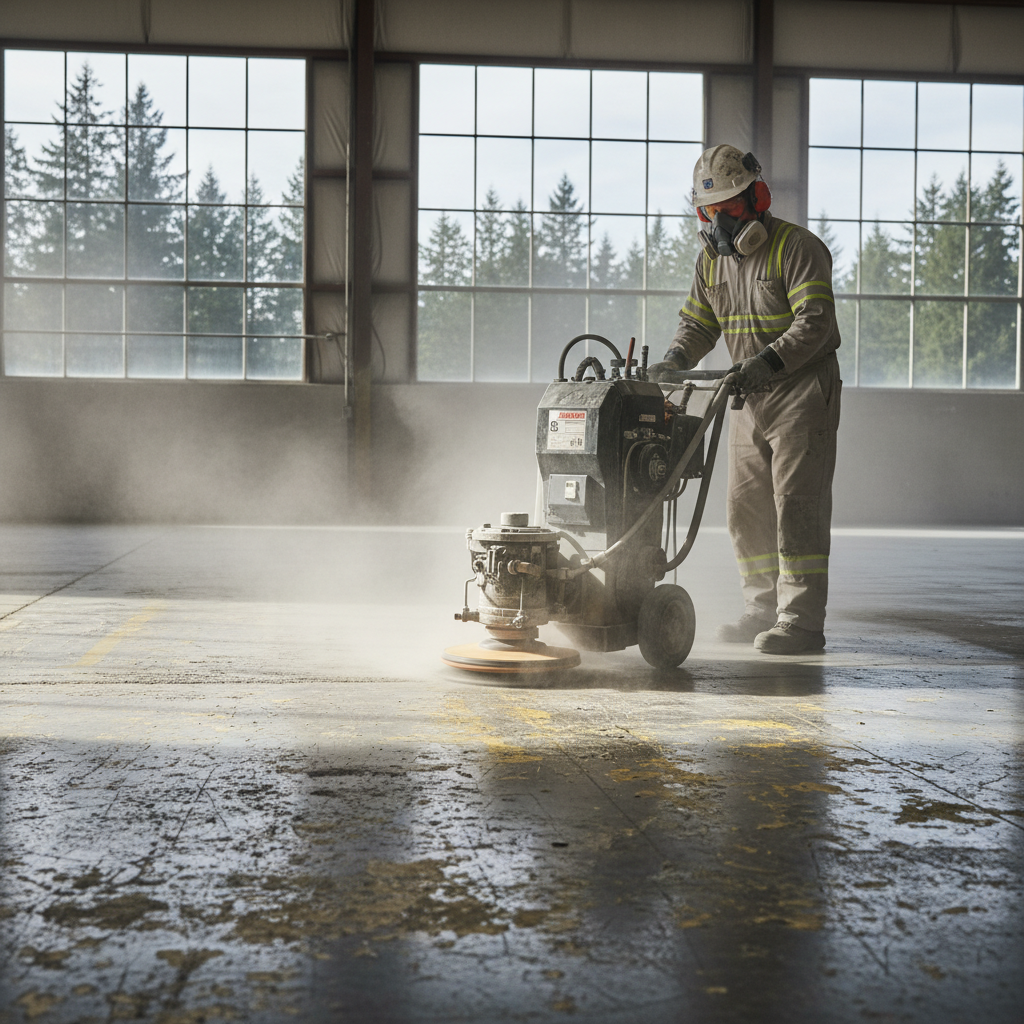
Modern concrete grinding equipment falls into three primary categories. Ride-on grinders cover large square footage efficiently, making them ideal for expansive warehouse floors throughout Salem’s industrial parks. Walk-behind planetary grinders provide maneuverability for medium-sized areas and tighter spaces. Hand-held grinders address edges, corners, and detailed work near columns or equipment foundations.
The evolution from early wet grinding methods to today’s sophisticated dry grinding systems represents a significant advancement. Contemporary vacuums capture 99% of concrete dust, maintaining air quality standards established by Oregon OSHA regulations. This capability allows work to continue in occupied facilities with minimal disruption—a crucial consideration for 24/7 manufacturing operations.
Regional Considerations for Salem Facilities
Oregon’s climate creates specific challenges that national contractors often overlook. Salem receives approximately 40 inches of annual rainfall, and moisture infiltration through concrete slabs remains a constant concern. Before grinding, we coordinate with Portland General Electric to verify proper facility electrical capacity for high-amperage grinding equipment—a detail that prevents project delays.
The Willamette Valley’s moderate winters allow year-round project scheduling, unlike colder climates where concrete work pauses. However, indoor humidity control becomes critical during wet months. We monitor moisture vapor emission rates according to ASTM standards to ensure optimal grinding and sealer application conditions.
Common Mistakes in Concrete Floor Preparation
Understanding what goes wrong helps facilities avoid costly errors when planning floor restoration projects. Through our experience working across Marion County, we’ve identified recurring mistakes that compromise results and waste resources.
Inadequate Surface Assessment Before Grinding
Many facility managers attempt DIY grinding or hire inexperienced contractors without proper surface evaluation. Concrete quality varies significantly—a 30-year-old industrial slab differs substantially from recent pours. Failing to test for compressive strength, identify subsurface voids, or detect existing cracks leads to equipment damage and unsatisfactory results.
Professional assessment includes moisture testing, hardness evaluation, and coating identification. Some older epoxy systems contain hazardous materials requiring special handling. Facilities near Keizer or North Salem’s industrial zones often have floors with multiple coating layers applied over decades—each requiring specific removal techniques.
Skipping Grit Stages to Save Time
The temptation to skip intermediate grinding stages and jump from coarse to fine grits creates visible scratches and uneven finishes. Each grit removes the scratches from the previous stage while refining the surface profile. Eliminating steps saves hours but creates results that won’t meet quality standards for polished concrete or coating adhesion.
We follow systematic progressions established by industry standards, typically doubling grit numbers between passes. This methodical approach ensures uniform surface preparation whether preparing for decorative concrete applications or high-performance industrial coatings.
Ignoring Dust Control and Air Quality
Concrete dust contains crystalline silica, a serious respiratory hazard. Grinding without proper dust collection violates Oregon OSHA regulations and endangers workers. Beyond compliance, inadequate dust control contaminates facility equipment, HVAC systems, and inventory—creating cleanup costs far exceeding professional service fees.
Modern HEPA-filtered vacuum systems integrated with grinding equipment capture particulates before they become airborne. This technology allows grinding work in active manufacturing areas without shutting down entire facilities—a capability especially valuable for Salem’s food processing and electronics industries.
Best Approach for Selecting Floor Grinding Services
Choosing the right contractor determines whether your floor restoration succeeds or becomes an expensive lesson. Salem facilities benefit from established local providers like Salem Concrete who understand regional conditions and maintain relationships with building departments and inspectors.
Evaluating Contractor Experience and Equipment
Request documentation of similar projects, particularly in your industry. A contractor experienced with concrete driveway work may lack the specialized equipment and knowledge for 50,000-square-foot warehouse floors. Ask about their grinding equipment age and capabilities—outdated machines cannot achieve modern polishing standards.
Verify Oregon contractor licensing through the Construction Contractors Board and confirm appropriate insurance coverage. Industrial grinding involves significant liability risks, and inadequate coverage could leave facility owners exposed to claims.
Understanding Project Timelines and Staging
Realistic scheduling prevents operational disruptions. Most commercial facilities cannot shut down entirely for floor work. Experienced contractors develop phased approaches, completing sections over weekends or off-shifts. A well-planned project minimizes downtime while maintaining quality standards.
For example, grinding 3,000 square feet per weekend allows a 9,000-square-foot project to complete over three weeks without impacting weekday operations. This approach proved successful for manufacturing facilities throughout the 97301, 97302, and 97305 zip codes, where continuous production remains essential.
Comparing Cost Versus Long-Term Value
Initial grinding and polishing costs exceed simple coating application, but lifecycle analysis reveals superior value. Polished concrete floors require minimal maintenance—routine dust mopping and occasional damp cleaning suffice. Epoxy coatings need reapplication every 5-7 years, accumulating costs and downtime.
Unlike coatings that peel and chip under heavy traffic, properly ground and polished concrete improves with age. The densified surface resists abrasion, moisture, and chemical exposure. Facilities making this investment today will experience reliable performance for 20+ years—a remarkable return compared to repeated coating failures.
Step-by-Step Guide to Industrial Floor Grinding Projects
Understanding the complete process helps facility managers plan effectively and set realistic expectations for their teams and contractors.
Pre-Project Assessment and Planning
Professional contractors begin with comprehensive site evaluation. This includes measuring floor areas, identifying obstacles, testing concrete hardness, checking for subsurface moisture, and documenting existing damage. Detailed assessment prevents mid-project surprises and allows accurate scheduling and budgeting.
We coordinate with facility management to understand operational constraints, establish work zones, and plan material staging areas. For facilities near Salem Parkway or Commercial Street, logistics planning ensures equipment delivery doesn’t disrupt traffic or operations. This preparation phase typically requires 1-2 site visits before work begins.
Coating Removal and Initial Grinding
The first grinding pass uses aggressive 16-30 grit diamonds to remove existing coatings, adhesives, and contaminated concrete. This stage generates significant dust, making vacuum efficiency critical. Operators work systematically across marked sections, overlapping passes to ensure complete coverage without gouging or creating uneven spots.
Edge work accompanies main floor grinding, using specialized equipment to reach areas large machines cannot access. Complete coating removal reveals the concrete’s true condition, sometimes uncovering cracks or voids requiring repair before proceeding to finer grinding stages.
Progressive Refinement and Polishing
Subsequent passes with progressively finer grits refine the surface. At approximately 120-200 grit, contractors apply lithium silicate densifiers. These chemicals penetrate 1-2 millimeters into the concrete, filling pores and hardening the surface through chemical reaction. Drying time varies with ambient conditions but typically requires several hours before continuing.
Final polishing stages (400-800 grit) create the desired sheen level—options range from matte to high-gloss depending on facility preferences and traffic patterns. Manufacturing areas often prefer moderate gloss balancing aesthetics with slip resistance, while retail spaces might choose higher polish for visual impact similar to polished patio surfaces.
Sealing and Post-Project Maintenance Planning
After achieving the target finish, contractors apply penetrating sealers to protect the polished surface and simplify maintenance. Unlike topical coatings, these sealers soak into the concrete, providing protection without creating a separate film layer that can peel or wear through.
Professional contractors provide maintenance plans detailing cleaning procedures, resealing schedules, and techniques for addressing future damage. Facilities can review our completed project portfolio to understand long-term performance expectations and maintenance requirements.
Frequently Asked Questions About Concrete Floor Grinding
How long does concrete floor grinding take?
Project duration depends on square footage, existing conditions, and desired finish level. Typically, contractors can grind and polish 1,000-1,500 square feet per day for standard projects. A 10,000-square-foot facility might require 2-3 weeks when working weekends only, or 7-10 days for continuous work. Complex projects with extensive coating removal or repairs extend timelines.
Can we keep operating during grinding work?
Yes, with proper planning. Modern dust control systems and phased scheduling allow facilities to continue operations in unaffected areas. Contractors establish barriers, control access to work zones, and schedule noisy operations during off-shifts when possible. Many Salem manufacturing facilities have successfully maintained production while completing floor restoration projects.
How does grinding compare to overlay systems?
Grinding works with existing concrete, while overlays add new material layers. Grinding proves more cost-effective for structurally sound slabs with surface damage. Overlays become necessary when concrete has extensive cracking, spalling, or insufficient thickness. Each approach has appropriate applications—professional assessment determines the best solution for specific conditions.
What maintenance do polished concrete floors require?
Polished floors need minimal maintenance compared to coated surfaces. Daily dust mopping removes debris, while weekly damp mopping with neutral pH cleaners maintains appearance. Annual or biannual reapplication of penetrating sealer preserves protection. Avoid harsh chemicals and abrasive cleaning methods that could dull the finish. Proper maintenance ensures decades of reliable service.
Does grinding damage rebar or embedded utilities?
Surface grinding removes only 1-3 millimeters of concrete, well above typical rebar depth of 50-75 millimeters. However, exposed rebar indicates structural issues requiring repair before grinding. Contractors use ground-penetrating radar or cover meters to locate embedded conduit and ensure adequate clearance. Professional operators avoid damaging subsurface elements through proper assessment and controlled grinding depth.
Conclusion: Transforming Salem Facilities Through Expert Floor Preparation
Concrete grinding for floor prep in Salem, OR, represents a proven investment for industrial and commercial facilities seeking durable, low-maintenance flooring solutions. The multi-stage process—from aggressive coating removal through fine polishing and sealing—transforms worn surfaces into high-performance floors capable of decades of reliable service.
Success requires experienced contractors who understand regional conditions, maintain modern equipment, and follow systematic processes established by organizations like the American Concrete Institute. Proper planning, realistic scheduling, and attention to dust control enable facilities throughout Marion County to complete projects without major operational disruptions.
Whether restoring manufacturing floors near the intersection of Portland Road and Lancaster Drive, preparing retail spaces in downtown Salem, or renovating warehouse facilities throughout zip codes 97301, 97302, and 97305, professional concrete grinding delivers results that outperform coatings while reducing long-term costs. The investment made today creates floors that will serve reliably for 20+ years—exceptional value for facilities planning their infrastructure future.
For Salem facilities evaluating floor restoration options, concrete grinding offers a practical path forward. By working with established local contractors who understand Oregon’s climate challenges and regulatory environment, you can transform problematic floors into valuable assets supporting your operations for decades to come.
Sources and References
- American Concrete Institute (ACI) – https://www.concrete.org/
- ASTM International – Standards for concrete testing and evaluation – https://www.astm.org/
- Oregon OSHA – Workplace safety standards for concrete grinding operations
- Industry research on polished concrete development and modern grinding equipment evolution
Disclaimer: This article provides general information about concrete grinding services and processes. Specific project requirements, timelines, and costs vary based on facility conditions, square footage, and desired outcomes. Consult qualified contractors for detailed assessments and project-specific recommendations.