
Last Updated: January 9, 2026
Picture this: You step onto your beautiful concrete patio on a rainy Salem morning, only to find water pooling against your foundation or worse—seeping into your crawlspace. It’s a nightmare scenario that plays out across the Willamette Valley every winter, and it’s completely preventable with the right drainage approach.
In Salem, OR, proper concrete patio drainage solutions aren’t just nice to have—they’re essential. With our heavy seasonal rainfall, clay-rich soils, and freeze-thaw cycles that can heave and crack poorly designed patios, getting drainage right from the start saves thousands in repairs down the road. Whether you’re planning a new patio or fixing an existing one that’s causing water problems, understanding how local conditions affect drainage design is the first step toward a dry, durable outdoor space.
Quick Answer: Essential Drainage Solutions for Salem Patios
Effective concrete patio drainage in Salem, OR combines proper surface grading (1–2% slope away from structures), compacted gravel sub-base for drainage, strategic use of channel or area drains where slope is limited, and underground piping to route water safely away from foundations—all designed to handle our wet winters and slow-draining clay soils.
Key Takeaways:
- Surface slope is your first defense—minimum 1/8″ per foot away from the house
- Clay soils common in Salem require enhanced sub-base preparation with compacted gravel
- Channel drains and underground piping are necessary where architectural constraints limit slope
- Integration with existing foundation drainage systems prevents water from overloading perimeter drains
- Regular maintenance of drains and surface sealing extends patio life through Oregon’s seasons
Why Salem’s Climate Demands Better Drainage Planning
Salem receives concentrated rainfall during fall through spring, with wet winters that saturate the ground and create persistent moisture challenges. When we work throughout the 97301, 97302, and 97305 zip codes, our teams consistently encounter the same soil and water issues that make drainage a non-negotiable part of every patio project.
The Clay Soil Challenge
Many Salem residential areas sit on clay or silty soils that drain slowly. Unlike sandy or loamy soils that quickly absorb water, clay holds moisture, creating hydrostatic pressure beneath and around concrete slabs. This pressure can cause heaving during freeze-thaw cycles, cracking, and settlement issues if the sub-base isn’t properly prepared.
Before any concrete pour, we coordinate with Portland General Electric to mark underground utility lines and assess site conditions. This early planning phase reveals soil composition and existing drainage patterns that shape our design approach.
Seasonal Water Management
Salem’s wet season brings sustained rainfall that saturates yards and creates runoff challenges. A patio designed without considering where roof water, surface runoff, and groundwater flow will end up becomes a collection point for all that moisture—channeling it straight toward your foundation or creating standing pools that damage the concrete surface.
Professional concrete patio contractors in Salem, OR understand these seasonal patterns and design systems that handle peak flows during December through February storms, not just average conditions.
Common Drainage Mistakes That Cause Patio Failures
Even experienced DIYers and some contractors make drainage errors that lead to costly repairs. Understanding these pitfalls helps you avoid them in your own project.
Insufficient or Reversed Slope
The single most common mistake is creating inadequate slope or, worse, accidentally sloping toward the house. This happens when contractors rush the grading phase or fail to account for settlement. We’ve seen dozens of Salem patios where a subtle reverse slope sends water straight into crawlspaces during storms.
Proper technique requires establishing grade stakes, checking levels in multiple directions, and accounting for the fact that new concrete will settle slightly over its first year. The minimum recommended slope is 1/8 inch per foot, but we typically design for 1/4 inch per foot to provide a margin of safety.
Skipping Sub-Base Preparation
Pouring concrete directly over native clay soil without a proper gravel base is asking for trouble. The sub-base serves multiple critical functions: it provides drainage beneath the slab, creates a stable platform that resists movement, and helps distribute loads evenly to prevent cracking.
A properly executed sub-base includes 4–6 inches of compacted crushed gravel, mechanically compacted in lifts. This creates capillary breaks that prevent moisture from wicking up into the concrete and provides drainage pathways for water that does reach the sub-grade level. Quality concrete patio services never skip this step.
Ignoring Downspouts and Roof Runoff
Your patio drainage system must account for roof water. A typical Salem home’s roof can shed hundreds of gallons during a heavy rain event. If downspouts dump directly onto or near your patio, no amount of surface grading will handle that volume.
Best practice involves extending downspouts well beyond the patio perimeter or tying them into underground drainage pipes that bypass the patio area entirely. According to the EPA’s stormwater guidance, managing roof runoff separately from surface drainage is key to preventing overload.
Best Drainage Solutions for Salem Concrete Patios
The most effective approach combines multiple drainage strategies tailored to your specific site conditions, patio layout, and surrounding landscape.
Proper Surface Grading and Slope
Every patio should slope away from structures at a minimum of 1/8 inch per foot, with 1/4 inch per foot preferred for Salem’s wet conditions. This slope should be consistent across the entire slab surface and maintained in the surrounding yard grade for at least 6–10 feet beyond the patio edge.
On relatively flat lots where natural drainage exists, proper grading alone often suffices. The key is coordinating patio elevation with existing lawn height so water flows smoothly from concrete to landscape without creating dams or low spots.
Channel Drains for Tight Spaces
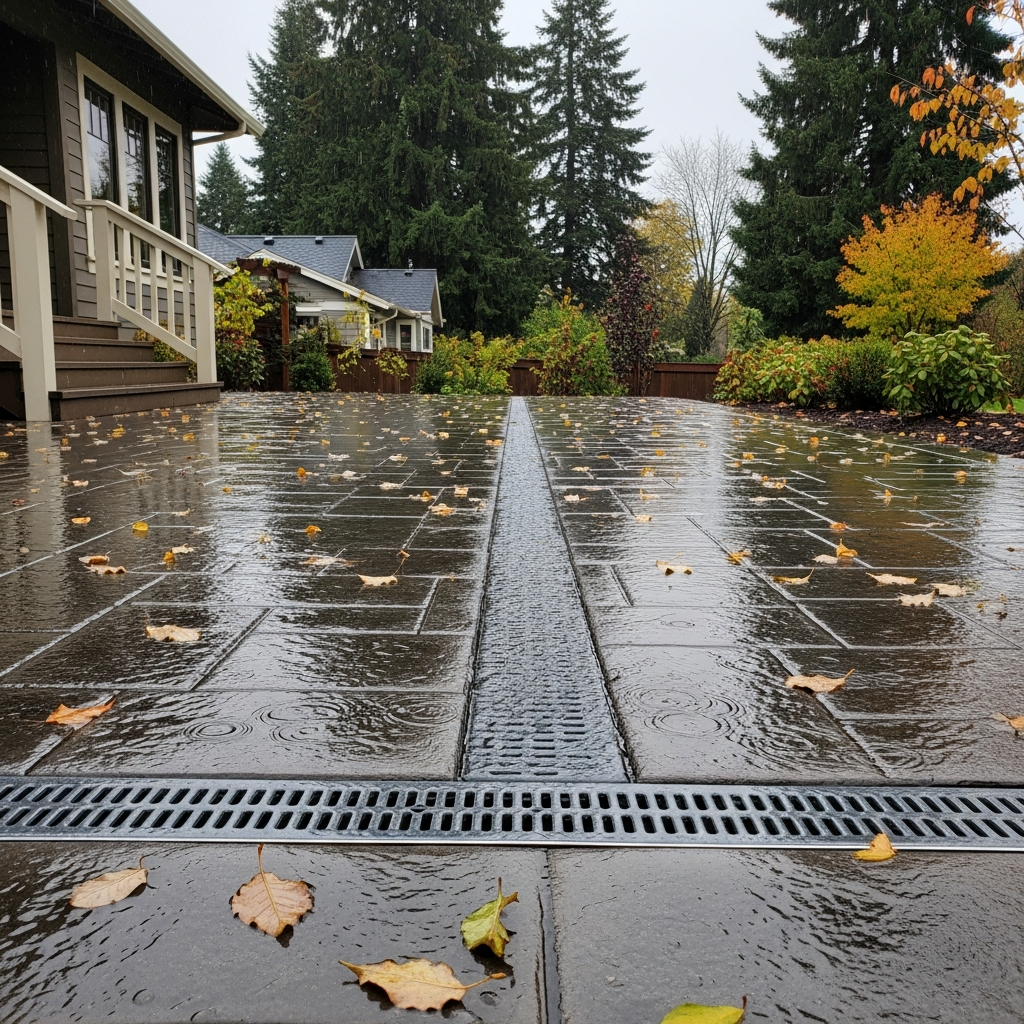
When architectural constraints limit slope options—such as patios that must meet door thresholds or property lines that restrict grading—channel drains (also called trench drains) become essential. These linear drains intercept water at critical points and route it to underground pipes.
We typically install precast concrete channel drains at the house edge of patios where doors or foundation heights prevent adequate slope. The patio slopes slightly toward the channel, which captures water and sends it to a discharge point downhill or to the street storm system. This solution is common in older Salem neighborhoods where lot grading leaves little room for adjustment.
Underground Drainage Networks
Comprehensive concrete patio drainage solutions in Salem, OR often include underground PVC or corrugated pipe systems that collect water from surface drains and transport it to appropriate discharge points. These networks tie together channel drains, area drains (catch basins), downspout extensions, and sometimes perimeter foundation drains.
The discharge point might be a lower area of the yard designed as a rain garden, a connection to the street storm drain system, or a dry well if soil conditions permit. The City of Salem’s development code requires that stormwater be managed on-site where feasible, making these systems both practical and often legally necessary for larger projects.
Step-by-Step: Installing Proper Patio Drainage
Whether you’re working with professionals or tackling a smaller project yourself, following a systematic approach ensures lasting results.
Phase 1: Site Assessment and Planning
Begin by mapping existing drainage patterns during a heavy rain. Note where water flows, where it pools, and how surrounding areas drain. Identify the location of downspouts, existing foundation drains, and any underground utilities. Contact Portland General Electric and NW Natural for utility locates before any excavation.
Measure the existing slope from your foundation outward and identify your desired patio elevation relative to door thresholds and surrounding grade. This planning phase determines whether simple grading will suffice or if you’ll need supplemental drains.
Phase 2: Excavation and Sub-Base
Excavate to a depth that accommodates your concrete thickness (typically 4 inches for patios) plus 4–6 inches of gravel base. Shape the excavation with the desired final slope already built in—it’s far easier to establish grade in the sub-base than to try correcting it in wet concrete.
Install any underground drain pipes at this stage, setting them in the gravel base with proper slope (minimum 1/4 inch per foot for drainage pipes). Then place and compact crushed gravel in 2-inch lifts, maintaining your established grade throughout. Due to Oregon’s freeze-thaw cycles, we always specify air-entrained concrete to resist surface scaling—a detail that generic national contractors often miss.
Phase 3: Form Setting and Drainage Installation
Set forms with careful attention to slope, using a builder’s level or laser level to verify grade. If installing channel drains, embed them in the forms or the concrete pour itself, ensuring they’re set at the correct depth and properly sloped toward outlets.
Place reinforcing mesh or rebar according to local standards—City of Salem building codes have specific requirements for different slab thicknesses and soil conditions. Professional services ensure compliance with all local regulations.
Phase 4: Concrete Pour and Finishing
Pour, screed, and finish the concrete while constantly checking slope with a long straightedge and level. Small adjustments during the initial set can prevent major drainage problems later. Include control joints every 8–10 feet to control cracking—joints should be placed strategically so they don’t interfere with drainage paths.
For enhanced aesthetics without compromising drainage, consider stamped concrete services that add texture and pattern while maintaining proper slope and water flow characteristics.
Retrofitting Drainage on Existing Problem Patios
If you already have a patio with drainage issues, several retrofit solutions can address problems without complete replacement.
Surface Drain Installation
A concrete-cutting saw can create a narrow trench along the foundation edge of an existing patio to install a channel drain. This captures water before it reaches the house and routes it to underground piping. While more invasive than new construction, it’s far less expensive than complete patio replacement and highly effective at solving foundation water problems.
Perimeter Grading Adjustment
Sometimes the patio itself isn’t the problem—it’s the surrounding soil grade that’s changed over time due to settling, landscaping, or erosion. Reshaping the soil around the patio to restore proper slope away from the structure can resolve water issues without touching the concrete. This works especially well when combined with extended downspout drainage and strategic landscaping.
Sealing and Surface Protection
Older patios with minor drainage issues can benefit from professional sealing to reduce water penetration into cracks and pores. While sealing doesn’t fix fundamental slope problems, it extends the life of concrete by preventing freeze-thaw damage and reducing moisture migration that can cause foundation issues.
Frequently Asked Questions
How much slope does a concrete patio need in Salem?
A minimum of 1/8 inch per foot is required, but we recommend 1/4 inch per foot (2% grade) for Salem’s wet climate. This ensures positive drainage even as concrete settles slightly over time and provides capacity for heavy rain events.
Do I need a drainage system if my patio slopes properly?
Not always. On properties with good natural drainage, proper surface slope alone may suffice. However, if you have tight spaces, high water tables, clay soils, or nearby downspouts, supplemental drains provide insurance against water problems and are usually worth the modest additional investment.
Can I connect patio drains to my foundation drainage system?
Generally no. Foundation perimeter drains are designed to handle groundwater around footings, not surface runoff. Connecting patio or roof drains to foundation systems can overload them, defeating their purpose. Instead, route surface drainage to separate discharge points or stormwater systems.
How often do patio drains need maintenance?
Inspect channel drains and surface inlets at least twice yearly—ideally before and after Salem’s wet season. Remove leaves, debris, and sediment that can clog grates or pipes. Underground pipes should be flushed every 3–5 years to prevent buildup that reduces flow capacity.
What’s the cost difference between basic and comprehensive drainage?
A patio designed with proper grading alone adds minimal cost—mostly labor to establish correct slope. Adding channel drains and underground piping typically adds $800–2,500 depending on system complexity and length of pipe runs. This investment prevents far more expensive foundation repairs and patio replacement down the line.
Conclusion: Building Dry, Durable Patios for Salem’s Climate
Effective concrete patio drainage isn’t optional in Salem—it’s the foundation of a patio that will serve you well through decades of wet winters and occasional freezes. By understanding how our local climate, soils, and typical lot conditions interact with concrete and water, you can design or retrofit a system that keeps your patio dry, your foundation protected, and your outdoor space usable year-round.
Whether you’re planning a new patio or addressing problems with an existing one, the key principles remain consistent: establish proper slope, prepare the sub-base correctly, add supplemental drains where needed, coordinate with roof and foundation drainage, and maintain the system over time. Working with experienced professionals who understand Oregon’s unique conditions ensures these principles translate into reliable, long-lasting results.
Salem Concrete brings local expertise to every project, understanding not just how to pour concrete but how to integrate it into the broader water management needs of your property. The investment in proper drainage pays dividends in durability, functionality, and peace of mind every time it rains.
Sources and References
- U.S. Environmental Protection Agency – Stormwater Management and Rain Gardens
- City of Salem, Oregon – Building Codes and Development Standards
- Portland General Electric – Underground Utility Location Services
- Regional concrete and drainage contractors specializing in Willamette Valley conditions