
Last Updated: December 24, 2025
Is your concrete walkway in Salem, OR crumbling, cracked, or becoming a safety hazard? You’re not alone—thousands of Oregon homeowners face deteriorating sidewalks and pathways that need replacement. Between freeze-thaw cycles, heavy rainfall, and decades of foot traffic, concrete walkways don’t last forever. The good news? Modern replacement techniques deliver durable, attractive results that can last 40+ years when done correctly.
When we work throughout Salem neighborhoods—from Downtown to South Salem near the intersection of Commercial Street SE and Mission Street SE—we consistently see homeowners waiting too long to address walkway damage. What starts as a small crack becomes a tripping hazard, then a liability issue. Understanding when to replace your concrete walkway and how to approach the project saves money and prevents injuries down the road.
Quick Answer: When Should You Replace Your Concrete Walkway?
Replace your concrete walkway when you notice extensive cracking (more than 1/4 inch wide), significant settling or unevenness (creating trip hazards), surface spalling or flaking, or structural damage affecting more than 30% of the surface area. In Salem, OR, most concrete walkways last 25-40 years before requiring full replacement, though proper maintenance can extend this lifespan.
Key Takeaways:
- Replace walkways with cracks wider than 1/4 inch or uneven surfaces over 1 inch difference
- Salem’s climate demands air-entrained concrete to withstand freeze-thaw cycles
- Typical costs range $8-15 per square foot for standard replacement in 2025
- City of Salem requires permits for walkway replacement in some circumstances
- Professional installation ensures proper slope, drainage, and ADA compliance
Understanding Concrete Walkway Deterioration in Salem, OR
Salem’s unique climate presents specific challenges for concrete walkways. We experience consistent rainfall averaging 40+ inches annually, combined with winter freeze-thaw cycles that accelerate concrete degradation. When water seeps into concrete pores and freezes, it expands, creating internal pressure that causes cracking and spalling over time.
According to the Oregon Department of Transportation, concrete specifications from 1939 recommended tamped granular finishes for slip resistance—standards that influenced residential construction throughout Oregon for decades. However, older walkways constructed before modern air-entrainment techniques became standard are particularly vulnerable to our wet climate.
Signs Your Walkway Needs Replacement vs. Repair
Not every damaged walkway requires complete replacement. Minor surface cracks under 1/4 inch wide can often be sealed or patched. However, structural issues demand replacement. When our teams inspect properties throughout the 97301, 97302, and 97304 zip codes, we look for these critical indicators:
- Extensive cracking: Multiple cracks wider than 1/4 inch, especially if they form a pattern
- Settling and heaving: Sections that have sunk or lifted more than 1 inch from adjacent areas
- Surface spalling: Flaking or scaling of the concrete surface exposing aggregate
- Edge deterioration: Crumbling along walkway borders and joints
- Root damage: Tree roots pushing up sections, creating permanent displacement
Climate-Specific Considerations for Salem Walkways
Due to Salem’s freeze-thaw cycles and moisture levels, we always specify air-entrained concrete for walkway replacement. This concrete type contains microscopic air bubbles that provide space for water to expand when freezing, preventing internal damage. Standard concrete mixes without air entrainment fail prematurely in Oregon’s climate—often within 10-15 years instead of the expected 30-40 years.
Before any concrete work, we coordinate with Portland General Electric to identify and mark underground utility lines. Salem’s older neighborhoods often have utilities running beneath walkways, and proper location prevents costly damage and safety hazards during excavation.
Common Mistakes in Concrete Walkway Replacement
We’ve seen countless walkway replacement projects fail prematurely due to avoidable errors. Understanding these mistakes helps homeowners make informed decisions and avoid contractors who cut corners.
Inadequate Base Preparation
The most common failure point isn’t the concrete itself—it’s the base beneath it. Many contractors rush through excavation and base preparation to save time. A proper base for Salem walkways requires at least 4-6 inches of compacted gravel or crushed rock, providing drainage and stable support. When we encounter properties near Bush’s Pasture Park or in West Salem, we often find that clay-heavy soil requires additional base depth to prevent settling.
Skipping compaction is another critical error. Loose fill settles over time, creating voids beneath the concrete that lead to cracking and sinking. Professional installation includes mechanical compaction in lifts, ensuring the base remains stable for decades.
Ignoring Drainage Requirements
Salem receives substantial rainfall, making proper drainage essential. Walkways must slope away from structures at a minimum rate of 1/4 inch per foot—enough to direct water away but not so steep as to create accessibility issues. We regularly see DIY projects and budget contractors who ignore this requirement, resulting in water pooling against foundations and accelerated concrete deterioration.
Using Incorrect Concrete Mix
Not all concrete is created equal. Standard residential mixes without proper air entrainment fail quickly in Oregon’s climate. The concrete should have a minimum compressive strength of 4,000 PSI and contain 5-8% entrained air. We source materials from local suppliers familiar with Oregon specifications, ensuring mixes are formulated for our specific environmental conditions.
Best Approach to Concrete Walkway Replacement in Salem
Successful concrete walkway replacement follows a methodical process that addresses all structural and aesthetic requirements. Here’s the professional approach we use throughout Salem.
Professional Assessment and Planning
Every project begins with thorough assessment. We measure the existing walkway, evaluate drainage patterns, identify underground utilities, and assess soil conditions. This planning phase determines the project scope, material requirements, and timeline. For properties in historic neighborhoods downtown near the Oregon State Capitol, we also verify any historic preservation requirements that might affect design choices.
The City of Salem requires permits for certain walkway projects, particularly those affecting public right-of-way or altering drainage patterns. Working with experienced contractors like Salem Concrete ensures proper permits are obtained and work meets all local building codes.
Material Selection and Specifications
For Salem’s climate, we recommend air-entrained concrete with 4,000+ PSI compressive strength. The typical walkway should be 4 inches thick for residential applications, though high-traffic areas may benefit from 5-6 inch thickness. Control joints should be cut at intervals no greater than 10 feet to control where cracking occurs naturally.
Many homeowners also consider decorative options during replacement. Stamped concrete services can provide the appearance of stone, brick, or custom patterns at a fraction of the cost of actual pavers. These techniques have advanced significantly, offering durability without sacrificing aesthetics.
Installation Process and Timeline
Professional installation typically takes 2-4 days for a standard residential walkway, depending on size and complexity. The process includes: demolition and removal of existing concrete, excavation and base preparation, installation of forms and reinforcement, concrete placement and finishing, control joint cutting, and curing period. The concrete requires 7 days minimum cure time before regular foot traffic, and 28 days to reach full strength.
Step-by-Step Guide to Replacing Your Concrete Walkway
Understanding the replacement process helps homeowners prepare for the project and communicate effectively with contractors.
Demolition and Site Preparation
The old concrete must be completely removed, typically using jackhammers and excavation equipment. We break the concrete into manageable pieces and haul it away—most concrete can be recycled at local facilities. The area is then excavated to the proper depth, accounting for both the new concrete thickness and the base layer beneath.
Base Construction and Grading
A 4-6 inch layer of crushed rock or gravel is placed and compacted in lifts. The base is graded to ensure proper slope away from structures. In areas with poor drainage or clay soil—common in parts of South Salem—we may install additional drainage measures such as French drains or increase base depth to 8 inches.
Forming, Reinforcement, and Pour
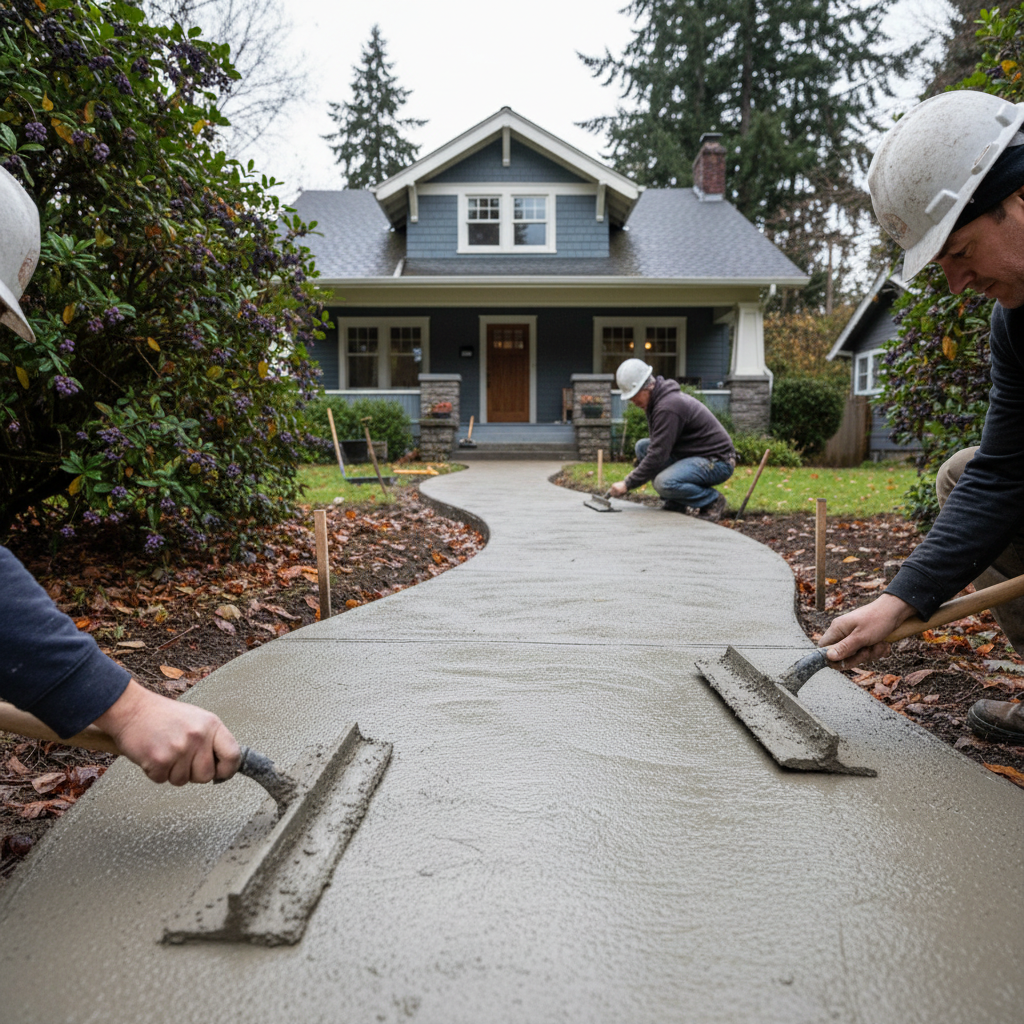
Wood or metal forms are set to define the walkway edges and establish the proper elevation and slope. Welded wire mesh or fiber reinforcement is placed to control cracking. The concrete is then poured, screeded to level, and finished with appropriate texture for slip resistance—particularly important given Salem’s wet climate. We often use a broom finish that provides excellent traction without being abrasive.
Control joints are cut within 24 hours of placement, dividing the walkway into sections that allow for natural expansion and contraction. These joints direct where cracks will occur—typically within the joint itself rather than randomly across the surface.
Cost Factors for Concrete Walkway Replacement
Several variables affect the total cost of concrete walkway replacement in Salem, OR. As of December 2025, homeowners typically pay between $8-15 per square foot for standard replacement, with decorative options ranging $12-20 per square foot.
| Cost Factor | Impact on Price | Typical Range |
|---|---|---|
| Walkway Size | Larger projects have lower per-square-foot costs | $8-12/sq ft |
| Demolition Complexity | Thick concrete or difficult access increases costs | +$2-4/sq ft |
| Decorative Finishes | Stamped or colored concrete adds premium | +$4-8/sq ft |
| Site Preparation | Poor soil or drainage issues require extra work | +$1-3/sq ft |
When budgeting for concrete walkway replacement in Salem, OR, consider the full scope beyond just the concrete. Permits, disposal fees, base materials, and finishing all contribute to the final cost. We provide detailed estimates that break down each component, helping homeowners understand exactly what they’re paying for.
While discussing walkways, many homeowners also evaluate other concrete projects. Similar techniques apply to concrete driveway services and concrete patio services, often with cost efficiencies when multiple projects are completed simultaneously.
Frequently Asked Questions About Concrete Walkway Replacement
How long does a new concrete walkway last in Salem, OR?
A properly installed concrete walkway using air-entrained concrete and correct base preparation typically lasts 30-40 years in Salem’s climate. Factors affecting longevity include concrete quality, installation practices, drainage, and maintenance. Sealing the concrete every 2-3 years extends its lifespan by protecting against moisture penetration and freeze-thaw damage.
Can I replace just a section of my walkway?
Yes, partial replacement is possible and often more cost-effective when damage is localized. However, matching the color and texture of existing concrete can be challenging. New concrete typically appears lighter and will cure to a slightly different shade than aged concrete. Discuss aesthetic considerations with your contractor before proceeding with partial replacement.
What’s the best time of year for walkway replacement in Salem?
Late spring through early fall (May through October) provides optimal conditions for concrete work in Salem. Temperatures should remain above 40°F during curing, and dry weather allows proper finishing and curing. While concrete can be placed in winter with special precautions, summer and fall projects generally produce better results with fewer complications.
Do I need a permit for walkway replacement in Salem, OR?
Permits depend on the project scope and location. Private walkways entirely on your property typically don’t require permits, but work affecting public right-of-way, altering drainage patterns, or in historic districts may need approval. Reputable contractors handle permit applications as part of their service. Contact the City of Salem Building Division to verify requirements for your specific project.
Should I consider brick or pavers instead of concrete?
According to research comparing materials over 40+ years, brick walkways can offer 85% lower maintenance costs than concrete, though they have higher upfront installation costs. Brick provides easier repairs (individual units can be replaced), better drainage, and distinctive aesthetics. However, concrete remains more common for its lower initial cost, faster installation, and smooth, uniform surface ideal for accessibility.
Conclusion: Investing in Quality Concrete Walkway Replacement
Concrete walkway replacement in Salem, OR represents a significant investment in your property’s safety, functionality, and curb appeal. The combination of proper materials, professional installation, and Salem-specific considerations ensures your new walkway performs reliably for decades. When you notice extensive cracking, settling, or safety concerns, replacement becomes not just advisable but necessary.
Throughout Salem—from neighborhoods near Willamette University to properties in Keizer—we see the results of both quality installations and cost-cutting mistakes. The difference is dramatic: properly installed walkways remain attractive and functional for 30-40 years, while shortcuts lead to premature failure, additional expenses, and safety liabilities.
Working with experienced contractors who understand Oregon’s climate requirements, local regulations, and best practices ensures your investment delivers lasting value. View examples of quality concrete work and completed walkway projects at Salem Concrete’s project gallery to see the difference professional installation makes.
Whether you’re addressing immediate safety concerns or planning proactive replacement before problems worsen, understanding the process, costs, and critical factors empowers you to make informed decisions. Your concrete walkway provides essential access to your home—it deserves the quality materials and expert installation that ensure it serves you reliably for generations.
Sources and References
- Oregon Department of Transportation – Historic Context Report on Roadway Infrastructure (2019)
- City of Salem Building Division – Construction Standards and Permits
- American Concrete Institute – Concrete in Cold Weather Specifications
- Portland Cement Association – Air-Entrained Concrete for Freeze-Thaw Protection