
Last Updated: December 24, 2025
Are you tired of looking at your plain, cracked concrete driveway? In Salem, OR, homeowners are discovering a transformative solution that combines durability with stunning visual appeal. Decorative concrete driveways offer the look of premium stone, brick, or tile without the maintenance headaches—and they’re specifically engineered to withstand Oregon’s unique climate challenges, from winter freeze-thaw cycles to summer heat.
As we approach 2026, stamped concrete services have become the fastest-growing segment of residential upgrades in the Salem area. Whether you’re enhancing curb appeal for a home sale or simply want a driveway that reflects your style, understanding your options is the first step toward making an informed investment in your property.
Quick Answer: What Makes Decorative Concrete Driveways Ideal for Salem?
Decorative concrete driveways in Salem, OR combine stamped patterns that mimic natural materials with durable concrete that resists Oregon’s rain, temperature swings, and UV exposure. They require minimal maintenance, last 25+ years with proper sealing, and cost significantly less than authentic stone or pavers while delivering comparable aesthetics.
Key Takeaways:
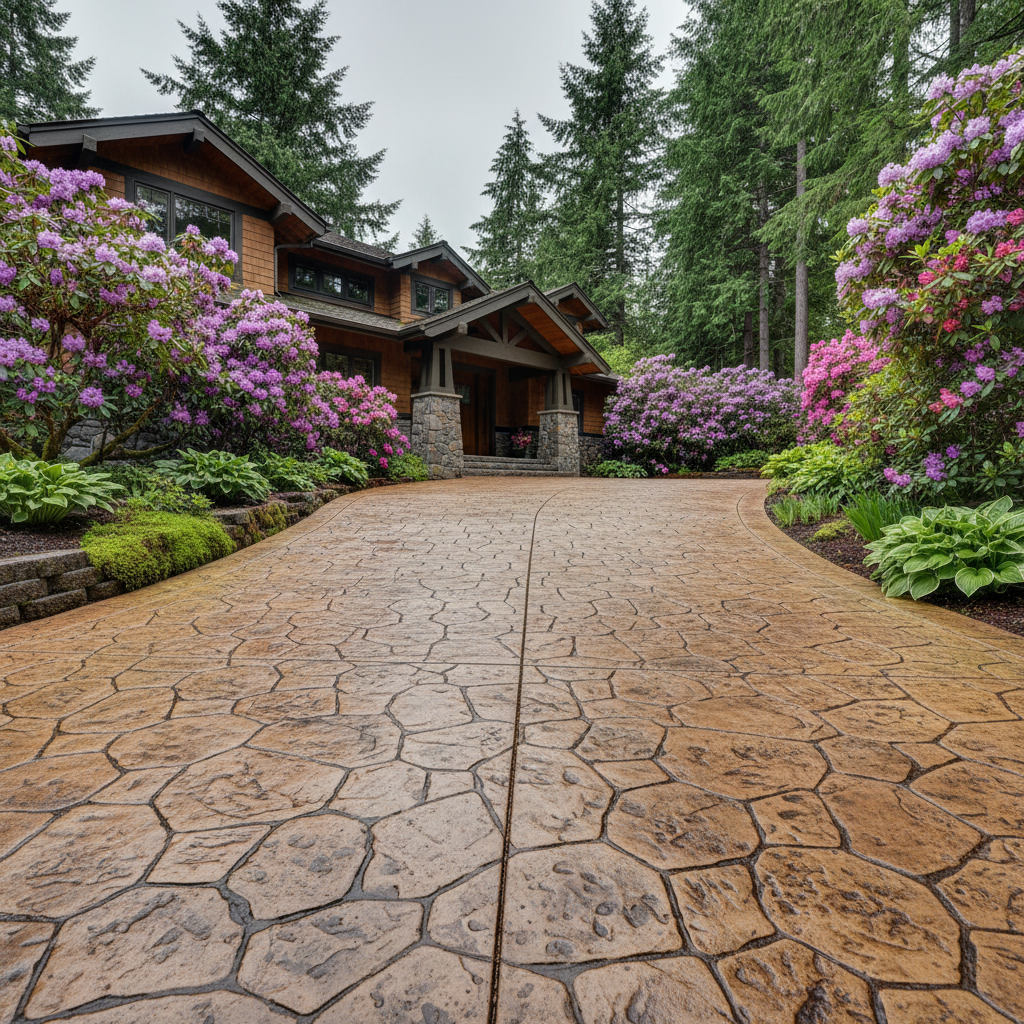
- Stamped patterns include cobblestone, Ashlar slate, brick, and seamless textures
- Custom colors match Oregon’s landscape and complement home exteriors
- Cost-effective compared to natural stone, with lower long-term maintenance
- Climate-resistant design handles Salem’s weather extremes
- Professional installation ensures proper drainage, sealing, and longevity
Understanding Decorative Concrete Options for Salem Driveways
When considering decorative concrete driveways Salem OR homeowners install, it’s essential to understand the various design possibilities. The term “decorative concrete” encompasses several techniques, with stamped concrete being the most popular choice for driveways due to its durability and versatility.
Popular Pattern Choices in the Salem Area
Ashlar Slate: This pattern creates the illusion of natural flagstone with irregular shapes and authentic texture. It’s particularly popular in Salem’s West Salem and South Salem neighborhoods (97302, 97306), where homeowners prefer a refined, natural aesthetic that complements Oregon’s landscape. The random pattern hides minor settling or cracking better than uniform designs.
Cobblestone: For properties seeking old-world European charm, cobblestone stamping delivers timeless appeal. This pattern works exceptionally well for circular or curved driveways near historic areas like downtown Salem (97301). The rounded stone appearance adds dimensional depth that catches light throughout the day.
Seamless Texture: Modern homes in newer developments along Lancaster Drive or near Keizer benefit from seamless concrete textures that mimic smooth stone. This contemporary option offers clean lines while maintaining slip resistance—a critical safety feature during Salem’s rainy seasons.
Brick Pattern: Classic herringbone or running bond brick patterns remain timeless choices. We often recommend brick patterns for borders and entryways, creating visual transitions between driveways and front walkways.
Color Selection and Oregon’s Environment
Color choice dramatically impacts your driveway’s appearance and performance. Earthy grays, warm tans, and reddish-brown tones complement Oregon’s natural palette while aging gracefully. Lighter colors reflect heat during summer months, reducing thermal expansion stress on the concrete.
When our team works throughout Marion County, we’ve observed that homeowners increasingly request multi-tone coloring—layering two or three complementary shades to create depth and visual interest. This technique also helps disguise minor staining from leaves, dirt, or tire marks that naturally accumulate over time.
Why Decorative Concrete Outperforms Alternatives
Compared to authentic pavers, natural stone, or brick, concrete driveway services deliver superior performance in Salem’s climate. Individual pavers shift during freeze-thaw cycles, creating uneven surfaces and tripping hazards. Natural stone requires regular sealing and can crack under vehicle weight. Decorative concrete provides a monolithic surface that distributes weight evenly and resists Oregon’s temperature fluctuations.
Common Mistakes Salem Homeowners Make
Even with growing popularity, misconceptions about decorative concrete lead to disappointing results. Understanding these pitfalls helps ensure your investment delivers decades of satisfaction.
Skipping Proper Subgrade Preparation
Oregon’s clay-heavy soils in the Willamette Valley require specialized preparation. We regularly encounter driveways installed over inadequately compacted subgrade, leading to settling and cracking within 2-3 years. Before any concrete pour, proper excavation, gravel base installation, and mechanical compaction are non-negotiable steps.
In Salem’s higher-moisture areas near Minto-Brown Island Park, drainage considerations become even more critical. Standing water beneath concrete creates voids as soil erodes, eventually causing expensive structural failures that decorative stamping cannot hide.
Choosing Patterns That Don’t Match Home Architecture
A rustic cobblestone pattern clashes with ultra-modern architecture. Similarly, contemporary geometric designs look out of place against traditional craftsman homes. When visiting properties throughout Salem neighborhoods from Fairmount Hill to Grant, we help homeowners select patterns that enhance rather than compete with existing architectural elements.
Neglecting Sealer Maintenance
The biggest long-term mistake? Failing to reseal decorative concrete every 2-3 years. Oregon’s rainfall, UV exposure, and temperature swings gradually degrade protective sealers. Without this maintenance layer, moisture penetrates the concrete, colors fade, and surface deterioration accelerates. Quality sealers cost a fraction of replacement yet extend driveway life by decades.
Best Approach: Planning Your Decorative Concrete Installation
Strategic planning separates mediocre outcomes from exceptional results. Here’s how to approach your project for maximum value and longevity.
Timing Your Project Around Salem’s Weather
Concrete installation requires specific temperature and moisture conditions. Salem’s ideal installation window runs from late spring through early fall (May through October), when temperatures consistently stay between 50°F and 80°F with minimal rain. Winter pours risk frost damage during curing, while summer heat above 90°F causes rapid moisture evaporation that weakens concrete strength.
Due to Salem’s extended rainy season, we recommend scheduling projects at least 2-3 months in advance during peak season. This ensures your preferred dates and prevents rushed installations during weather breaks.
Coordinating with Local Utilities and Regulations
Before any excavation, we coordinate with Portland General Electric and Northwest Natural Gas to mark underground utility lines throughout Salem properties. Oregon’s call-before-you-dig requirements protect both workers and homeowners from expensive utility strikes.
The City of Salem requires permits for driveway modifications that alter drainage patterns or connect to public streets. Building Department regulations ensure proper slope away from structures (minimum 2% grade) and compliance with stormwater management requirements. Licensed contractors handle permit applications, but homeowners should verify this critical step isn’t overlooked.
Selecting the Right Concrete Mix for Oregon
Not all concrete is equal. For Salem’s climate, we specify air-entrained concrete with at least 5-7% air content. These microscopic air bubbles allow water to expand during freezing without cracking the concrete—essential for Oregon’s winter freeze-thaw cycles. Standard concrete without air entrainment will develop surface scaling and structural damage within a few years.
A contrarian tip many national contractors miss: due to Salem’s extended spring moisture, we always add crystalline waterproofing admixtures to the concrete mix itself. This creates internal waterproofing that works even if surface sealers degrade, providing a secondary defense against moisture intrusion that generic mixes lack.
How to Choose a Decorative Concrete Contractor in Salem
Contractor selection determines whether your investment becomes a source of pride or frustration. Follow this systematic approach to identify qualified professionals.
Verify Licensing and Insurance
Oregon’s Construction Contractors Board requires licensing for any concrete work exceeding $1,000. Verify active CCB status online and confirm contractors carry comprehensive liability insurance and workers’ compensation coverage. This protects you from liability if injuries or property damage occur during installation.
Reputable contractors like Salem Concrete openly provide license numbers and insurance certificates. Any hesitation or excuses should raise immediate red flags.
Review Local Portfolio Projects
Request to see completed projects specifically in Salem and surrounding Marion County areas. Photos from other states don’t demonstrate understanding of Oregon’s soil conditions, weather patterns, or local architectural styles. If possible, visit completed driveways that are 3-5 years old to observe how decorative finishes hold up over time.
Understand the Installation Process
Quality contractors clearly explain their process: excavation depth, base material specifications, concrete thickness (minimum 4 inches for driveways, preferably 5-6 inches), reinforcement methods, and curing procedures. They should discuss control joints—planned weak points that direct cracking to inconspicuous locations—and explain their sealing products and application methods.
Stamping occurs within a narrow time window after pouring. Contractors must have adequate crew size and equipment to complete pattern application before concrete hardens—typically 2-4 hours depending on temperature and humidity. Small operations may lack resources to stamp larger driveways properly, resulting in rushed work or inconsistent patterns.
Cost Considerations for Salem Decorative Concrete Projects
Understanding cost factors helps you budget appropriately and evaluate contractor quotes. For detailed pricing breakdowns, explore stamped concrete driveway cost Salem OR information that reflects current market conditions.
Factors Affecting Installation Costs
Site accessibility: Properties with narrow access requiring wheelbarrows instead of concrete trucks increase labor costs. Steep slopes demand additional forming and may require specialized equipment.
Existing driveway removal: Demolishing and hauling away old concrete adds $2-4 per square foot. Proper disposal is critical—Oregon regulations prohibit illegal dumping, and violations carry substantial fines.
Pattern complexity: Intricate patterns with multiple colors or hand-tooled details require more skilled labor and time than simple stamps. Custom patterns may involve creating specialized mats or forms.
Drainage modifications: Properties requiring French drains, catch basins, or regrading to meet city codes add engineering and installation costs but prevent future water damage problems.
Long-Term Value Comparison
While decorative concrete costs more upfront than plain concrete, it delivers significant return on investment. According to national real estate data, attractive driveways contribute 5-10% to home value and significantly improve curb appeal for potential buyers.
Compared to natural stone or pavers that require 15-20% more in material costs plus potential ongoing maintenance for shifting or replacement, decorative concrete offers superior lifetime value. A properly installed and maintained decorative concrete driveway in Salem should last 25-30 years—potentially outlasting the homeowner’s residence period.
Maintaining Your Decorative Concrete Driveway
Proper maintenance preserves your investment and ensures decades of performance. Fortunately, decorative concrete requires minimal upkeep compared to alternative materials.
Routine Cleaning Best Practices
Regular sweeping or leaf blowing removes debris that can stain surfaces. For deeper cleaning, use a garden hose or pressure washer on low setting (under 3000 PSI) to avoid damaging stamped textures or sealers. Avoid harsh chemicals, deicing salts, or acidic cleaners that etch concrete and fade integral colors.
Salem’s frequent rainfall naturally rinses driveways, but organic material from surrounding trees can cause staining if left to decompose on surfaces. Quick removal of leaves, particularly oak or maple, prevents tannin stains that become difficult to remove.
Resealing Schedule and Products
Reseal decorative concrete every 2-3 years to maintain protection and color vibrancy. In Salem’s wet climate, acrylic sealers offer good moisture resistance and UV protection at moderate cost. For higher-traffic driveways or maximum durability, penetrating silane/siloxane sealers provide deeper protection, though they cost more per application.
Apply sealers during dry weather with temperatures between 50-90°F and no rain forecast for 24 hours. Fall sealing (September-October) prepares driveways for winter moisture, while spring application (May-June) protects against summer UV exposure.
Frequently Asked Questions
How long does decorative concrete installation take?
Most residential driveways require 3-5 days from excavation through initial curing. The concrete pour and stamping occur in one day, followed by 3-7 days of curing before vehicle traffic. Full strength develops over 28 days, but normal use can resume after one week.
Will decorative concrete crack like regular concrete?
All concrete develops minor cracks as it cures and settles. Professional contractors use control joints to direct cracking along pattern lines where it’s less visible. Proper subgrade preparation, adequate thickness, and appropriate reinforcement minimize problematic cracking. Stamped patterns often disguise hairline cracks better than plain concrete.
Can decorative concrete handle Oregon winters?
Yes, when properly installed with air-entrained concrete and quality sealers. Avoid using deicing salts, which can damage any concrete surface. Sand or kitty litter provides traction without chemical damage. The monolithic surface of decorative concrete handles freeze-thaw cycles better than pavers or brick, which shift and crack.
What happens if my decorative concrete gets damaged?
Minor surface damage can often be repaired with specialized concrete overlays or staining techniques that blend with existing colors and patterns. Significant structural damage may require replacement of affected sections. Experienced contractors can often match patterns and colors remarkably well, though slight variations may be visible up close.
Is decorative concrete slippery when wet?
Stamped textures typically provide better traction than smooth concrete. For areas requiring extra slip resistance, contractors can add traction additives to sealers or specify broom-finished borders. Proper drainage design prevents water pooling that creates hazardous conditions regardless of surface texture.
Conclusion: Transforming Your Salem Property
Decorative concrete driveways Salem OR homeowners install represent a smart intersection of aesthetics, durability, and value. With proper planning, qualified installation, and basic maintenance, your decorative concrete driveway will enhance your property’s appearance and function for decades.
Whether you’re drawn to the timeless elegance of Ashlar slate, the classic charm of cobblestone, or contemporary seamless textures, decorative concrete offers customization that reflects your personal style while standing up to Oregon’s challenging climate. The combination of stamped patterns, custom colors, and protective sealers creates surfaces that rival natural materials without their drawbacks.
As you plan your project, prioritize contractor experience with local conditions, verify proper licensing and insurance, and insist on air-entrained concrete with appropriate waterproofing for Salem’s environment. For comprehensive concrete patio contractors Salem OR expertise, seek professionals who demonstrate thorough knowledge of Oregon’s unique requirements.
Your driveway represents one of your home’s largest surface areas and significantly impacts first impressions. Investing in quality decorative concrete installation transforms this functional space into an architectural feature that welcomes guests and increases property value throughout Salem’s diverse neighborhoods—from historic Grant to modern developments in South Salem’s 97306 and 97302 zip codes.
Sources and References
- Forbes Home Improvement Guide – Concrete Driveway Costs and Installation
- Oregon Construction Contractors Board – Licensing Requirements
- City of Salem Building Department – Driveway Permit Requirements
- Portland General Electric – Underground Utility Location Services