
Last Updated: January 11, 2026
Ever tried to schedule a concrete pour only to discover you ordered too little—or paid for yards you never used? If you’re searching for local concrete delivery near me Salem, you’re facing a choice that affects both your project timeline and your budget. Salem, OR homeowners and contractors now have access to delivery options that range from traditional batch-plant trucks to innovative mobile-mix services that produce concrete right at your site.
The concrete delivery landscape in Salem has evolved significantly over the past three decades. What was once dominated by large regional producers now includes specialized volumetric mixers and experienced local contractors who coordinate materials as part of comprehensive service packages. Understanding these options—and which one fits your specific project—can save you hundreds of dollars and prevent costly scheduling delays.
Quick Answer: Salem Concrete Delivery Options
For local concrete delivery near me Salem, you can choose between mobile-mix services that batch on-site (ideal for small pours and rural locations), large regional ready-mix producers for high-volume projects, or full-service concrete contractors who handle delivery and installation. Mobile mixers deliver from ¼ yard to 25 yards and reduce waste; traditional ready-mix works best for large commercial pours.
Key Takeaways:
- Volumetric/mobile-mix trucks produce concrete on-site, eliminating waste on small jobs and variable-quantity pours
- Regional ready-mix producers serve Salem with multi-plant logistics networks for larger residential and commercial projects
- Full-service contractors coordinate delivery, mix design, and placement as part of comprehensive project packages
- Salem’s delivery ecosystem includes firms with decades of local experience dating back to the 1940s
- Rural and distant job sites benefit most from mobile-mix technology, keeping concrete fresh during extended travel
Understanding Salem’s Concrete Delivery Ecosystem
When we work with homeowners and contractors throughout the Willamette Valley, one of the most common questions revolves around which delivery method makes sense for a given project. Salem’s concrete delivery infrastructure reflects both its historical roots in post-war construction and modern innovations in mobile mixing technology.
The Three Delivery Models Available in Salem
The Salem market offers three distinct approaches to concrete delivery, each suited to different project scales and requirements:
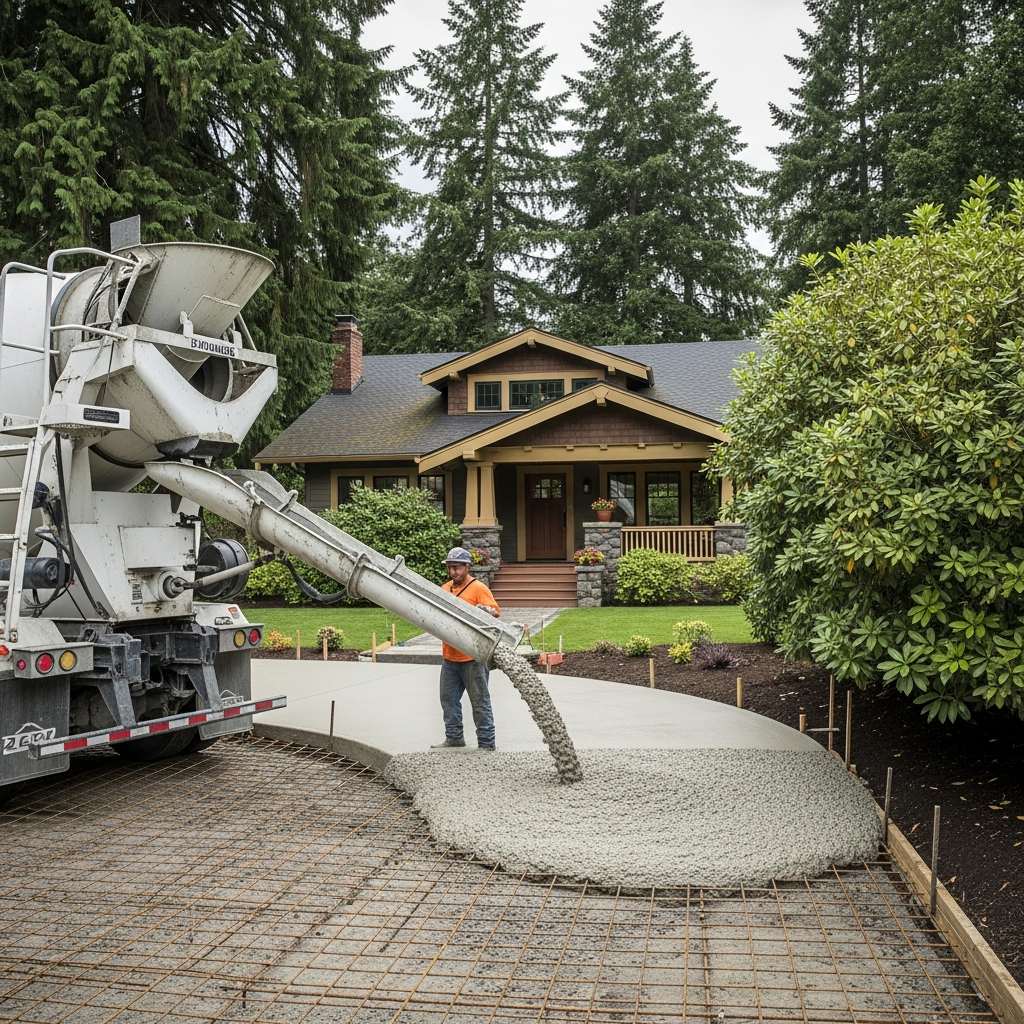
Mobile/volumetric mixers transport cement, aggregates, and water separately in compartmentalized trucks, then batch the concrete on your site in the exact quantity you need. This approach emerged in Salem in the mid-1990s and has proven especially valuable for small residential pours, unpredictable quantity needs, and rural locations where traditional batch-plant delivery faces timing challenges. Companies operating these systems can adjust output from a quarter yard to 25 yards during a single visit.
Traditional ready-mix producers batch concrete at centralized plants and deliver it in rotating drum trucks. Large regional suppliers like Glacier Northwest serve Salem as part of multi-city networks spanning Oregon and Washington, making this the preferred option for high-volume commercial projects, multi-phase developments, and situations requiring specialized mix designs prepared under plant quality-control protocols.
Integrated contractor services coordinate delivery as part of comprehensive project packages. When you hire an experienced concrete contractor, they manage supplier relationships, mix specifications, scheduling logistics, and placement—translating into a single point of accountability for residential driveways, commercial slabs, and structural elements.
How Salem’s Geography Affects Delivery Choices
Salem’s position in the mid-Willamette Valley creates unique delivery considerations. Projects in outlying areas—toward Detroit and the Santiam Canyon, or south toward Jefferson and Monmouth (serving zip codes 97352, 97317, and 97301)—face longer transit times that affect concrete workability with traditional batch-plant delivery. Oregon’s freeze-thaw cycles demand air-entrained concrete for exterior flatwork, and coordinating with Pacific Power for utility line marking becomes critical before any excavation work begins.
In our experience working throughout Salem and surrounding Marion County communities, mobile-mix services solve a problem that traditional delivery can’t: the ability to keep concrete fresh during extended rural travel while producing only what the project actually consumes. This capability proved essential when Salem-based mobile mixers supplied concrete for the reconstruction of Detroit’s City Hall following the 2020 wildfires.
Common Mistakes When Ordering Concrete Delivery
Over two decades of Oregon concrete work has shown us the same ordering mistakes repeatedly cost homeowners and contractors both time and money. Understanding these pitfalls helps you make smarter decisions when evaluating concrete delivery near Salem.
Underestimating Quantities
The most expensive concrete mistake isn’t over-ordering by half a yard—it’s running short mid-pour and needing an emergency second truck. Traditional batch plants require minimum orders and charge premium rates for small “short loads.” A residential driveway project that needs an extra yard halfway through often faces delays of hours while a new truck is dispatched, risking cold joints and visible seams in the finished surface.
Volumetric delivery mitigates this risk by allowing the truck to remain on-site and produce additional concrete as needed, but only if you’ve arranged for that capability upfront. The key is measuring your forms carefully and adding 5-8% for waste and minor measurement errors.
Ignoring Access and Placement Logistics
Concrete trucks are large, heavy vehicles that require clear access routes and stable staging areas. Many Salem residential projects—especially older homes near Bush’s Pasture Park or historic neighborhoods around Mission Street—feature narrow driveways, low-hanging utility lines, or landscaping that blocks direct chute access. Failing to plan for a concrete pump or wheelbarrow relay adds labor hours and significantly increases placement costs.
Choosing Delivery Based on Price Alone
The lowest per-yard quote often comes with hidden costs: minimum order requirements that force you to buy more than you need, strict delivery windows that don’t accommodate weather delays, or mix designs that aren’t optimized for Oregon climate conditions. According to the National Ready Mixed Concrete Association, proper mix design for regional conditions significantly affects long-term durability and maintenance costs.
Best Practices for Salem Concrete Delivery
Successful concrete delivery in Salem, OR requires matching the right delivery method to your specific project requirements, timeline, and site conditions. Here’s what we’ve learned from managing concrete logistics throughout the region.
Match Delivery Type to Project Scale
For small residential projects (under 10 yards)—patios, walkways, small shed foundations—mobile-mix delivery typically provides the best value and flexibility. You avoid minimum-order penalties and pay only for concrete actually placed. For medium residential work (10-30 yards) such as standard driveways or garage floors, either mobile-mix or traditional ready-mix works well; your choice depends on whether you value quantity flexibility or prefer the certainty of pre-batched plant mix. For large commercial projects (30+ yards) involving structural elements, parking lots, or multi-phase pours, traditional ready-mix from regional producers offers better economies of scale and access to specialized mixes.
Plan for Oregon Weather and Site Conditions
Salem’s climate demands specific concrete considerations. Winter pours require cold-weather mix modifications and protection during curing; summer work in temperatures above 80°F needs proper hydration protocols to prevent premature setting. Unlike coastal Oregon or eastern regions, the Willamette Valley experiences moderate freeze-thaw cycles that make air-entrained concrete essential for all exterior flatwork—a specification some out-of-area suppliers may not automatically provide.
Site preparation matters as much as the concrete itself. Ensure utility locates are complete (coordinate with Pacific Power and other providers at least 48 hours before pour day), confirm access routes can accommodate concrete trucks (minimum 12-foot width, adequate overhead clearance), and have backup plans for weather delays built into your schedule.
Work with Experienced Local Contractors
The most reliable path to successful concrete delivery often involves hiring contractors who’ve built relationships with local suppliers over years or decades. Established Salem firms understand regional mix designs, know which suppliers provide the best service for different project types, and have backup resources when logistics challenges arise. When you contact a qualified contractor, you’re accessing their supplier network and scheduling leverage—advantages that DIY projects and one-time buyers can’t replicate.
Step-by-Step: Ordering Concrete Delivery in Salem
Whether you’re managing the delivery yourself or working through a contractor, understanding the ordering process helps ensure smooth execution.
1. Calculate Your Concrete Volume Accurately
Measure your project dimensions carefully (length × width × depth) and convert to cubic yards by dividing cubic feet by 27. For a standard driveway measuring 20 feet wide, 40 feet long, and 4 inches thick: (20 × 40 × 0.33) ÷ 27 = 9.8 cubic yards. Add 5-8% for waste and irregularities, bringing your order to approximately 10.5 yards. Online calculators from resources like the Portland Cement Association can verify your math.
2. Specify Mix Design Requirements
Concrete isn’t one-size-fits-all. You need to specify compressive strength (measured in PSI—typical residential flatwork uses 3,000-4,000 PSI), air entrainment (essential for freeze-thaw resistance in Salem), slump (measures workability—higher slump flows more easily but may sacrifice strength), and any additives (accelerators for cold weather, retarders for hot conditions, fiber reinforcement for crack control). Experienced suppliers will ask these questions; if they don’t, that’s a red flag.
3. Coordinate Scheduling and Site Readiness
Book delivery at least 3-5 business days in advance (longer during peak construction season, typically May through September). Confirm your site is ready: forms set and braced, subgrade properly compacted and moistened, reinforcement in place, utilities marked, access routes clear. Have adequate labor on hand—concrete doesn’t wait, and you typically have 90 minutes maximum from the time of batching to complete placement and finishing.
4. Verify Delivery Details and Backup Plans
Get written confirmation of quantity, mix specifications, delivery date/time, and total cost including any delivery charges or fuel surcharges. Discuss contingency plans: what happens if weather forces a delay? What’s the protocol if you discover you need an extra yard? Can the supplier accommodate a last-minute time change if your site prep runs behind schedule? Clear communication prevents expensive misunderstandings.
Understanding Delivery Costs and Value in 2026
Concrete pricing reflects raw material costs, delivery distance, order size, and mix complexity. In early 2026, standard ready-mix concrete in the Salem market typically ranges from $120-$160 per cubic yard for common residential mixes, with prices influenced by cement costs, aggregate availability, and fuel surcharges.
Cost Factors That Affect Salem Delivery Pricing
Volume discounts reduce per-yard costs on larger orders; a 15-yard order might cost $140/yard while a 5-yard order runs $155/yard due to fixed delivery fees spread across fewer yards. Distance charges add to base pricing for locations beyond the supplier’s normal service radius—rural deliveries to areas like Aumsville or Turner may include surcharges. Special mix requirements (high-strength concrete, colored mixes, specialty additives) increase material costs. Time-sensitive delivery (weekend or evening pours) often carries premium pricing.
Mobile-mix services use different pricing models, often charging by the yard for concrete actually produced rather than ordered, which can reduce waste costs on projects where exact quantities are uncertain. Some suppliers offer preferred pricing for repeat commercial customers or contractors with established accounts.
Hidden Costs to Watch For
Beyond per-yard pricing, watch for short-load fees (charges for orders below minimum quantities, often 5-10 yards), wait-time charges (fees if the truck must wait while your crew finishes prep work—typically $2-3 per minute after a grace period), return charges (fees for unused concrete returned to the plant), and Saturday delivery premiums. These extras can add 15-30% to your total cost if you’re not prepared.
FAQ: Local Concrete Delivery in Salem, OR
What’s the minimum concrete delivery order in Salem?
Traditional ready-mix suppliers typically require 5-10 yard minimums, though this varies by company and season. Volumetric/mobile-mix services can deliver as little as a quarter yard, making them ideal for small repairs or projects where traditional batch plants aren’t economical.
How far in advance should I schedule concrete delivery?
Book residential deliveries at least 3-5 business days ahead; commercial projects requiring specialty mixes or large volumes may need 1-2 weeks’ notice. Peak construction season (May-September) often requires longer lead times. Always have a backup date in case weather forces postponement.
Can concrete trucks access my residential site?
Standard concrete trucks need minimum 12-foot-wide access, adequate overhead clearance (watch for tree branches and power lines), and stable ground to support 60,000+ pound vehicles. If direct chute access isn’t possible, plan for a concrete pump or wheelbarrow relay—discuss with your supplier during scheduling.
What happens if I order too much or too little concrete?
Ordering too much means paying for unused yards plus potential return fees. Ordering too little requires scheduling an emergency truck, causing delays that risk cold joints and may not be possible same-day. Mobile-mix services reduce this risk by allowing quantity adjustments during the pour. Always calculate carefully and add 5-8% for waste.
Should I hire a contractor or order concrete delivery myself?
For projects beyond simple DIY work (large driveways, structural elements, commercial slabs), hiring an experienced contractor provides significant value. They handle supplier coordination, mix design, site prep verification, placement logistics, finishing expertise, and warranty protection—advantages that typically outweigh the cost of their services for complex or high-value projects.
Conclusion: Making the Right Choice for Your Salem Project
Finding reliable local concrete delivery near me Salem comes down to matching delivery method, supplier capabilities, and contractor expertise to your specific project requirements. Salem’s diverse concrete ecosystem—ranging from mobile-mix innovators to established regional producers and experienced local contractors—offers options for virtually any residential or commercial application.
The most successful concrete projects share common elements: accurate quantity calculations, appropriate mix specifications for Oregon climate conditions, realistic scheduling that accounts for weather and site readiness, and clear communication with suppliers or contractors about expectations and contingencies. Whether you’re pouring a small patio, a residential driveway, or a commercial parking lot, taking time to understand your delivery options and plan thoroughly prevents the costly mistakes that turn concrete projects into expensive lessons.
For homeowners and contractors in Salem, Keizer, and surrounding Marion County communities, working with established local professionals who understand regional conditions, maintain supplier relationships, and bring decades of experience provides peace of mind that DIY delivery coordination often can’t match. The difference between a concrete project that lasts decades and one that requires premature repair often comes down to these behind-the-scenes details.
Sources and References
- National Ready Mixed Concrete Association (NRMCA) – Industry standards and best practices for ready-mixed concrete
- Portland Cement Association – Concrete mix design guidelines and technical resources
- Research data on Salem concrete delivery providers and historical development
- Industry case studies on volumetric concrete mixing technology and applications
- Regional construction data for Oregon’s Willamette Valley market