
Last Updated: December 24, 2025
When the next winter storm rolls through Salem, OR, and you watch water pooling on your cracked concrete patio, you’ll wish you’d made a different choice. The decision between pavers and poured concrete isn’t just about aesthetics—it’s about surviving Salem’s wet winters, freeze-thaw cycles, and clay-heavy soils that shift with every rainstorm. Choose wrong, and you’ll be staring at cracks and costly repairs within a decade.
As concrete patio contractors in Salem, OR, we’ve seen hundreds of homeowners face this exact dilemma. The answer isn’t always straightforward—it depends on your budget, timeline, soil conditions, and how long you plan to stay in your home. Both options have distinct advantages in our Pacific Northwest climate, and understanding these differences now can save you thousands down the road.
Quick Answer: Which Is Better for Salem Homeowners?
Pavers typically outperform concrete in Salem’s climate, offering better freeze-thaw resistance, easier repairs, and superior drainage. However, poured concrete wins on speed and upfront cost. For long-term value in our wet climate, most experts recommend pavers despite the 20-30% higher initial investment.
Key Takeaways:
- Durability: Pavers last 30-50+ years; concrete often needs major repairs sooner in Salem’s conditions
- Repairs: Replace individual pavers easily; concrete requires cutting and re-pouring entire sections
- Drainage: Paver joints allow water infiltration; concrete slabs create runoff issues
- Cost: Concrete is 20-30% cheaper initially but may cost more over time with repairs
- Design: Pavers offer unlimited patterns and colors; concrete provides sleek, modern surfaces
Understanding Salem’s Climate Challenges
Before choosing between patio pavers and concrete patios in Salem, you need to understand what you’re up against. Our Pacific Northwest weather isn’t kind to hardscaping. Salem receives an average of 40 inches of rain annually, with most falling between October and May. Combine that with periodic freezing temperatures and the clay-heavy soils found throughout neighborhoods like South Salem, West Salem, and the Fairmount Hill area, and you have the perfect recipe for patio failure.
Why Freeze-Thaw Cycles Matter
When water penetrates concrete and freezes, it expands by roughly 9%, creating internal pressure that causes cracking. In Salem, we experience multiple freeze-thaw cycles each winter—enough to stress monolithic concrete slabs but not enough to prevent the cycle from repeating. According to the National Weather Service, Salem typically sees 15-25 nights below freezing each year, concentrated in December through February.
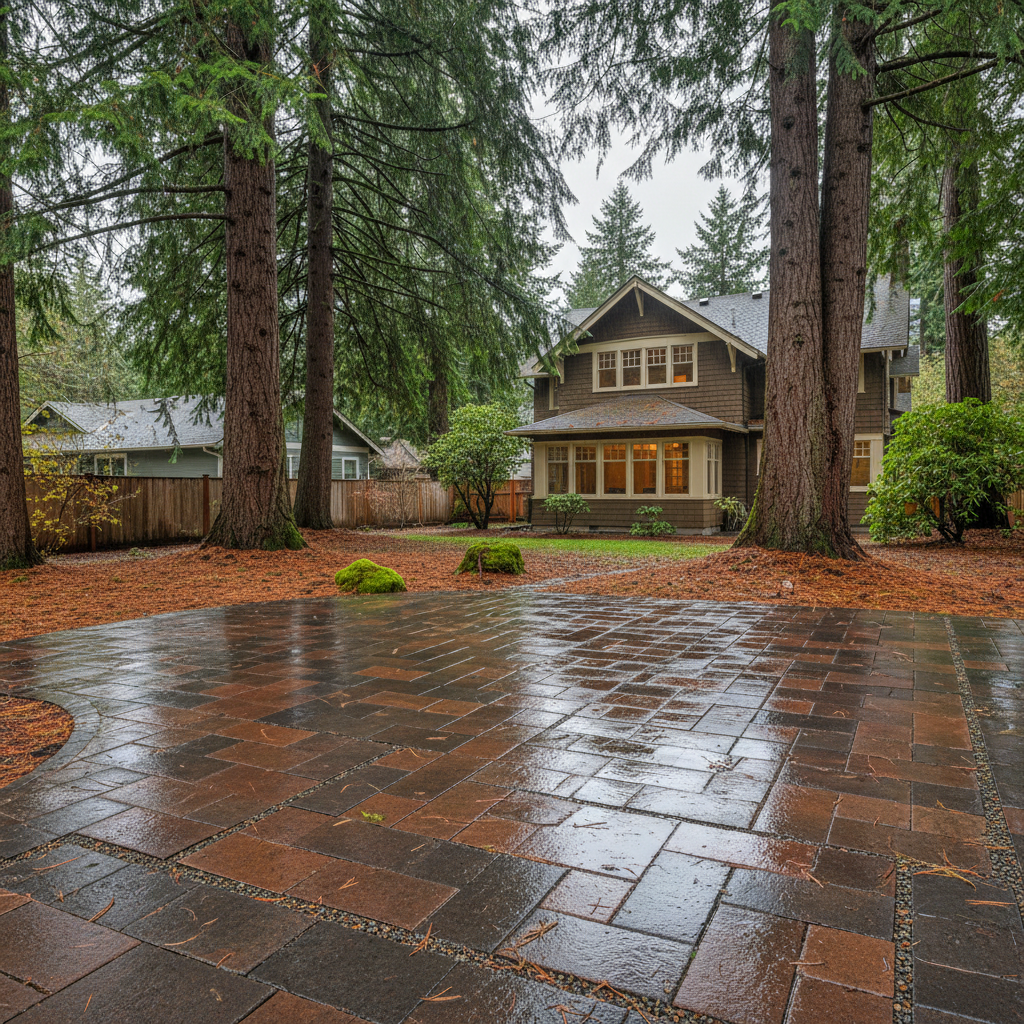
Pavers handle this differently. Individual units sit on a flexible gravel base with built-in joints that accommodate movement. When ground shifts or water freezes, the system flexes rather than cracks. This is why we consistently recommend pavers for properties in areas with poor drainage, such as those near Mill Creek or Pringle Creek.
Soil Movement and Foundation Stability
Many Salem properties sit on Willamette silt loam or Woodburn silt loam—soils that expand when wet and contract when dry. This seasonal movement is subtle but relentless. A rigid concrete slab resists this movement until stress exceeds its tensile strength, resulting in the inevitable crack. We’ve seen this repeatedly in neighborhoods throughout zip codes 97301, 97302, and 97304.
Comparing Durability and Lifespan
| Factor | Concrete Pavers | Poured Concrete |
|---|---|---|
| Expected Lifespan | 30-50+ years | 15-25 years (with repairs) |
| Compressive Strength | 9,000-12,000 psi | 3,000-4,000 psi |
| Freeze-Thaw Resistance | Excellent (flexible system) | Moderate (prone to cracking) |
| Repair Difficulty | Easy (replace individual units) | Difficult (cut and re-pour) |
The strength difference is significant. Individual concrete pavers are manufactured at much higher pressures than residential poured concrete, resulting in a denser, more durable product. When our team installs concrete patio services throughout Salem, we explain that while a 3,000-psi slab is adequate for patios, pavers’ 9,000+ psi rating provides a substantial durability advantage.
Common Mistakes Salem Homeowners Make
Choosing Concrete for Short-Term Savings
The biggest mistake we see is selecting poured concrete solely because it’s cheaper upfront. Yes, concrete costs 20-30% less initially, but when cracks appear in year seven and you need to replace entire sections, that savings evaporates. In Salem’s climate, the question isn’t if concrete will crack—it’s when. We’ve replaced dozens of 10-15-year-old concrete patios that homeowners wished they’d built with pavers from the start.
Ignoring Drainage Planning
Salem’s heavy rainfall demands proper drainage design. Impermeable concrete slabs create runoff that can erode landscaping, damage foundations, or create standing water. Before any utility work—whether installing underground drainage or working near existing lines—we always coordinate with Portland General Electric and the City of Salem utilities department to mark underground infrastructure. Pavers naturally allow some water infiltration through joints, reducing runoff and helping meet local stormwater management goals.
Skipping Proper Base Preparation
Whether you choose pavers or concrete, base preparation is critical. On Salem’s shifting soils, cutting corners on excavation depth, compaction, or drainage aggregate is a recipe for failure. Both systems need at least 6-8 inches of compacted crushed rock base, proper edge restraints, and adequate slope for drainage.
When Concrete Makes Sense in Salem
Despite our climate challenges, poured concrete isn’t always the wrong choice. It excels in specific situations where its characteristics align with homeowner priorities.
Budget-Conscious New Construction
For new homes where landscaping budgets are tight, a basic broom-finished concrete patio provides functional outdoor space at minimum cost. Many Salem builders include small concrete patios as standard, knowing homeowners can expand or upgrade later. If you’re planning to sell within 5-10 years, concrete’s lower upfront cost may make financial sense.
Modern, Minimalist Designs
Some contemporary home designs call for large, seamless surfaces that pavers can’t provide. Stamped concrete services can create decorative patterns while maintaining a continuous surface. When properly sealed and maintained, decorative concrete can look stunning—though it requires more upkeep than many homeowners expect.
The Paver Advantage for Long-Term Salem Homeowners
If you’re staying in your Salem home for 15+ years, pavers typically represent the better investment. Here’s why our crews consistently recommend them for clients planning to age in place or extensively landscape their properties.
Modular Flexibility
Need to run electrical for landscape lighting in five years? Want to add a water feature or buried propane line for a fire pit? With pavers, you simply lift the necessary units, do your work, and replace them. With concrete, you’re cutting, creating a permanent scar, and hoping your patch blend matches reasonably well. This flexibility is invaluable for evolving outdoor spaces.
Superior Traction in Wet Weather
Most pavers feature textured surfaces that provide better traction than smooth concrete when wet—a significant safety advantage during Salem’s long rainy season. For households with children, elderly residents, or anyone concerned about slip-and-fall risks, this alone can justify the extra investment.
Frequently Asked Questions
How much more do pavers cost than concrete in Salem?
Pavers typically cost 20-30% more than basic concrete initially. A standard poured concrete patio might run $8-12 per square foot installed, while pavers range from $12-18 per square foot for basic interlocking concrete pavers, more for natural stone. However, factor in Salem’s climate and potential repair costs—concrete often becomes more expensive over a 20-year timeline.
Can I install pavers over my existing concrete patio?
Sometimes, but it depends on the concrete’s condition and elevation concerns. If your existing slab is relatively sound with only minor cracking, we can install pavers over it using a sand-setting bed. However, this raises the finished surface height, which may create drainage issues or awkward transitions to doorways. For badly cracked or settled slabs, removal and proper base installation deliver better long-term results. We evaluate these on a case-by-case basis when consulting with Salem homeowners.
Do I need a permit for a patio in Salem?
Generally, residential patios under 200 square feet that aren’t attached to the house structure don’t require permits in Salem, but regulations can vary by property and location. It’s always wise to check with the City of Salem Building Division before starting any hardscaping project. Requirements may differ if you’re in a floodplain, historic district, or have easements.
Making Your Decision
The choice between patio pavers and concrete patios in Salem ultimately depends on your specific situation. If you need a functional outdoor space quickly and affordably, and you’re comfortable with potential cracking and maintenance, poured concrete serves that purpose. If you’re investing in your forever home, value design flexibility, and want to minimize long-term repair headaches, pavers justify their premium.
Consider your property’s specific conditions—soil type, drainage patterns, sun exposure, and existing landscaping. Properties with clay soils, poor drainage, or a history of foundation movement strongly favor pavers. Flat lots with well-draining gravel or sandy soils can accommodate concrete more successfully.
When evaluating contractors, ask about base preparation methods, drainage planning, and their experience with Salem’s specific soil and climate challenges. A quality installation of either system requires proper excavation, compaction, and attention to detail. Poor installation will doom even the best material choice. For those considering decorative options, reviewing stamped concrete driveway costs in Salem, OR can provide insight into decorative concrete pricing.
Both options have earned their place in Salem’s landscape. The key is matching the solution to your budget, timeline, and long-term vision for your outdoor living space. Whatever you choose, proper design and installation will serve you far better than cutting corners on materials or preparation.
Sources and References
- National Weather Service – Climate data for Salem, Oregon
- City of Salem Building Division – Local building codes and permit requirements
- Portland General Electric – Utility coordination and underground infrastructure
Financial Disclaimer: Cost estimates provided are general ranges based on 2025 market conditions in Salem, OR. Actual costs vary based on site conditions, material selection, project scope, and contractor pricing. Always obtain multiple written estimates for your specific project.