
Last Updated: December 24, 2025
What’s the one silent killer of concrete driveways, sidewalks, and patios in Salem, OR? It’s not heavy traffic or tree roots—it’s water infiltration through unsealed joints. When moisture seeps into expansion joints during our wet winters and freezes during cold snaps, it creates a relentless cycle of damage that can destroy even well-constructed concrete. The solution lies in choosing the right flexible sealant to protect your investment.
For Salem homeowners and property managers, understanding polyurethane concrete caulk in Salem, OR applications means the difference between concrete that lasts decades and slabs that crack and spall within years. Our wet climate and occasional freeze-thaw cycles demand sealants that can flex with temperature changes while keeping water out. This comprehensive guide explores how modern elastomeric sealants protect concrete investments throughout the Willamette Valley.
Quick Answer: Why Flexible Sealants Matter for Salem Concrete
Polyurethane-based concrete sealants are flexible, moisture-resistant materials designed to fill and protect joints in concrete slabs, driveways, and structures. In Salem’s climate, these elastomeric sealants accommodate thermal expansion and contraction while preventing water infiltration that causes freeze-thaw damage, spalling, and premature concrete failure. They offer superior adhesion and movement capability compared to rigid fillers.
Key Benefits for Salem Properties:
- Accommodates ±25% or more joint movement from thermal cycling
- Prevents water and salt infiltration in driveways and sidewalks
- Resists abrasion from vehicle traffic and foot traffic
- Maintains adhesion through wet winters and temperature swings
- Extends concrete lifespan by protecting control joints and expansion joints
Understanding Concrete Joint Sealants for Salem’s Climate
When we work throughout Salem—from downtown near the State Capitol to residential areas in zip codes 97301 and 97302—we see the same pattern: concrete joints that aren’t properly sealed deteriorate rapidly. Salem’s annual rainfall averaging 40+ inches, combined with occasional winter freezes, creates the perfect conditions for joint failure. Water enters unsealed control joints, freezes during cold nights, expands, and progressively damages concrete from the inside out.
Modern elastomeric sealants evolved from earlier rigid fillers precisely because concrete moves. A concrete driveway in Salem can expand and contract significantly between summer heat and winter cold. Rigid materials crack under this stress; flexible polyurethane-based sealants stretch and compress with the movement, maintaining a watertight barrier year after year.
Why Flexibility Matters in Joint Protection
Concrete joints exist for a reason: they control where concrete cracks as it shrinks during curing and responds to temperature changes. Control joints are essentially planned weak points that direct cracking to neat, straight lines rather than random spider webs across your slab. But these joints only work if they’re properly sealed against moisture.
According to Federal Highway Administration research on concrete pavement durability, joint sealants must accommodate movement while preventing intrusion of water and incompressible materials. In Salem’s environment, where we coordinate with Pacific Power for utility clearances before slab work, we’ve learned that high-performance elastomeric sealants rated for ±25% movement capability significantly outperform rigid alternatives in horizontal applications like driveways, sidewalks, and concrete patios.
Material Chemistry and Performance Characteristics
Polyurethane sealants belong to a class of elastomers developed in the mid-20th century and refined for construction applications through the 1970s and 1980s. These materials cure through moisture reaction, creating a rubber-like consistency that bonds tenaciously to properly prepared concrete surfaces. Most professional-grade formulations meet ASTM C920 standards for elastomeric joint sealants, which specify performance requirements for movement capability, adhesion, and durability.
The chemistry delivers several performance advantages for Salem applications. Unlike older solvent-based products, modern moisture-curing polyurethanes emit lower volatile organic compounds (VOCs), making them safer for applicators and compliant with environmental regulations. Their abrasion resistance makes them ideal for traffic-bearing joints where vehicles or foot traffic pass directly over sealed joints—a critical consideration for residential driveways and commercial walkways throughout Marion County.
Comparing Sealant Options for Concrete Joints
Salem property owners often ask whether polyurethane-based products outperform alternatives like silicone or acrylic latex. The answer depends on the specific application. For horizontal concrete joints subject to traffic and weather exposure, polyurethane elastomers generally excel due to their combination of flexibility, adhesion, and toughness.
| Sealant Type | Best Applications | Key Limitation |
|---|---|---|
| Polyurethane | Horizontal traffic joints, driveways, parking areas | Application temperature-sensitive |
| Silicone | Vertical joints, facades, high UV exposure | Lower abrasion resistance |
| Acrylic Latex | Interior joints, paintable applications | Limited flexibility and durability |
For Salem’s climate—where Willamette Valley aggregate from nearby quarries expands and contracts similarly to local concrete—we typically recommend polyurethane-based elastomeric sealants for all exterior horizontal concrete joints. The material’s chemical resistance also protects against automotive fluids in driveways and deicing salts occasionally used on walkways during winter weather events.
Common Mistakes in Joint Sealing
In our experience working across Salem neighborhoods from South Gateway to West Salem (97304), we’ve seen countless joint-sealing failures that could have been easily prevented. Understanding these common errors helps property owners make better decisions when protecting their concrete investments.
Inadequate Surface Preparation
The most frequent mistake is applying sealant to dirty, damp, or contaminated concrete. Polyurethane elastomers require clean, dry, sound concrete to achieve proper adhesion. Oil stains, dust, loose concrete particles, and surface moisture all prevent chemical bonding between sealant and substrate. Before any sealant application, joints must be thoroughly cleaned using wire brushes, compressed air, or specialized joint-cleaning equipment. The concrete should be dry to the touch unless the product specifically allows application to damp surfaces.
Improper Joint Design and Backer Rod Use
Many DIY attempts fail because sealant is applied too deeply or without proper backing. Professional joint sealing follows specific depth-to-width ratios—typically 1:2 for most applications. A properly sized closed-cell foam backer rod controls sealant depth while providing a surface for the sealant to bridge across the joint without bonding to the bottom. This “two-point adhesion” allows the sealant to stretch and compress effectively. Three-point adhesion (when sealant sticks to joint sides and bottom) causes premature failure as the material tears under stress.
Wrong Environmental Conditions During Application
Applying moisture-curing polyurethane sealants during rain, in freezing temperatures, or when concrete temperatures fall outside the manufacturer’s specified range leads to poor curing and adhesion failures. Most products require substrate temperatures between 40°F and 100°F. In Salem’s climate, this means avoiding applications during cold winter mornings or during our frequent rain events. Planning installation during dry weather windows—typically late spring through early fall—ensures optimal performance.
Best Practices for Long-Lasting Joint Protection
Professional concrete contractors in Salem follow systematic approaches that maximize sealant performance and longevity. These practices align with industry standards and decades of field experience across diverse applications.
Timing New Concrete Joint Sealing
For newly poured concrete, joint sealing should wait until the slab has fully cured and shrinkage has stabilized—typically 28 days minimum. Sealing too early can trap moisture and interfere with proper concrete curing. Our teams assess moisture levels and ensure joints have opened to their maximum anticipated width before sealing. According to Portland Cement Association guidelines, this patience prevents premature sealant failure and ensures joints function as designed.
Professional-Grade Materials and Application
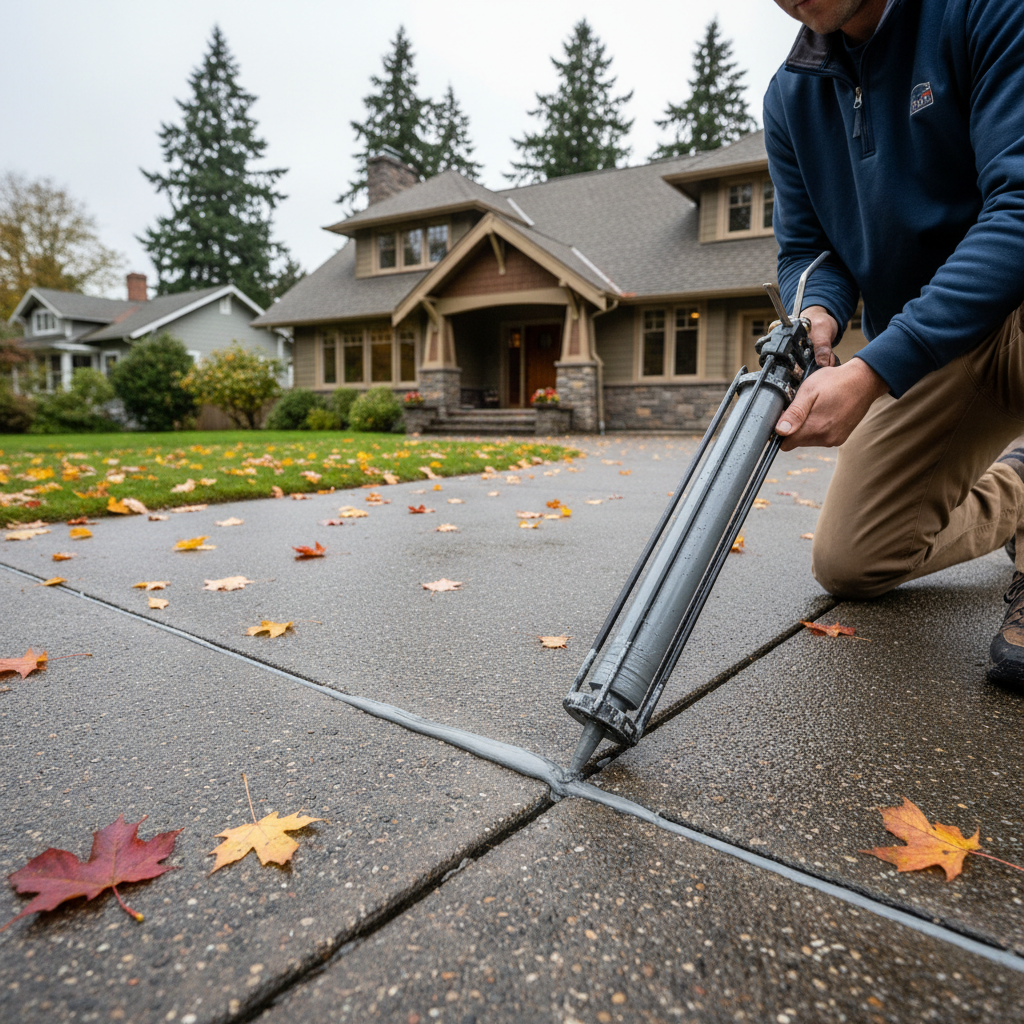
While consumer-grade caulk tubes work for minor repairs, large-scale applications benefit from professional bulk products applied with pneumatic guns. Self-leveling formulations designed for horizontal concrete joints create smooth, flush surfaces that don’t pond water or create trip hazards. These products typically come in sausages or cartridges and require specialized dispensing equipment for proper application.
When we complete concrete services throughout Salem, we match sealant color to concrete appearance whenever possible. Gray or concrete-tone sealants blend visually while providing the same protection as standard products, maintaining the aesthetic integrity of decorative concrete installations.
Salem-Specific Climate Adaptation
Here’s something most national contractors don’t know: Salem’s combination of high humidity and moderate temperature swings creates unique sealant performance challenges. Unlike areas with extreme freeze-thaw cycles (like the Cascades passes) or hot, dry climates (like Eastern Oregon), Salem joints experience frequent moisture cycling without severe temperature extremes. This means sealants must prioritize moisture resistance and maintain adhesion through wet conditions rather than just extreme cold tolerance.
We’ve found that products formulated for Pacific Northwest conditions—with enhanced moisture cure rates and mildew resistance—outperform generic formulations by several years in Salem applications. The investment in regional-specific materials pays dividends in reduced maintenance and longer replacement cycles.
Step-by-Step Joint Sealing Process
Professional joint sealing follows a methodical process that ensures maximum adhesion and longevity. Understanding this workflow helps property owners recognize quality workmanship and make informed decisions.
Preparation and Cleaning Phase
Step 1: Remove old sealant. For reseal projects, existing material must be completely removed using specialized tools. Any residue or loose particles are cleaned out with wire brushes and compressed air.
Step 2: Clean joint faces. Both sides of the joint are cleaned to expose sound concrete. This may require grinding or sandblasting for heavily contaminated surfaces.
Step 3: Verify dryness. Moisture testing ensures concrete is sufficiently dry for sealant application. In Salem’s humid climate, this sometimes requires waiting several dry days after rain.
Installation Phase
Step 4: Install backer rod. Closed-cell foam backer rod is pressed into the joint at the correct depth, creating the proper sealant reservoir geometry.
Step 5: Apply sealant. Elastomeric sealant is dispensed into the joint in a continuous bead, filling the space completely without voids or air pockets.
Step 6: Tool the surface. For horizontal joints, self-leveling formulations settle naturally. For vertical or overhead joints, the sealant surface is tooled smooth to achieve proper geometry and appearance.
Curing and Protection
Step 7: Allow proper cure time. Most polyurethane concrete caulk in Salem applications requires 24-72 hours to develop full properties, depending on temperature and humidity. During this period, joints should remain undisturbed and protected from rain.
Step 8: Inspect and test. After curing, joints are inspected for complete adhesion and proper appearance. Any deficiencies are addressed before final approval.
Frequently Asked Questions About Concrete Joint Sealants
How long does polyurethane concrete caulk last in Salem’s climate?
Professional-grade polyurethane sealants properly applied to horizontal concrete joints typically last 10-15 years in Salem’s climate before requiring replacement. Longevity depends on traffic levels, UV exposure, and maintenance. Regular inspection every 3-5 years helps identify early deterioration before significant damage occurs.
Can I seal concrete joints myself or should I hire professionals?
Small repairs and limited joint lengths (under 50 linear feet) are manageable DIY projects if you follow manufacturer instructions carefully and invest in proper materials. Larger projects, resealing work, or critical applications like parking structures benefit from professional installation. Improper sealing often costs more to correct than professional installation would have cost initially.
When is the best time of year to seal concrete joints in Salem?
Late spring through early fall (May through October) provides the most reliable weather windows for joint sealing in Salem. These months offer consistent dry periods and moderate temperatures ideal for sealant application and curing. Avoid winter months when rain frequency increases and temperatures may fall below product specifications.
What causes sealed joints to fail prematurely?
The most common failure modes include adhesive failure (sealant pulls away from concrete due to poor surface prep), cohesive failure (sealant tears internally from excessive movement or poor material choice), and substrate failure (concrete itself deteriorates at joint edges). Proper installation following manufacturer specifications prevents the vast majority of premature failures.
Do I need to seal all concrete joints or just expansion joints?
All concrete joints that penetrate the full slab depth—including control joints, construction joints, and expansion joints—should be sealed to prevent water infiltration. Shallow decorative scoring typically doesn’t require sealing. For exterior concrete exposed to weather, sealing all full-depth joints protects against freeze-thaw damage and extends slab life significantly.
Protecting Your Salem Concrete Investment
Properly sealed concrete joints represent a small investment that delivers outsized returns in longevity and appearance. Throughout Salem—from older established neighborhoods to new developments—concrete flatwork protected with quality elastomeric sealants consistently outlasts unsealed or poorly sealed installations by decades.
The key lies in matching material properties to application demands and Salem’s specific climate challenges. Flexible polyurethane-based products offer the optimal balance of movement capability, adhesion, durability, and abrasion resistance for most horizontal concrete joints. Combined with professional installation techniques and appropriate timing, these sealants protect against moisture infiltration, freeze-thaw damage, and premature deterioration.
Whether you’re planning new concrete installation or maintaining existing slabs, understanding joint sealing fundamentals helps you make informed decisions. If you’re ready to protect your concrete investment with professional-grade materials and expert installation, contact us to discuss your specific project needs. For more information about our comprehensive approach to durable concrete construction in the Salem area, visit concretesalem.com.
Sources and References
This article draws on industry standards and authoritative research including:
- Federal Highway Administration – Concrete pavement joint sealing research and durability studies
- Portland Cement Association – Technical guidance on concrete curing and joint sealing timing
- ASTM International – C920 Standard Specification for Elastomeric Joint Sealants
- Field experience and case observations from concrete installations throughout Salem, OR and Marion County
Disclaimer: This article provides general information about concrete joint sealing materials and practices. Specific product performance, installation requirements, and suitability vary by manufacturer and application. Always consult product technical data sheets and follow manufacturer instructions. For professional assessment of your specific project, consult qualified concrete contractors familiar with local conditions and building codes.