
Last Updated: December 24, 2025
Is your driveway showing its age with cracks, spalling, or surface wear? In Salem, OR, where wet winters and temperature swings take their toll on concrete, many homeowners face the same dilemma: full replacement or resurfacing. The answer might surprise you—resurfacing a concrete driveway in Salem offers a cost-effective alternative that can restore beauty and function without the expense of demolition.
When our team works throughout Marion County, we consistently see driveways that are structurally sound but cosmetically compromised. Oregon’s clay-heavy soils, freeze-thaw cycles, and persistent rainfall create unique challenges that demand specialized knowledge. Whether you’re near the historic downtown or out by the Turner Road area, understanding your resurfacing options can save thousands while delivering a surface that looks brand new.
Quick Answer: What Is Driveway Resurfacing?
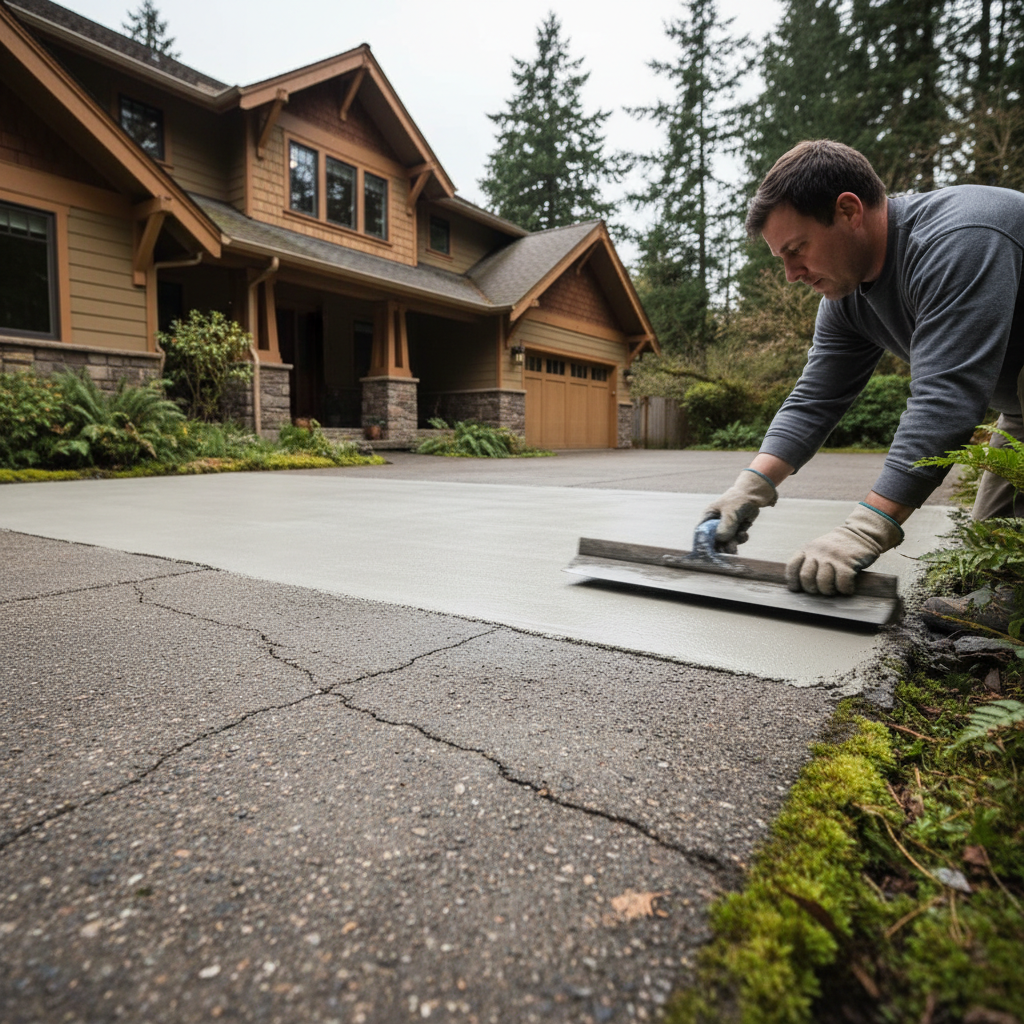
Resurfacing concrete driveways in Salem involves applying a thin overlay (typically 1-2 inches) over existing concrete to repair imperfections, restore appearance, and extend lifespan. This process costs 30-50% less than full replacement while offering decorative options like stamped patterns that mimic stone or brick.
Key Benefits of Concrete Resurfacing:
- Cost savings of 50-70% compared to complete replacement
- Faster completion (2-4 days vs. 1-2 weeks for replacement)
- Decorative options including stamped concrete patterns
- Repairs cracks, spalling, and surface imperfections
- Enhanced durability against Oregon’s climate challenges
Understanding Concrete Driveway Resurfacing in Salem, OR
Concrete resurfacing has evolved significantly since the early days when Portland cement concrete became standard for Salem driveways in the mid-20th century. Today’s techniques combine proven durability with aesthetic versatility, making it possible to transform worn surfaces into attractive focal points that complement your home’s architecture.
When Resurfacing Makes Sense
Not every damaged driveway qualifies for resurfacing. The existing slab must be structurally sound—meaning no significant heaving, deep settling, or widespread crumbling. In our experience working across Salem neighborhoods from West Salem to South Lancaster Drive, we find that driveways with surface-level damage but solid foundations are ideal candidates.
The best candidates for resurfacing show hairline cracks, minor spalling, surface discoloration, or outdated appearance. These issues don’t compromise structural integrity but significantly detract from curb appeal. A professional assessment can determine whether your driveway’s foundation can support a new surface layer without requiring complete demolition.
Salem’s Climate Considerations
Oregon’s Willamette Valley presents unique challenges for concrete work. With average annual rainfall exceeding 40 inches and winter temperatures that hover around freezing, driveways in Salem, OR endure moisture penetration and freeze-thaw stress that accelerates surface degradation. Before any major excavation work, we coordinate with Salem Electric to mark underground utility lines, ensuring safe project execution.
Unlike drier climates where cosmetic repairs might suffice, Salem resurfacing projects require air-entrained concrete mixes that create microscopic air pockets to accommodate freeze-thaw expansion. This technical adaptation—standard in Oregon but often overlooked by inexperienced contractors—can mean the difference between a resurfaced driveway that lasts decades and one that fails within years.
Decorative Resurfacing Options
The surge in stamped concrete driveway costs in Salem, OR reflects growing homeowner demand for surfaces that combine durability with aesthetic appeal. Stamped patterns like Cobblestone, Ashlar Slate, and Brick can transform a plain concrete surface into a design element that complements your landscaping and architectural style.
These decorative overlays don’t just look attractive—they provide superior weather resistance compared to natural stone or pavers, which can shift or crack in Salem’s soil conditions. The resurfacing process allows for color integration, texture variation, and pattern customization that would be impossible with basic concrete repair.
Common Mistakes to Avoid When Resurfacing
Understanding what can go wrong helps ensure your project succeeds. We’ve seen countless DIY attempts and substandard contractor work throughout Marion County that could have been avoided with proper planning and expertise.
Ignoring Underlying Structural Issues
The most critical mistake is applying a resurfacing overlay to a compromised foundation. If your driveway has major cracks wider than ¼ inch, significant settling, or widespread deterioration, resurfacing will only mask problems temporarily. Within months, the new surface will crack and fail along the same fault lines.
Professional evaluation determines whether targeted repairs to the existing slab can create a stable base for resurfacing, or whether full replacement is the only viable solution. This assessment saves money in the long run by preventing premature failure and the need for rework.
Inadequate Surface Preparation
Bonding between the existing concrete and new overlay depends entirely on proper surface preparation. Oil stains, dirt, loose material, and smooth finished surfaces prevent proper adhesion. In Salem’s damp climate, inadequate cleaning or moisture-contaminated surfaces commonly cause delamination—where the overlay separates from the base.
Professional contractors use mechanical scarification, pressure washing, and bonding agents to create optimal adhesion conditions. Skipping these steps to save time or money virtually guarantees premature failure, regardless of overlay quality.
Wrong Mix for Oregon Weather
Standard concrete mixes appropriate for Arizona or California fail quickly in Salem’s wet, freeze-thaw environment. The contrarian truth that national contractors often miss: air-entrained Portland cement mixes with 5-7% air content are essential for durability in Oregon’s climate. These microscopic air pockets allow water that penetrates the surface to expand during freezing without causing spalling or cracking.
According to Federal Highway Administration guidelines, air entrainment is critical for freeze-thaw resistance in northern climates, yet we regularly encounter failed resurfacing jobs that used inappropriate mixes.
Professional Approach to Driveway Resurfacing
Quality resurfacing follows a systematic process that addresses Salem’s specific environmental challenges while delivering lasting aesthetic results. Understanding this process helps you evaluate contractors and set realistic expectations.
Initial Assessment and Planning
Professional evaluation begins with thorough inspection of the existing slab. We check for structural integrity, drainage patterns, crack patterns, and soil stability throughout neighborhoods from 97301 to 97305. This assessment determines whether the foundation can support resurfacing or requires reinforcement first.
Drainage evaluation is particularly critical in Salem. Poor drainage accelerates concrete deterioration and causes settlement issues. Our concrete driveway services include grading analysis to ensure water flows away from structures rather than pooling on the surface or undermining the foundation.
Surface Preparation Process
Proper preparation creates the bonding surface necessary for overlay adhesion. This involves:
- Mechanical scarification to remove surface contaminants and create texture
- High-pressure washing (3,000+ PSI) to eliminate all debris and loose material
- Crack repair using flexible sealants that accommodate movement
- Bonding agent application to maximize overlay adhesion
- Moisture testing to ensure optimal curing conditions
This preparation phase typically requires one full day but determines whether your resurfacing will last 15-20 years or fail within 2-3 years. Experienced contractors never skip these critical steps.
Overlay Application and Finishing
The overlay itself—typically 1-2 inches of specialized concrete mix—is poured and finished according to design specifications. For stamped patterns, timing is critical: stamps must be applied when the concrete reaches optimal firmness, and release agents must be properly distributed to achieve consistent pattern definition.
Weather plays a crucial role in Salem applications. We monitor temperature and humidity to ensure proper curing—too cold and the concrete won’t gain adequate strength; too hot and surface cracking can occur. Oregon’s mild but wet climate requires protective covering during initial curing to prevent rain damage while maintaining necessary moisture levels.
How to Plan Your Driveway Resurfacing Project
Successfully executing a resurfacing project requires coordination, timing, and clear understanding of the process. These steps help ensure smooth project completion.
Step 1: Schedule Professional Evaluation
Contact experienced contractors for on-site assessments. Request detailed written estimates that specify materials, timeline, warranty coverage, and payment terms. Reputable providers like Salem Concrete offer transparent evaluations that clearly explain whether resurfacing suits your situation.
During evaluation, ask about concrete mix specifications, air entrainment percentages, and curing procedures. Contractors who can’t answer these technical questions likely lack the expertise needed for long-lasting results in Oregon’s climate.
Step 2: Choose Design and Materials
If opting for decorative resurfacing, review pattern samples and color options. Popular Salem choices include earth tones that complement Pacific Northwest landscaping—warm grays, tans, and browns that coordinate with natural surroundings. Consider how patterns will look at your driveway’s scale; intricate patterns suit larger surfaces while simple textures work better for narrow driveways.
Material selection should prioritize weather-appropriate mixes. Confirm your contractor uses air-entrained concrete with polymer modifiers that enhance flexibility and bonding strength—both critical for Salem’s freeze-thaw conditions.
Step 3: Plan for Access and Timing
Resurfacing typically requires 3-7 days from start to vehicle use. Plan alternative parking and coordinate with household members. In Salem, late spring through early fall (May-October) offers optimal weather conditions, though experienced contractors can work year-round with appropriate precautions.
Ensure clear access for concrete trucks and equipment. Notify neighbors of potential noise and brief street parking needs. Professional contractors maintain clean work sites and minimize disruption to surrounding properties.
Step 4: Post-Installation Care
New concrete requires initial curing protection—typically 3-7 days before foot traffic and 7-14 days before vehicle use. Follow contractor guidelines precisely, as premature loading can cause permanent surface damage. Apply sealer 30-60 days after installation to protect against moisture penetration, staining, and surface wear.
Ongoing maintenance includes periodic sealer reapplication (every 2-3 years), prompt stain removal, and winter deicing with concrete-safe products. Avoid metal shovels that can scratch decorative surfaces, and never use rock salt or harsh chemicals that deteriorate concrete.
Cost Factors for Salem Concrete Resurfacing
Resurfacing costs vary based on multiple factors, but generally range from $3-$10 per square foot depending on complexity and finishes. This compares favorably to complete replacement costs of $8-$15 per square foot, making resurfacing an attractive option for budget-conscious homeowners.
| Resurfacing Type | Cost per Sq Ft | Best For |
|---|---|---|
| Basic Overlay | $3-$5 | Minor repairs, simple restoration |
| Textured Finish | $5-$7 | Added traction, subtle appearance upgrade |
| Stamped Concrete | $7-$10 | Maximum aesthetic impact, pattern variety |
| Full Replacement | $8-$15 | Severely damaged or settled driveways |
Key cost factors include driveway size, condition of existing concrete, pattern complexity, color integration, and site accessibility. Properties in areas with limited access or requiring extensive prep work will see higher per-square-foot costs. However, even high-end stamped resurfacing typically costs less than mid-range replacement.
For detailed pricing information specific to decorative options, review our guide on stamped concrete driveway cost in Salem, OR to understand how pattern selection and customization affect final investment.
Frequently Asked Questions
How long does resurfaced concrete last in Salem’s climate?
Properly installed resurfacing with air-entrained concrete typically lasts 15-20 years in Salem, OR. Longevity depends on material quality, installation expertise, and ongoing maintenance including periodic sealing and proper drainage management.
Can any concrete driveway be resurfaced?
No. The existing slab must be structurally sound without significant settling, major cracking, or widespread deterioration. Driveways with deep structural problems require complete replacement rather than resurfacing. Professional evaluation determines suitability.
Is resurfacing cheaper than replacement?
Yes, resurfacing typically costs 50-70% less than full replacement. A 500-square-foot driveway might cost $1,500-$5,000 to resurface versus $4,000-$7,500 for complete replacement, depending on finish choices and site conditions.
What maintenance does resurfaced concrete require?
Resurfaced driveways need sealer reapplication every 2-3 years, regular cleaning to prevent staining, and use of concrete-safe deicing products in winter. Avoid metal shovels on decorative surfaces and address spills promptly to maintain appearance.
How soon can I drive on newly resurfaced concrete?
Most resurfaced driveways can handle foot traffic after 3-7 days and vehicle traffic after 7-14 days, though timing varies with weather conditions and specific overlay materials. Your contractor will provide precise guidance based on your project specifics.
Conclusion
Resurfacing concrete driveways in Salem offers homeowners an economical path to restored beauty and extended service life without the disruption and expense of complete replacement. By addressing surface imperfections while preserving structurally sound foundations, resurfacing delivers lasting value that withstands Oregon’s challenging climate when properly executed.
Success depends on choosing experienced contractors who understand Salem’s specific environmental requirements—particularly the need for air-entrained mixes, proper drainage, and climate-appropriate curing techniques. Whether opting for basic overlays or decorative stamped patterns, working with professionals who prioritize preparation, use quality materials, and follow proven processes ensures results that enhance your property for decades.
Ready to transform your worn driveway into an attractive, durable surface? Explore our comprehensive services or contact us today for a professional evaluation and transparent estimate tailored to your property’s specific needs throughout the 97301, 97302, and 97305 areas.
Sources and References
- Federal Highway Administration – Concrete Pavement Technology Program (fhwa.dot.gov)
- Historical concrete development and specifications in Oregon, 1824-1950s
- Local Salem contractors with 20+ years experience in Marion County
- American Association of State Highway and Transportation Officials (AASHTO) standards
Financial Disclaimer: Cost estimates provided are general ranges based on current market conditions in Salem, OR as of December 24, 2025. Actual project costs vary based on specific site conditions, material selections, and contractor pricing. Obtain multiple detailed written estimates before proceeding with any concrete work.