
Last Updated: December 24, 2025
Are you staring at a dull gray slab in your Salem home or business, wondering if there’s a way to transform it without tearing everything out? The answer is right beneath your feet. Stains for concrete floors in Salem, OR have evolved from a niche decorative technique into a mainstream flooring solution that marries durability with distinctive design—perfect for our Pacific Northwest climate and the region’s growing emphasis on sustainable renovation.
Whether you’re renovating a historic home near Bush’s Pasture Park or upgrading a commercial space along Commercial Street SE, concrete staining offers a practical alternative to carpet or vinyl that stands up to Salem’s wet winters while delivering a custom look. We’ve seen growing interest across neighborhoods from West Salem to South Gateway, where homeowners and business owners alike are discovering that their existing concrete can become a finished floor rather than something to hide.
Quick Answer: What You Need to Know About Concrete Staining in Salem
Concrete staining in Salem, OR involves applying acid-based or water-based stains to existing concrete slabs to create permanent, variegated color. The process transforms functional gray floors into decorative surfaces with natural stone-like appearances, offering durability and low maintenance suited to our climate.
Key takeaways for Salem homeowners and businesses:
- Acid stains create permanent, mottled earth tones by chemically reacting with concrete
- Water-based stains offer broader color palettes and lower odor
- Salem’s wet climate requires proper moisture testing and appropriate sealers
- Existing cracks and patches will show through stains—consider this part of the character
- Professional application ensures proper surface prep and sealing for longevity
Understanding Concrete Staining: What Makes It Different
When our team evaluates concrete services for Salem properties, we often explain that staining isn’t painting—it’s a chemical or penetrating process that becomes part of the concrete itself. This fundamental difference is why stained floors develop their characteristic depth and permanence.
How Acid Stains Create Lasting Color
Acid-based stains—the traditional method that traces back to mid-20th-century decorative concrete development—work through a chemical reaction. These stains contain water, hydrochloric or other acids, and metallic salts. When applied to cured concrete, they react with the free lime (calcium hydroxide) in the cement paste, creating insoluble colored compounds within the surface layer.
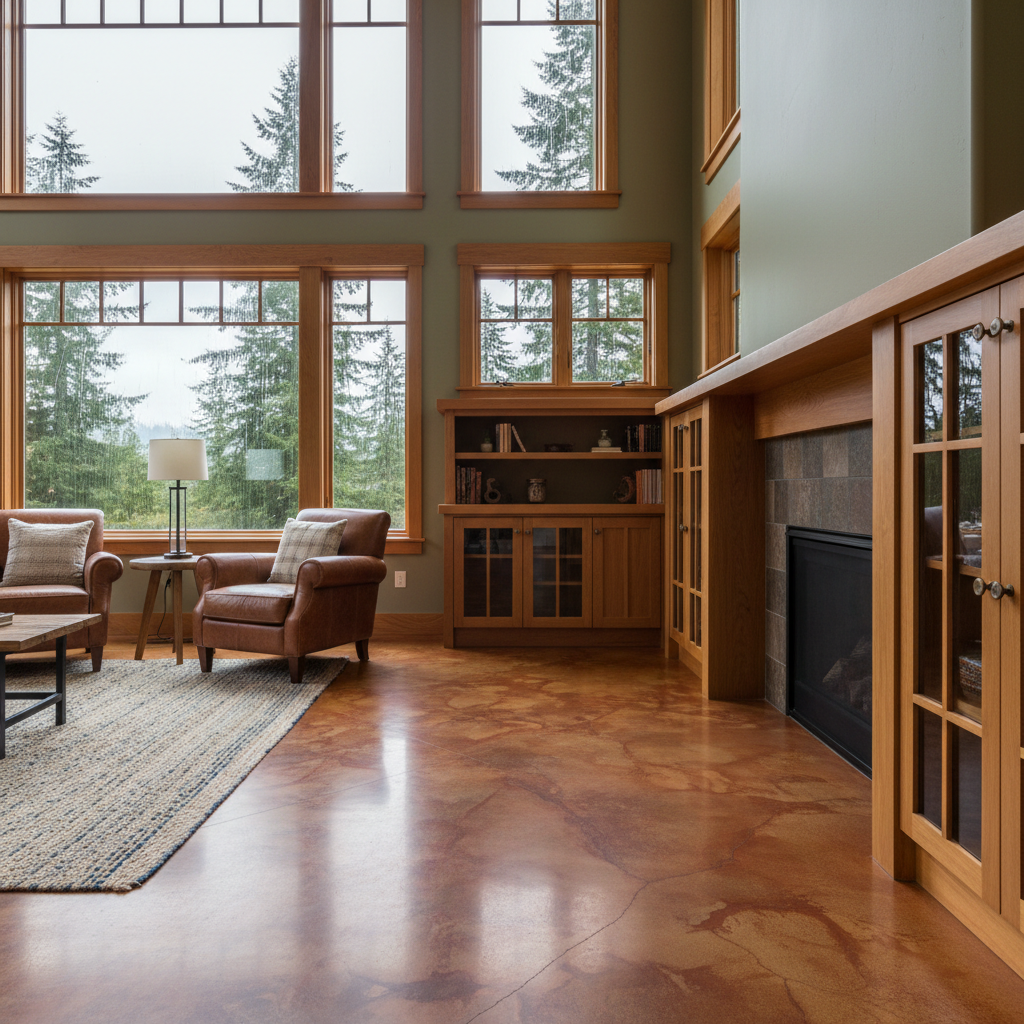
The result is a translucent, variegated appearance similar to stained leather or natural stone—never uniform, always unique. Earth tones dominate: browns, tans, greens, and blues. In Salem’s older homes with original slabs, acid stains can enhance the character of vintage concrete rather than covering it up.
Water-Based Stains: Broader Options with Easier Application
Water-based concrete stains and dyes penetrate the surface through capillary action rather than chemical reaction. They offer more predictable, uniform color and a much broader palette—including vivid blues, reds, and custom hues that acid stains can’t achieve. For commercial spaces in downtown Salem looking to match brand colors, water-based options often provide the solution.
These products typically have lower VOC content and less odor than acid stains, making them practical for occupied buildings. When paired with polished concrete systems, they create high-performance floors suitable for retail, office, and industrial applications throughout the Willamette Valley.
Polished and Stained Systems
An increasingly popular approach combines mechanical grinding and polishing with stain or dye application. The concrete is ground smooth with progressively finer diamond tooling, then stained, and polished to a gloss finish. This delivers both decorative color and exceptional durability—ideal for Salem’s light-industrial businesses and modern residential spaces that prioritize low maintenance.
Common Mistakes When Choosing Stains for Concrete Floors
We’ve seen dozens of staining projects across Salem neighborhoods from Fairmount Hill to Morningside, and certain mistakes come up repeatedly—often costing homeowners money and disappointment.
Ignoring Moisture Vapor Transmission
Salem’s wet winters mean concrete slabs—especially those on grade without vapor barriers—can transmit moisture from the soil below. Moisture vapor transmission (MVT) interferes with stain absorption and can cause sealers to delaminate or cloud. Before staining any slab, proper moisture testing is essential. We coordinate with Pacific Power to ensure utilities are marked before any concrete work, but moisture issues often require specialized testing equipment to diagnose.
Expecting Paint-Like Uniformity
One of the most common disconnects: homeowners envision a solid, even color like painted drywall. Concrete staining—especially with acid stains—produces organic, mottled patterns. Variations in concrete density, existing patches, and micro-cracking all affect how stain reacts. This unpredictability is the medium’s signature, not a flaw. If you need absolute color consistency, consider water-based dyes or alternative flooring.
Skipping Professional Surface Preparation
DIY staining attempts often fail because surface prep was inadequate. Concrete must be thoroughly cleaned of oils, sealers, curing compounds, and contaminants. In Salem’s older homes—common in the Grant and Englewood neighborhoods—decades of accumulated grime or previous coatings can block stain penetration. Professional grinding or chemical stripping is usually necessary for consistent results.
Best Approach: Selecting the Right Stain System for Salem Conditions
Choosing between acid and water-based stains—or a polished system—depends on your floor’s use, aesthetic goals, and Salem’s specific environmental factors.
Residential Interiors: Character and Warmth
For living rooms, basements, or converted garages in Salem homes, acid stains deliver warmth and natural variation that complements the region’s rustic-modern design trends. Earth tones blend well with wood accents and exposed brick common in renovated properties near downtown. After staining, a penetrating sealer followed by an acrylic or polyurethane topcoat protects against tracked-in moisture and household wear.
Commercial and Retail Spaces: Branding and Durability
Businesses along Lancaster Drive or in Keizer Station benefit from water-based stains or dyes paired with polished concrete. These systems offer precise color matching for brand identity, high gloss for visual appeal, and superior abrasion resistance for foot traffic. The non-porous polished surface resists spills and simplifies cleaning—critical for food service, retail, and office environments.
Exterior Patios and Walkways: Weather Resistance
For concrete patio services and exterior applications, stains must withstand Salem’s freeze-thaw cycles and UV exposure. Acid stains are generally more UV-stable than water-based options. Pairing stains with stamped concrete services creates decorative patterns that mimic stone or slate, elevating outdoor living spaces throughout zip codes 97301, 97302, and 97305.
Salem-specific insight: Due to our Pacific Northwest freeze-thaw cycles and sustained winter moisture, we always specify air-entrained concrete for new exterior slabs before staining. The microscopic air bubbles provide expansion space for freezing water, preventing surface scaling that would compromise stain adhesion and appearance over time—a detail that national guides often overlook but is critical in our climate.
How-To Guide: The Concrete Staining Process in Salem
Professional concrete staining follows a disciplined sequence. Shortcuts compromise both appearance and durability.
Step 1: Surface Evaluation and Moisture Testing
Before any stain touches the slab, we evaluate the concrete’s condition. Cracks, spalling, and prior coatings are documented. Moisture testing—using calcium chloride tests or relative humidity probes—determines whether the slab is dry enough for staining and sealing. In Salem’s climate, this step is non-negotiable.
Step 2: Cleaning and Profile Preparation
Concrete is mechanically cleaned via grinding, shot blasting, or aggressive scrubbing with degreasers and etching solutions. The goal is a clean, slightly porous surface that accepts stain uniformly. Any existing sealers, waxes, or contaminants must be completely removed—residue blocks penetration and causes blotchy results.
Step 3: Stain Application
For acid stains, the solution is sprayed or brushed onto the damp-clean surface and allowed to react for several hours. The chemical reaction develops color gradually. After the desired tone is achieved, the surface is neutralized (typically with baking soda solution) and thoroughly rinsed to remove residues and stop the reaction.
Water-based stains are applied similarly but without the acid reaction or neutralization step. Multiple coats may be layered to build color intensity. Drying time is shorter, and there’s no acidic residue to manage.
Step 4: Sealing and Protection
Once the stain is fully cured and dry, a sealer is applied. Options include penetrating sealers (which leave a natural matte finish), acrylics (affordable, moderate gloss), or polyurethanes and epoxies (high durability, higher gloss). For Salem floors subject to tracked-in rain and mud, a robust sealer system—often a penetrating base coat plus a film-forming topcoat—is standard practice.
Frequently Asked Questions About Concrete Floor Staining
Can any concrete slab be stained?
Most slabs can be stained, but results depend on the concrete’s condition, age, and prior treatments. New slabs need adequate curing time (typically 28 days). Older slabs with heavy coatings, sealers, or oil contamination may require extensive prep or may not accept stain uniformly. A professional evaluation is essential.
How long does stained concrete last in Salem’s climate?
When properly applied and sealed, stained concrete floors can last decades. The stain itself is permanent—it won’t peel or chip like paint. However, the sealer will wear over time and require reapplication every 2–5 years depending on traffic and exposure. Routine cleaning and resealing maintain appearance and protection.
What’s the cost range for staining concrete floors in Salem?
Costs vary widely based on surface condition, stain type, and project complexity. Basic acid staining for a clean, well-prepared interior slab typically ranges from $2 to $4 per square foot. More complex jobs—heavy prep, multiple colors, or polished systems—can run $5 to $10+ per square foot. Always get detailed estimates that include surface prep, staining, and sealing.
Is concrete staining environmentally friendly?
Staining existing concrete is inherently sustainable—it reuses the slab already in place rather than adding new flooring materials. Water-based stains are low-VOC and safer for indoor air quality. Acid stains require careful handling and neutralization but produce minimal waste. Compared to manufacturing and installing new carpet, tile, or vinyl, staining has a lower environmental footprint.
Can I DIY concrete staining, or should I hire a professional?
DIY is possible for small, low-stakes projects like garage floors or basement workshops. However, staining visible living spaces or commercial floors demands expertise in surface prep, stain chemistry, and sealer application. Mistakes are difficult and expensive to correct. For best results—especially in Salem’s moisture-prone environment—professional installation is recommended.
Choosing a Salem Contractor for Your Concrete Staining Project
Finding the right partner for your concrete floor transformation matters. Look for contractors with documented experience in both acid and water-based systems, a portfolio of completed Salem-area projects, and transparent communication about what to expect—including the natural variability inherent in stained concrete.
Our teams work throughout Salem and the surrounding Willamette Valley, serving residential and commercial clients from West Salem across to Four Corners and south through Keizer. When you’re ready to explore what stains for concrete floors can do for your Salem property, contact us for a consultation and honest assessment of your slab’s potential.
Concrete staining isn’t a one-size-fits-all solution, but for many Salem homes and businesses, it’s the ideal blend of durability, aesthetics, and sustainability—turning functional gray slabs into distinctive finished floors that stand up to our Pacific Northwest lifestyle.
Sources and References
- Wikipedia contributors. “Concrete.” Wikipedia, The Free Encyclopedia. https://en.wikipedia.org/wiki/Concrete
- Industry standards and practices for decorative concrete staining, including acid-based and water-based stain systems
- Local contractor insights and Salem, OR climate considerations for concrete flooring applications